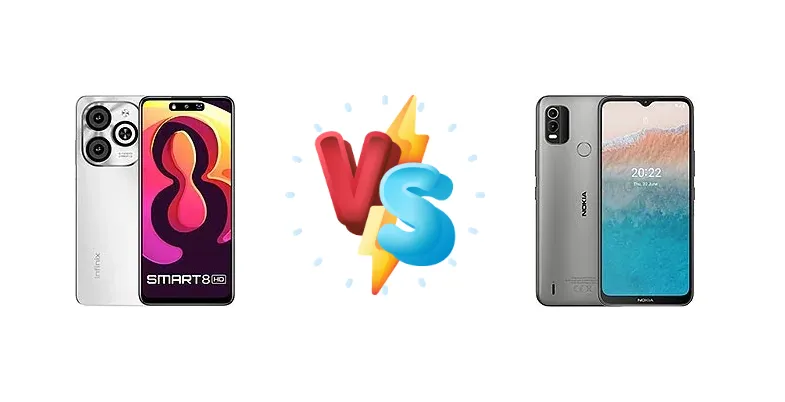
The sub-$150 smartphone market is fiercely competitive, and the Infinix Smart 8 HD and Nokia C21 Plus represent two compelling options for users prioritizing affordability. While both devices run Android and offer essential smartphone functionality, significant differences in their underlying hardware dictate their performance and suitability for various users. This comparison dissects these differences, focusing on the core components that impact daily usability.
🏆 Quick Verdict
For most users, the Infinix Smart 8 HD emerges as the better choice. Its Unisoc T606 chipset, built on a more modern 12nm process, delivers noticeably improved performance compared to the Nokia C21 Plus’s older 28nm Unisoc SC9863A. While both offer similar battery life due to their low-power components, the Infinix provides a smoother overall experience for everyday tasks.
| Network |
|---|
| 2G bands | GSM 850 / 900 / 1800 / 1900 | GSM 850 / 900 / 1800 / 1900 |
| 3G bands | HSDPA 850 / 900 / 2100 | HSDPA 850 / 900 / 2100 |
| 4G bands | 1, 3, 5, 8, 38, 40, 41 | LTE |
| Speed | HSPA, LTE | HSPA 42.2/5.76 Mbps, LTE Cat4 150/50 Mbps |
| Technology | GSM / HSPA / LTE | GSM / HSPA / LTE |
| | - | HSDPA 850 / 900 / 1700(AWS) / 1900 / 2100 |
| Launch |
|---|
| Announced | 2023, December 08 | 2022, February 28 |
| Status | Available. Released 2023, December 13 | Available. Released 2022, April 29 |
| Body |
|---|
| Build | Glass front, plastic back, plastic frame | Glass front, aluminum frame, plastic back |
| Dimensions | 163.6 x 75.6 x 8.5 mm (6.44 x 2.98 x 0.33 in) | 164.8 x 75.9 x 8.6 mm (6.49 x 2.99 x 0.34 in) |
| SIM | Nano-SIM + Nano-SIM | · Nano-SIM· Nano-SIM + Nano-SIM |
| Weight | 184 g (6.49 oz) | 178 g or 191 g (6.28 oz) |
| | - | Splash protection |
| Display |
|---|
| Protection | - | Scratch-resistant glass |
| Resolution | 720 x 1612 pixels, 20:9 ratio (~267 ppi density) | 720 x 1600 pixels, 20:9 ratio (~269 ppi density) |
| Size | 6.6 inches, 104.6 cm2 (~84.6% screen-to-body ratio) | 6.52 inches, 102.6 cm2 (~82.1% screen-to-body ratio) |
| Type | IPS LCD, 90Hz, 500 nits (peak) | IPS LCD |
| Platform |
|---|
| CPU | Octa-core (2x1.6 GHz Cortex-A75 & 6x1.6 GHz Cortex-A55) | Octa-core (4x1.6 GHz Cortex-A55 & 4x1.2 GHz Cortex-A55) |
| Chipset | Unisoc T606 (12 nm) | Unisoc SC9863A (28 nm) |
| GPU | Mali-G57 MP1 | IMG8322 |
| OS | Android 13, XOS 13 | Android 11 (Go edition) |
| Memory |
|---|
| Card slot | microSDXC (dedicated slot) | microSDXC (dedicated slot) |
| Internal | 64GB 3GB RAM, 64GB 4GB RAM | 32GB 2GB RAM, 32GB 3GB RAM, 64GB 2GB RAM, 64GB 3GB RAM, 64GB 4GB RAM |
| | - | eMMC 5.1 |
| Main Camera |
|---|
| Dual | - | 13 MP, (wide), AF
Auxiliary lens |
| Features | Ring-LED flash, HDR, panorama | LED flash, HDR, panorama |
| Single | 13 MP, f/1.8, 27mm (wide), AF
Auxiliary lens | 5 MP |
| Video | 1080p@30fps | 1080p@30fps |
| Selfie camera |
|---|
| Features | - | LED flash |
| Single | 8 MP, f/2.0, (wide) | 5 MP |
| Video | Yes | 720p |
| Sound |
|---|
| 3.5mm jack | - | Yes |
| 35mm jack | Yes | Yes |
| Loudspeaker | Yes | Yes |
| Comms |
|---|
| Bluetooth | 5.0, A2DP, LE | 4.2, A2DP |
| NFC | No | No |
| Positioning | GPS | GPS |
| Radio | FM radio | FM radio |
| USB | USB Type-C 2.0, OTG | microUSB 2.0 |
| WLAN | Wi-Fi 802.11 a/b/g/n/ac, dual-band | Wi-Fi 802.11 b/g/n |
| Features |
|---|
| Sensors | Fingerprint (side-mounted), accelerometer, proximity, compass | Fingerprint (rear-mounted), accelerometer, proximity |
| Battery |
|---|
| Charging | 10W wired
Reverse wired | 10W wired |
| Type | 5000 mAh | Li-Ion 4000/5050 mAh |
| Misc |
|---|
| Colors | Timber Black, Shiny Gold, Crystal Green, Galaxy White | Dark Cyan, Warm Gray |
| Models | X6525 | TA-1433, TA-1431, TA-1426, TA-1424 |
| Price | About 70 EUR | About 120 EUR |
| SAR | - | 0.57 W/kg (head) 0.65 W/kg (body) |
| SAR EU | - | 0.40 W/kg (head) 0.99 W/kg (body) |
Infinix Smart 8 HD
- More powerful Unisoc T606 chipset
- More efficient 12nm process
- Reverse wired charging capability
- Slightly larger display
- Brand recognition may be lower than Nokia
- Software update frequency potentially less consistent
Nokia C21 Plus
- Nokia’s reputation for software reliability
- Potentially longer software support lifecycle
- Compact form factor (6.5-inch screen)
- Android Go Edition for optimized performance
- Significantly weaker Unisoc SC9863A chipset
- Less efficient 28nm process
- Slower overall performance
- Limited multitasking capabilities
Display Comparison
Neither device boasts a standout display. Both likely feature LCD panels, typical for this price point. However, detailed display specs (resolution, brightness) are unavailable. The Nokia C21 Plus’s smaller screen size (6.5 inches vs. the Infinix’s 6.6 inches) might offer slightly higher pixel density, but the difference will be minimal. The absence of features like high refresh rates or even full HD resolution means both displays will be adequate for basic viewing but lack vibrancy and sharpness.
Camera Comparison
Camera performance on both devices will be limited. Detailed sensor information is lacking, but it’s safe to assume both rely on basic sensors. The focus should be on capturing usable images in good lighting conditions. The inclusion of a reverse wired charging feature on the Infinix Smart 8 HD suggests a slightly more versatile camera system, potentially allowing for power sharing with other devices, though image quality itself is unlikely to be a differentiating factor.
Performance
The core difference lies in the chipsets. The Infinix Smart 8 HD’s Unisoc T606, fabricated on a 12nm process, offers a significant architectural advantage over the Nokia C21 Plus’s Unisoc SC9863A (28nm). The T606’s octa-core configuration, featuring two Cortex-A75 performance cores alongside six A55 efficiency cores, provides a more responsive experience than the C21 Plus’s four A55 cores and four slower A55 cores. This translates to faster app loading times and smoother multitasking. The older 28nm process of the SC9863A also implies higher power consumption for similar tasks, potentially offsetting any battery capacity advantages.
Battery Life
Both phones feature 10W wired charging, indicating similar charging speeds. While battery capacity isn’t specified, the power-efficient nature of both chipsets, particularly the Unisoc T606’s 12nm process, suggests all-day battery life is achievable with moderate usage. The Infinix’s more efficient processor may provide a slight edge in longevity, but the difference will likely be marginal. The reverse wired charging capability of the Infinix is a unique feature, allowing it to act as a power bank for other devices.
Buying Guide
Buy the Infinix Smart 8 HD if you need a phone capable of handling more than just basic communication – light multitasking, occasional social media browsing, and even some casual gaming will be more enjoyable. Buy the Nokia C21 Plus if you prioritize a brand known for software stability and a potentially longer software support lifecycle, and your usage is strictly limited to calls, texts, and very light app usage.
Frequently Asked Questions
❓ Will the Infinix Smart 8 HD struggle with popular apps like WhatsApp and Facebook?
While not a powerhouse, the Unisoc T606 in the Infinix Smart 8 HD is capable of running WhatsApp and Facebook smoothly. You might experience slight delays when loading these apps initially, but everyday usage should be acceptable. The Nokia C21 Plus, with its weaker chipset, may exhibit more noticeable lag.
❓ Is the Android Go Edition on the Nokia C21 Plus a significant benefit?
Android Go Edition is designed for low-RAM devices, optimizing performance and data usage. While helpful, the Unisoc SC9863A’s limitations are more significant than any benefit provided by Android Go. The Infinix Smart 8 HD, with its more powerful processor, offers a better overall experience even without the Go Edition optimizations.
❓ Can the Infinix Smart 8 HD handle basic mobile games?
The Infinix Smart 8 HD can handle less demanding 2D games and some older 3D titles at lower settings. Don't expect to play graphically intensive games like PUBG Mobile at high frame rates. The Nokia C21 Plus will struggle even with basic games.
❓ How long will it take to fully charge both phones?
With both phones utilizing 10W charging, a full charge from 0% will likely take around 3-4 hours. The battery capacity, which isn't specified, will influence the exact charging time, but the slow charging speed is consistent across both devices.