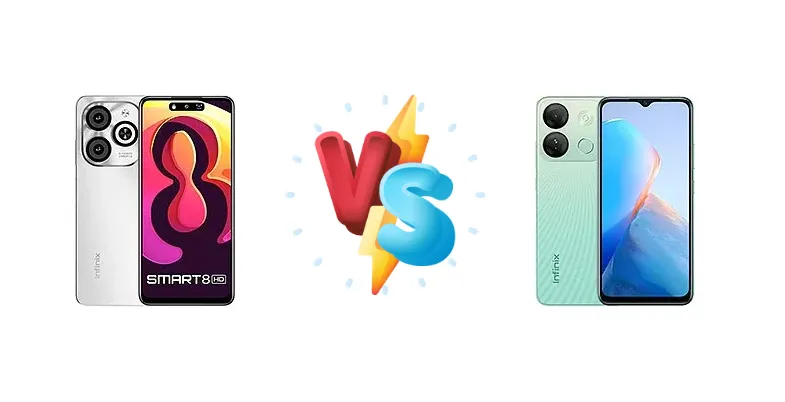
Infinix consistently targets the ultra-budget segment, and the Smart series is a cornerstone of that strategy. The Smart 8 HD arrives as a successor to the Smart 7 HD, but the improvements aren't immediately obvious on paper. This comparison dives deep into the architectural differences and real-world implications to determine if the Smart 8 HD justifies an upgrade, or if the Smart 7 HD remains a compelling value proposition.
🏆 Quick Verdict
For most users, the Infinix Smart 8 HD is the better choice. The upgrade to the Unisoc T606 chipset, with its more modern Cortex-A75 cores, provides a noticeable performance boost in everyday tasks and light gaming, making it a more future-proof option despite both phones sharing the same 10W charging.
| Network |
|---|
| 2G bands | GSM 850 / 900 / 1800 / 1900 | GSM 850 / 900 / 1800 / 1900 |
| 3G bands | HSDPA 850 / 900 / 2100 | HSDPA 850 / 900 / 2100 |
| 4G bands | 1, 3, 5, 8, 38, 40, 41 | 1, 3, 5, 8, 38, 40, 41 |
| Speed | HSPA, LTE | HSPA, LTE |
| Technology | GSM / HSPA / LTE | GSM / HSPA / LTE |
| | - | 1, 2, 3, 4, 5, 7, 8, 20, 28, 38, 40, 41 |
| Launch |
|---|
| Announced | 2023, December 08 | 2023, April 14 |
| Status | Available. Released 2023, December 13 | Available. Released 2023, April 14 |
| Body |
|---|
| Build | Glass front, plastic back, plastic frame | Glass front, plastic back, plastic frame |
| Dimensions | 163.6 x 75.6 x 8.5 mm (6.44 x 2.98 x 0.33 in) | 163.9 x 75.5 x 8.7 mm (6.45 x 2.97 x 0.34 in) |
| SIM | Nano-SIM + Nano-SIM | Nano-SIM + Nano-SIM |
| Weight | 184 g (6.49 oz) | 196.5 g (6.95 oz) |
| Display |
|---|
| Resolution | 720 x 1612 pixels, 20:9 ratio (~267 ppi density) | 720 x 1612 pixels, 20:9 ratio (~267 ppi density) |
| Size | 6.6 inches, 104.6 cm2 (~84.6% screen-to-body ratio) | 6.6 inches, 104.6 cm2 (~84.6% screen-to-body ratio) |
| Type | IPS LCD, 90Hz, 500 nits (peak) | IPS LCD, 500 nits |
| Platform |
|---|
| CPU | Octa-core (2x1.6 GHz Cortex-A75 & 6x1.6 GHz Cortex-A55) | Octa-core 1.6 GHz |
| Chipset | Unisoc T606 (12 nm) | - |
| GPU | Mali-G57 MP1 | - |
| OS | Android 13, XOS 13 | Android 12 (Go edition) |
| Memory |
|---|
| Card slot | microSDXC (dedicated slot) | microSDXC (dedicated slot) |
| Internal | 64GB 3GB RAM, 64GB 4GB RAM | 64GB 2GB RAM |
| | - | UFS 2.1 |
| Main Camera |
|---|
| Dual | - | 8 MP, f/2.0
0.08 MP, (depth) |
| Features | Ring-LED flash, HDR, panorama | Dual-LED flash, HDR, panorama |
| Single | 13 MP, f/1.8, 27mm (wide), AF
Auxiliary lens | 8 MP, f/2.0
Auxiliary lens |
| Video | 1080p@30fps | 1080p@30fps |
| Selfie camera |
|---|
| Features | - | LED flash |
| Single | 8 MP, f/2.0, (wide) | 5 MP, f/2.0 |
| Video | Yes | 720p@30fps |
| Sound |
|---|
| 3.5mm jack | - | Yes |
| 35mm jack | Yes | Yes |
| Loudspeaker | Yes | Yes |
| Comms |
|---|
| Bluetooth | 5.0, A2DP, LE | 5.0, A2DP, LE |
| NFC | No | No |
| Positioning | GPS | GPS |
| Radio | FM radio | FM radio |
| USB | USB Type-C 2.0, OTG | microUSB 2.0, OTG |
| WLAN | Wi-Fi 802.11 a/b/g/n/ac, dual-band | Wi-Fi 802.11 b/g/n |
| Features |
|---|
| Sensors | Fingerprint (side-mounted), accelerometer, proximity, compass | Fingerprint (rear-mounted), accelerometer, proximity |
| Battery |
|---|
| Charging | 10W wired
Reverse wired | 10W wired |
| Type | 5000 mAh | 5000 mAh |
| Misc |
|---|
| Colors | Timber Black, Shiny Gold, Crystal Green, Galaxy White | Ink Black, Silk Blue, Jade White, Green Apple |
| Models | X6525 | X6516 |
| Price | About 70 EUR | About 110 EUR |
Infinix Smart 8 HD
- More powerful Unisoc T606 chipset for smoother performance
- Modern CPU architecture (Cortex-A75) improves responsiveness
- Potentially longer software support due to newer chipset
- Still utilizes slow 10W charging
- Display specifications are likely basic
Infinix Smart 7 HD
- Likely lower price point than the Smart 8 HD
- Sufficient for basic smartphone tasks
- Simple and easy to use
- Older, less efficient CPU
- Slower app loading times and multitasking
- Potentially limited software updates
Display Comparison
Both the Infinix Smart 8 HD and Smart 7 HD lack detailed display specifications in the provided data. However, given their market positioning, we can assume both utilize LCD panels with a 720p+ resolution. The absence of information regarding peak brightness, color gamut coverage, or PWM dimming rates suggests neither phone prioritizes display quality. Users seeking vibrant colors or comfortable viewing in direct sunlight should consider alternatives.
Camera Comparison
Detailed camera specifications are absent for both devices. Given the price point, it’s safe to assume both feature a primary camera alongside auxiliary lenses (likely a depth or macro sensor). Without knowing sensor sizes, apertures, or image processing capabilities, a direct comparison is difficult. However, any improvements in the Smart 8 HD’s camera performance will likely stem from the enhanced ISP (Image Signal Processor) integrated within the Unisoc T606 chipset, potentially leading to better dynamic range and noise reduction.
Performance
The core difference lies in the chipset. The Infinix Smart 8 HD features the Unisoc T606 (12nm), a significant upgrade over the Smart 7 HD’s unspecified octa-core CPU clocked at 1.6 GHz. The T606’s architecture – utilizing 2x 1.6 GHz Cortex-A75 cores and 6x 1.6 GHz Cortex-A55 cores – provides a substantial leap in single-core and multi-core performance. The A75 cores are considerably more powerful than the likely Cortex-A53 cores found in the Smart 7 HD, resulting in snappier app launches and smoother operation of demanding applications. While both phones likely share similar RAM configurations, the T606’s improved efficiency will contribute to better sustained performance.
Battery Life
Both the Infinix Smart 8 HD and Smart 7 HD are equipped with 10W wired charging. This slow charging speed is typical for this price segment and means a full charge will take a considerable amount of time. While battery capacity isn’t specified, the more efficient Unisoc T606 in the Smart 8 HD may translate to slightly longer battery life, offsetting the lack of faster charging. Users prioritizing minimal downtime should consider a power bank as an accessory.
Buying Guide
Buy the Infinix Smart 8 HD if you prioritize smoother multitasking, slightly improved app loading times, and a chipset with a longer software support lifespan. This phone is ideal for first-time smartphone users or those needing a reliable secondary device. Buy the Infinix Smart 7 HD if you find it heavily discounted and your usage is limited to basic communication – calls, texts, and light social media – as the performance difference won't be as noticeable in those scenarios.
Frequently Asked Questions
❓ Will the Unisoc T606 in the Smart 8 HD handle popular apps like WhatsApp and Facebook smoothly?
Yes, the Unisoc T606 is more than capable of handling everyday apps like WhatsApp, Facebook, and Instagram without significant lag. The Cortex-A75 cores provide a noticeable performance boost over older chipsets, ensuring a smoother user experience even with multiple apps open.
❓ Is the 10W charging on either phone a major drawback?
Yes, 10W charging is quite slow by today's standards. Expect a full charge to take over 3 hours. This is a common compromise in the ultra-budget segment, and a power bank is recommended for users who need quick top-ups.
❓ Can the Infinix Smart 8 HD run mobile games like PUBG Mobile or Call of Duty Mobile?
While the Smart 8 HD can *run* these games, expect to play them on the lowest graphics settings to maintain a playable frame rate. The Unisoc T606 isn't a gaming powerhouse, but it's a step up from the Smart 7 HD and will offer a slightly better gaming experience.
❓ How long will Infinix likely support the Smart 8 HD with software updates?
Infinix's software support for budget devices is typically limited. While a specific timeframe isn't guaranteed, the newer Unisoc T606 chipset may receive at least one major Android update (potentially to Android 14) and security patches for a reasonable period.