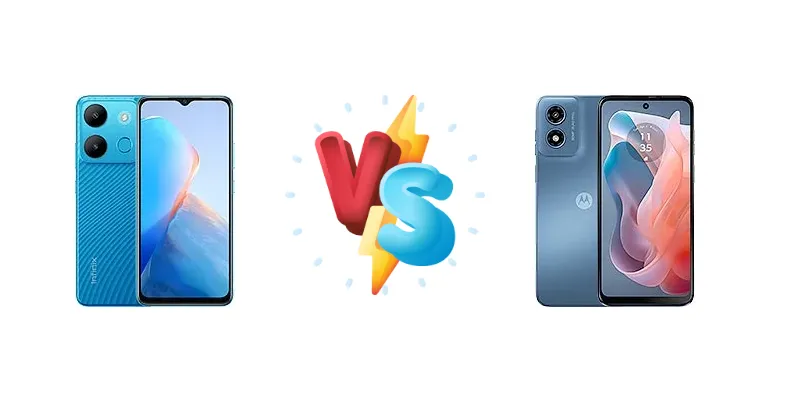
The sub-$150 smartphone market is fiercely competitive. The Infinix Smart 7 and Motorola Moto G Play (2024) both aim to deliver essential smartphone functionality at an accessible price. However, they take drastically different approaches to achieving this, particularly in their core processing power and efficiency. This comparison dissects those differences to determine which device offers the best value for your money.
🏆 Quick Verdict
For the average user prioritizing responsiveness and future-proofing, the Motorola Moto G Play (2024) is the clear winner. Its Snapdragon 680 chipset, built on a 6nm process, provides a significant performance advantage over the Infinix Smart 7’s Helio A22, despite the latter’s lower price point. While the Smart 7 is cheaper, the G Play offers a smoother, more capable experience.
| Network |
|---|
| 2G bands | GSM 850 / 900 / 1800 / 1900 | GSM 850 / 900 / 1800 / 1900 |
| 3G bands | HSDPA 850 / 900 / 2100 | HSDPA 850 / 900 / 1700(AWS) / 1900 / 2100 |
| 4G bands | 1, 3, 5, 8, 38, 40, 41 | 1, 2, 3, 4, 5, 7, 8, 12, 13, 17, 25, 26, 28, 38, 41, 66, 71 - USA |
| Speed | HSPA, LTE | HSPA, LTE |
| Technology | GSM / HSPA / LTE | GSM / HSPA / LTE |
| | 1, 2, 3, 4, 5, 7, 8, 20, 28, 38, 40, 41 | - |
| Launch |
|---|
| Announced | 2023, February 09 | 2024, January 16 |
| Status | Available. Released 2023, February 22 | Available. Released 2024, January 26 |
| Body |
|---|
| Build | Glass front, plastic back, plastic frame | Glass front, plastic frame, plastic back |
| Dimensions | 163.8 x 75.6 x 8.7 mm (6.45 x 2.98 x 0.34 in) | 163.8 x 75 x 8.3 mm (6.45 x 2.95 x 0.33 in) |
| SIM | Nano-SIM + Nano-SIM | Nano-SIM |
| Weight | 188 g (6.63 oz) | 185 g (6.53 oz) |
| Display |
|---|
| Protection | - | Corning Gorilla Glass 3 |
| Resolution | 720 x 1612 pixels, 20:9 ratio (~267 ppi density) | 720 x 1600 pixels, 20:9 ratio (~270 ppi density) |
| Size | 6.6 inches, 104.6 cm2 (~84.5% screen-to-body ratio) | 6.5 inches, 102.0 cm2 (~83.0% screen-to-body ratio) |
| Type | IPS LCD, 500 nits | IPS LCD, 90Hz, 500 nits (typ) |
| Platform |
|---|
| CPU | Quad-core 2.0 GHz Cortex-A53 | Octa-core (4x2.4 GHz Kryo 265 Gold & 4x1.9 GHz Kryo 265 Silver) |
| Chipset | Mediatek MT6761 Helio A22 (12 nm) | Qualcomm SM6225 Snapdragon 680 4G (6 nm) |
| GPU | PowerVR GE8320 | Adreno 610 |
| OS | Android 12 | Android 13, upgradable to Android 14 |
| Memory |
|---|
| Card slot | microSDXC (dedicated slot) | microSDXC (dedicated slot) |
| Internal | 64GB 3GB RAM, 64GB 4GB RAM | 64GB 4GB RAM, 128GB 4GB RAM |
| | eMMC 5.1 | - |
| Main Camera |
|---|
| Dual | 13 MP, AF
Auxiliary lens | - |
| Features | Dual-LED flash, HDR, panorama | LED flash, HDR, panorama |
| Single | 5 MP | 50 MP, f/1.8, (wide), 0.64µm, PDAF |
| Video | 1080p@30fps | 1080p@30fps |
| Selfie camera |
|---|
| Features | LED flash | HDR |
| Single | 5 MP | 8 MP, f/2.0, (wide), 1.12µm |
| Video | 720p@30fps | 1080p@30fps |
| Sound |
|---|
| 3.5mm jack | Yes | - |
| 35mm jack | Yes | Yes |
| Loudspeaker | Yes | Yes, with stereo speakers |
| Comms |
|---|
| Bluetooth | 5.0, A2DP, LE | 5.1, A2DP, LE |
| NFC | No | No |
| Positioning | GPS | GPS, GALILEO, GLONASS |
| Radio | FM radio | No |
| USB | microUSB 2.0, OTG | USB Type-C 2.0 |
| WLAN | Wi-Fi 802.11 a/b/g/n/ac, dual-band | Wi-Fi 802.11 a/b/g/n/ac, dual-band |
| Features |
|---|
| Sensors | Fingerprint (rear-mounted), accelerometer, proximity | Fingerprint (side-mounted), accelerometer, proximity, compass, barometer |
| Battery |
|---|
| Charging | 10W wired | 15W wired |
| Type | 5000 mAh | 5000 mAh |
| Misc |
|---|
| Colors | Polar Black, Coastal Green, Iceland White, Peacock Blue | Sapphire Blue |
| Models | X6515 | XT2413-1, XT2413 |
| Price | About 90 EUR | $ 55.00 |
Infinix Smart 7
- Lowest possible price point
- Functional for basic smartphone tasks
- Likely long battery life due to less demanding chipset
- Significantly slower performance
- Less efficient chipset
- Limited future-proofing
Motorola Moto G Play (2024)
- Faster and more responsive performance
- More efficient Snapdragon 680 chipset
- Faster charging (15W)
- Better image processing capabilities
- Slightly higher price
- May not have a significantly better display
- Still a budget device with inherent limitations
Display Comparison
Neither device boasts a standout display. Both likely utilize LCD panels, a common cost-saving measure in this segment. However, specifics like resolution and peak brightness are not provided. The Moto G Play’s advantage likely lies in its potential for better color calibration due to the more advanced chipset’s image signal processing capabilities. Bezels are expected to be substantial on both, prioritizing affordability over a premium aesthetic.
Camera Comparison
Without detailed sensor information, a direct camera comparison is difficult. However, it’s safe to assume both phones feature basic camera setups geared towards casual photography. The Moto G Play’s Snapdragon 680 ISP (Image Signal Processor) will likely provide superior image processing, resulting in better dynamic range and noise reduction, even with similar sensor hardware. The Infinix Smart 7 will likely rely on software processing to compensate for its less capable chipset, potentially leading to over-sharpened or artificial-looking images. The presence of a 2MP macro lens on either device is largely a marketing gimmick and should not be a deciding factor.
Performance
The performance gap is the most significant differentiator. The Motorola Moto G Play (2024) features the Qualcomm Snapdragon 680, an octa-core processor built on a 6nm process. This translates to significantly improved efficiency and performance compared to the Infinix Smart 7’s MediaTek Helio A22, a quad-core chip fabricated on a larger 12nm node. The Snapdragon 680’s Kryo cores (2.4 GHz Gold & 1.9 GHz Silver) offer a substantial clock speed advantage and architectural improvements, resulting in faster app loading times, smoother multitasking, and a more enjoyable gaming experience. The 6nm process also means less heat generation, reducing the likelihood of performance throttling during sustained use.
Battery Life
Battery capacity isn’t specified, but both phones likely feature batteries in the 5000mAh range, typical for this price point. The Motorola Moto G Play (2024) benefits from the Snapdragon 680’s superior power efficiency, meaning it will likely achieve longer battery life with similar usage. Furthermore, the G Play supports 15W wired charging, while the Smart 7 is limited to 10W. This translates to a faster 0-100% charge time for the Moto G Play, reducing downtime.
Buying Guide
Buy the Infinix Smart 7 if you absolutely need the lowest possible price and your smartphone usage is limited to basic tasks like calls, texts, and light social media. It’s a functional device for those on a very tight budget. Buy the Motorola Moto G Play (2024) if you value a more responsive user experience, occasional gaming, and a chipset that will remain relevant for longer. The G Play offers a better balance of performance and affordability.
Frequently Asked Questions
❓ Will the Snapdragon 680 in the Moto G Play (2024) handle popular games like PUBG Mobile?
The Snapdragon 680 is capable of running PUBG Mobile, but likely at medium settings to maintain a stable frame rate. Don't expect flagship-level gaming performance, but it's a significant improvement over the Helio A22 in the Infinix Smart 7, which would struggle with even lower settings.
❓ Is the 15W charging on the Moto G Play (2024) a substantial improvement over the Infinix Smart 7’s 10W charging?
Yes, while not a massive leap, 15W charging will noticeably reduce the time it takes to fully charge the Moto G Play (2024). Expect a roughly 30-60 minute difference in a full charge cycle compared to the Infinix Smart 7.
❓ How much of a difference will the 6nm process of the Snapdragon 680 make in real-world usage?
The 6nm process is crucial. It means the Snapdragon 680 generates less heat for the same level of performance as the 12nm Helio A22. This translates to sustained performance without throttling, better battery life, and a cooler device during extended use.
❓ If I only use my phone for calls, texts, and WhatsApp, is the extra cost of the Moto G Play (2024) worth it?
For extremely basic usage, the Infinix Smart 7 is sufficient. However, even for these tasks, the Moto G Play (2024) will offer a smoother and more responsive experience, making it a more pleasant device to use overall. The future-proofing is also a consideration.