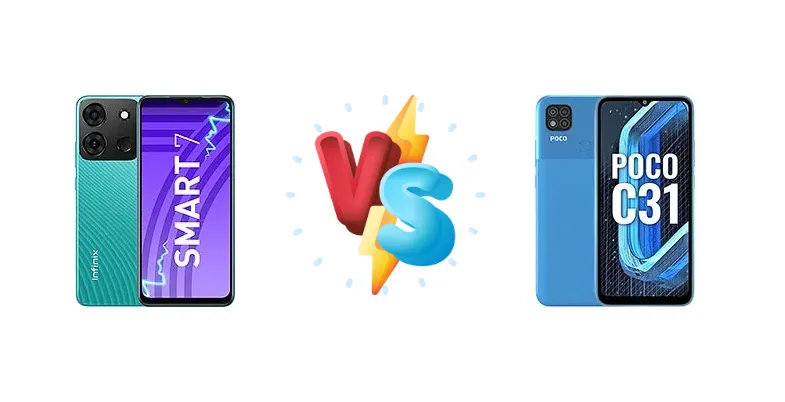
The sub-$150 smartphone market is fiercely competitive. Both the Infinix Smart 7 (India) and Xiaomi Poco C31 aim to deliver essential smartphone functionality at an incredibly low price point. However, they take different approaches to achieving this, primarily through their chipset choices. This comparison dissects those differences and determines which device offers the best value for your money.
🏆 Quick Verdict
For the average user prioritizing responsiveness and slightly better gaming capabilities, the Xiaomi Poco C31 emerges as the winner. Its MediaTek Helio G35, built on a more efficient 12nm process, provides a noticeable performance edge over the Infinix Smart 7’s Unisoc SC9863A1, despite both phones sharing 10W charging and similar price points.
| Network |
|---|
| 2G bands | GSM 850 / 900 / 1800 / 1900 | GSM 850 / 900 / 1800 / 1900 |
| 3G bands | HSDPA 850 / 900 / 2100 | HSDPA 850 / 900 / 2100 |
| 4G bands | 1, 3, 5, 8, 38, 40, 41 | 1, 3, 5, 8, 40, 41 |
| Speed | HSPA, LTE | HSPA, LTE |
| Technology | GSM / HSPA / LTE | GSM / HSPA / LTE |
| Launch |
|---|
| Announced | 2023, February 22 | 2021, September 30 |
| Status | Available. Released 2023, February 27 | Available. Released 2021, October 02 |
| Body |
|---|
| Build | Glass front, plastic back, plastic frame | - |
| Dimensions | 164.2 x 75.6 x 9.4 mm (6.46 x 2.98 x 0.37 in) | 164.9 x 77.1 x 9 mm (6.49 x 3.04 x 0.35 in) |
| SIM | Nano-SIM + Nano-SIM | Nano-SIM + Nano-SIM |
| Weight | 207 g (7.30 oz) | 194 g (6.84 oz) |
| Display |
|---|
| Resolution | 720 x 1612 pixels, 20:9 ratio (~267 ppi density) | 720 x 1600 pixels, 20:9 ratio (~269 ppi density) |
| Size | 6.6 inches, 104.6 cm2 (~84.3% screen-to-body ratio) | 6.53 inches, 102.9 cm2 (~81.0% screen-to-body ratio) |
| Type | IPS LCD, 500 nits | IPS LCD |
| Platform |
|---|
| CPU | Octa-core (4x1.6 GHz Cortex-A55 & 4x1.2 GHz Cortex-A55) | Octa-core (4x2.3 GHz Cortex-A53 & 4x1.8 GHz Cortex-A53) |
| Chipset | Unisoc SC9863A1 (22 nm) | Mediatek MT6765G Helio G35 (12 nm) |
| GPU | IMG8322 | PowerVR GE8320 |
| OS | Android 12, XOS 12 | Android 10, MIUI 12 |
| Memory |
|---|
| Card slot | microSDXC (dedicated slot) | microSDXC (dedicated slot) |
| Internal | 64GB 3GB RAM, 64GB 4GB RAM, 128GB 4GB RAM | 32GB 3GB RAM, 64GB 4GB RAM |
| | eMMC 5.1 | eMMC 5.1 |
| Main Camera |
|---|
| Dual | 13 MP, AF
Auxiliary lens | - |
| Features | Dual-LED flash, HDR, panorama | LED flash, HDR |
| Single | 5 MP | 5 MP, f/2.2, (wide), 1.12µm |
| Triple | - | 13 MP, f/2.2, (wide), 1.0µm, PDAF
2 MP (macro)
Auxiliary lens |
| Video | 1080p@30fps | 1080p@30fps |
| Selfie camera |
|---|
| Features | LED flash | HDR |
| Single | 5 MP | 5 MP, f/2.2, (wide), 1.12µm |
| Video | 720p@30fps | 1080p@30fps |
| Sound |
|---|
| 3.5mm jack | Yes | Yes |
| 35mm jack | Yes | Yes |
| Loudspeaker | Yes | Yes |
| Comms |
|---|
| Bluetooth | 4.2, A2DP | 5.0, A2DP, LE |
| NFC | No | No |
| Positioning | GPS | GPS, GLONASS, BDS |
| Radio | Unspecified | FM radio |
| USB | USB Type-C 2.0 | microUSB 2.0, OTG |
| WLAN | Wi-Fi 802.11 b/g/n | Wi-Fi 802.11 a/b/g/n, Wi-Fi Direct |
| Features |
|---|
| Sensors | Fingerprint (rear-mounted), accelerometer, proximity, compass | Fingerprint (rear-mounted), accelerometer, proximity |
| Battery |
|---|
| Charging | 10W wired | 10W wired |
| Type | 6000 mAh | Li-Po 5000 mAh |
| Misc |
|---|
| Colors | Azure Blue, Emerald Green, Night Black | Royal Blue, Shadow Gray |
| Models | X6517 | MZB0A0MIN, MZB0A0KIN, 211033MI, 22031116AI |
| Price | About 80 EUR | About 90 EUR |
| SAR | - | 0.51 W/kg (head) 0.83 W/kg (body) |
Infinix Smart 7 (India)
- Potentially longer battery life due to less powerful chipset.
- May be slightly more affordable depending on regional pricing.
- Unisoc chipset offers a different experience for users seeking alternatives to MediaTek.
- Slower processor and less responsive user experience.
- Less efficient 22nm process may lead to more heat.
- Likely lower gaming performance.
Xiaomi Poco C31
- Faster and more efficient MediaTek Helio G35 chipset.
- Smoother user experience and better app loading times.
- Improved gaming performance compared to the Infinix Smart 7.
- Potentially slightly shorter battery life under heavy load.
- May be marginally more expensive.
- Relies on MediaTek's software ecosystem.
Display Comparison
Neither device boasts a standout display. Both are likely to feature LCD panels, typical for this price bracket. However, detailed specs like resolution and brightness are missing. The focus here is on performance, not visual fidelity. Bezels are expected to be substantial on both, maximizing screen real estate within a budget. Color accuracy will likely be standard for the segment, prioritizing power efficiency over color calibration.
Camera Comparison
Camera performance is expected to be similar, leaning towards basic functionality. Details on sensor sizes and apertures are unavailable, but both phones likely employ budget sensors. The emphasis will be on computational photography to enhance image quality, but limitations will be apparent in low-light conditions. Any 2MP macro or depth sensors are likely to offer minimal benefit, serving primarily as marketing features. Image processing will likely prioritize speed over detail.
Performance
The core difference lies in the chipsets. The Poco C31’s MediaTek Helio G35 (12nm) features a more modern architecture and higher clock speeds (4x2.3 GHz Cortex-A53 & 4x1.8 GHz Cortex-A53) compared to the Infinix Smart 7’s Unisoc SC9863A1 (22nm) with its (4x1.6 GHz Cortex-A55 & 4x1.2 GHz Cortex-A55). The 12nm process of the Helio G35 translates to better power efficiency and potentially less thermal throttling under sustained load. While both are octa-core, the Cortex-A53 cores in the Poco C31 are generally faster than the A55 cores in the Infinix, resulting in a snappier user experience. The Unisoc chip, being on a larger 22nm node, will likely consume more power for the same tasks.
Battery Life
Both devices are equipped with 10W wired charging, indicating similar charging speeds (expect around 2-3 hours for a full charge). While battery capacity isn't specified, the less demanding Unisoc SC9863A1 in the Infinix Smart 7 *could* translate to slightly longer battery life in typical usage scenarios. However, the Helio G35’s efficiency gains might offset this difference, especially with moderate to heavy use. Real-world battery life will heavily depend on usage patterns and network conditions.
Buying Guide
Buy the Infinix Smart 7 (India) if you primarily need a phone for basic communication – calls, texts, and light social media – and value a potentially longer-lasting battery due to the less demanding chipset. Buy the Xiaomi Poco C31 if you prefer a smoother user experience, enjoy occasional mobile gaming, and want a device that feels more responsive in everyday tasks, even if it means slightly reduced battery longevity.
Frequently Asked Questions
❓ Will the Poco C31 struggle with popular apps like WhatsApp and Facebook?
No, the MediaTek Helio G35 is capable of running popular social media apps like WhatsApp and Facebook smoothly. While it won't offer a flagship-level experience, it provides a responsive and usable experience for everyday tasks. The Infinix Smart 7 will run these apps, but with potentially more noticeable lag.
❓ Is the 10W charging speed acceptable for both phones?
10W charging is standard for phones in this price range. Expect a full charge to take around 2-3 hours. Neither phone offers fast charging capabilities. While slow, it's sufficient for overnight charging or topping up during downtime.
❓ Can the Poco C31 handle basic mobile games like PUBG Mobile or Free Fire?
The Poco C31 can run PUBG Mobile and Free Fire, but you'll need to lower the graphics settings to achieve playable frame rates. The Helio G35 provides a slight advantage over the Unisoc SC9863A1 in the Infinix Smart 7, allowing for slightly higher settings or smoother gameplay.
❓ Which phone is better for someone who primarily uses their phone for calls and texts?
The Infinix Smart 7 (India) is a solid choice for basic communication. Its less powerful chipset will consume less power during calls and texts, potentially extending battery life. However, the difference will be minimal, and the Poco C31 is still perfectly adequate for this purpose.