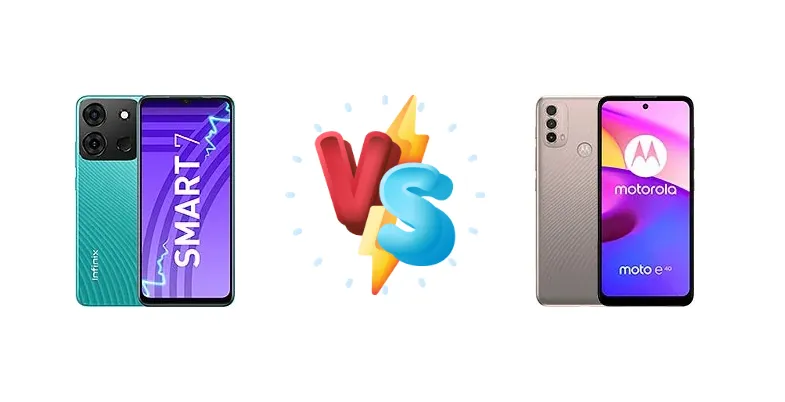
The Infinix Smart 7 (India) and Motorola Moto E40 represent the fiercely competitive sub-$150 smartphone market. Both devices aim to deliver essential smartphone functionality at an accessible price point, but they achieve this with different chipsets and subtle variations in design. This comparison dissects their core specifications to determine which offers the best value for budget-conscious consumers.
🏆 Quick Verdict
For most users, the Motorola Moto E40 emerges as the slightly better choice. Its Unisoc T700 chipset, clocked at 1.8 GHz, provides a noticeable performance advantage over the Infinix Smart 7’s Unisoc SC9863A1, translating to smoother multitasking and app loading. While both offer 10W charging, the E40’s superior processing power makes it the more capable all-rounder.
| Network |
|---|
| 2G bands | GSM 850 / 900 / 1800 / 1900 | GSM 850 / 900 / 1800 / 1900 |
| 3G bands | HSDPA 850 / 900 / 2100 | HSDPA 850 / 900 / 1700(AWS) / 1900 / 2100 |
| 4G bands | 1, 3, 5, 8, 38, 40, 41 | 1, 2, 3, 4, 5, 7, 8, 19, 28, 40, 66 - Brazil |
| Speed | HSPA, LTE | HSPA 42.2/5.76 Mbps, LTE Cat4 150/50 Mbps |
| Technology | GSM / HSPA / LTE | GSM / HSPA / LTE |
| Launch |
|---|
| Announced | 2023, February 22 | 2021, October 07 |
| Status | Available. Released 2023, February 27 | Available. Released 2021, October 11 |
| Body |
|---|
| Build | Glass front, plastic back, plastic frame | Glass front, plastic frame, plastic back |
| Dimensions | 164.2 x 75.6 x 9.4 mm (6.46 x 2.98 x 0.37 in) | 165.1 x 75.7 x 9.1 mm (6.5 x 2.98 x 0.36 in) |
| SIM | Nano-SIM + Nano-SIM | · Nano-SIM· Nano-SIM + Nano-SIM |
| Weight | 207 g (7.30 oz) | 198 g (6.98 oz) |
| Display |
|---|
| Resolution | 720 x 1612 pixels, 20:9 ratio (~267 ppi density) | 720 x 1600 pixels, 20:9 ratio (~270 ppi density) |
| Size | 6.6 inches, 104.6 cm2 (~84.3% screen-to-body ratio) | 6.5 inches, 102.0 cm2 (~81.6% screen-to-body ratio) |
| Type | IPS LCD, 500 nits | IPS LCD, 90Hz |
| Platform |
|---|
| CPU | Octa-core (4x1.6 GHz Cortex-A55 & 4x1.2 GHz Cortex-A55) | Octa-core 1.8 GHz |
| Chipset | Unisoc SC9863A1 (22 nm) | Unisoc T700 |
| GPU | IMG8322 | Mali G52 |
| OS | Android 12, XOS 12 | Android 11 |
| Memory |
|---|
| Card slot | microSDXC (dedicated slot) | microSDXC (dedicated slot) |
| Internal | 64GB 3GB RAM, 64GB 4GB RAM, 128GB 4GB RAM | 64GB 4GB RAM |
| | eMMC 5.1 | eMMC 5.1 |
| Main Camera |
|---|
| Dual | 13 MP, AF
Auxiliary lens | - |
| Features | Dual-LED flash, HDR, panorama | LED flash, HDR, panorama |
| Single | 5 MP | - |
| Triple | - | 48 MP, f/2.0, 26mm (wide), PDAF
2 MP (macro)
Auxiliary lens |
| Video | 1080p@30fps | 1080p@30fps |
| Selfie camera |
|---|
| Features | LED flash | HDR |
| Single | 5 MP | 8 MP, f/2.0 |
| Video | 720p@30fps | 1080p@30fps |
| Sound |
|---|
| 3.5mm jack | Yes | Yes |
| 35mm jack | Yes | Yes |
| Loudspeaker | Yes | Yes |
| Comms |
|---|
| Bluetooth | 4.2, A2DP | 5.0, A2DP, LE |
| NFC | No | No |
| Positioning | GPS | GPS, GLONASS, GALILEO |
| Radio | Unspecified | FM radio |
| USB | USB Type-C 2.0 | USB Type-C 2.0 |
| WLAN | Wi-Fi 802.11 b/g/n | Wi-Fi 802.11 b/g/n |
| Features |
|---|
| Sensors | Fingerprint (rear-mounted), accelerometer, proximity, compass | Fingerprint (rear-mounted), accelerometer, proximity |
| Battery |
|---|
| Charging | 10W wired | 10W wired |
| Type | 6000 mAh | Li-Po 5000 mAh |
| Misc |
|---|
| Colors | Azure Blue, Emerald Green, Night Black | Carbon Gray, Pink Clay |
| Models | X6517 | - |
| Price | About 80 EUR | About 90 EUR |
Infinix Smart 7 (India)
- Potentially lower price point
- Simple and straightforward user experience
- Reliable for basic communication tasks
- Slower processor compared to Moto E40
- Likely more noticeable lag during multitasking
- Less responsive user interface
Motorola Moto E40
- Faster Unisoc T700 processor
- Smoother multitasking and app loading
- More responsive user experience
- May be slightly more expensive than the Infinix Smart 7
- 10W charging is relatively slow
- Camera performance is likely similar to the Smart 7
Display Comparison
Neither device boasts a standout display. Given the context data lacks display specifics, we can infer both likely utilize LCD panels common in this price bracket. The focus here isn't on visual fidelity, but rather basic functionality. Bezels are likely to be substantial on both, and color accuracy will be standard for budget phones. The absence of higher refresh rates or advanced panel technologies like LTPO is expected.
Camera Comparison
Camera performance is likely to be similar, with both devices relying on basic sensors. Without specific sensor details, it’s safe to assume both will struggle in low-light conditions. The inclusion of a 2MP macro camera on either device is largely a marketing tactic, offering limited practical benefit due to the low resolution. Image processing will be basic, prioritizing speed over detail. Users shouldn't expect flagship-level image quality from either phone.
Performance
The core difference lies in the chipsets. The Motorola Moto E40’s Unisoc T700, with its 1.8 GHz clock speed, represents a clear step up from the Infinix Smart 7’s Unisoc SC9863A1 (1.6 GHz & 1.2 GHz). The T700’s higher clock speed directly impacts application launch times and overall system responsiveness. While both utilize an octa-core configuration, the T700’s architecture is more modern, offering improved efficiency. This translates to a smoother experience when switching between apps or browsing the web. The Smart 7 will likely exhibit more noticeable lag during demanding tasks.
Battery Life
Both phones feature 10W wired charging, indicating similar charging speeds – expect around 2.5 to 3.5 hours for a full charge. While battery capacity isn’t specified, the power efficiency of the Unisoc T700 in the Moto E40 might slightly offset any potential capacity difference, potentially leading to comparable real-world battery life. The focus here is on all-day usability with moderate usage, rather than rapid charging or extended power reserves.
Buying Guide
Buy the Infinix Smart 7 (India) if your primary need is a basic smartphone for essential tasks like calls, messaging, and light social media use, and you prioritize a potentially lower price point. Buy the Motorola Moto E40 if you prefer a more responsive user experience, anticipate running multiple apps simultaneously, or occasionally engage in casual gaming. The E40’s faster processor offers a tangible improvement in everyday usability.
Frequently Asked Questions
❓ Will the Motorola Moto E40 handle popular apps like WhatsApp and Facebook smoothly?
Yes, the Unisoc T700 chipset in the Moto E40 is sufficiently powerful to run apps like WhatsApp and Facebook without significant lag. The 1.8 GHz clock speed and octa-core architecture provide a smoother experience compared to the Infinix Smart 7, especially when multitasking between these apps.
❓ Is the Infinix Smart 7 a good option for someone who primarily uses their phone for calls and texts?
Absolutely. The Infinix Smart 7 is a perfectly adequate choice for basic communication. Its Unisoc SC9863A1 chipset is capable of handling calls, texts, and simple messaging apps without issue. If your smartphone needs are minimal, the Smart 7 offers a functional and affordable solution.
❓ Can either of these phones play modern mobile games?
While both phones *can* play some mobile games, performance will be limited. Expect to play less demanding titles at lower settings. The Moto E40 will offer a slightly better gaming experience due to its faster processor, but don't expect flagship-level performance. Demanding games like PUBG Mobile will likely be unplayable or require significant compromises in graphics settings.