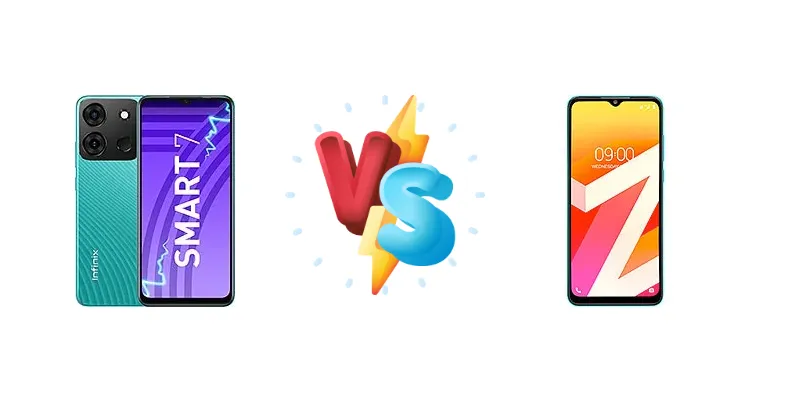
The sub-₹8,000 (approximately $100 USD) smartphone segment is fiercely competitive. Both the Infinix Smart 7 (India) and Lava Z6 aim to deliver essential smartphone functionality at an incredibly affordable price. However, they take different approaches to achieving this, primarily through their choice of chipset. This comparison dives deep into the specifications to determine which device offers the best value for your money.
🏆 Quick Verdict
For the average user prioritizing responsiveness and slightly better efficiency, the Lava Z6 is the stronger choice. Its MediaTek Helio G35, built on a 12nm process, offers a performance advantage over the Infinix Smart 7’s Unisoc SC9863A1, despite similar core counts. While both phones are entry-level, the Lava Z6 provides a smoother experience for everyday tasks.
| Network |
|---|
| 2G bands | GSM 850 / 900 / 1800 / 1900 | GSM 900 / 1800 |
| 3G bands | HSDPA 850 / 900 / 2100 | HSDPA 900 / 2100 |
| 4G bands | 1, 3, 5, 8, 38, 40, 41 | 1, 3, 5, 8, 40, 41 |
| Speed | HSPA, LTE | HSPA 42.2/5.76 Mbps, LTE Cat4 150/50 Mbps |
| Technology | GSM / HSPA / LTE | GSM / HSPA / LTE |
| Launch |
|---|
| Announced | 2023, February 22 | 2021, January 07 |
| Status | Available. Released 2023, February 27 | Available. Released 2021, January 11 |
| Body |
|---|
| Build | Glass front, plastic back, plastic frame | Glass front, plastic back, plastic frame |
| Dimensions | 164.2 x 75.6 x 9.4 mm (6.46 x 2.98 x 0.37 in) | 164.5 x 75.8 x 9 mm (6.48 x 2.98 x 0.35 in) |
| SIM | Nano-SIM + Nano-SIM | Nano-SIM + Nano-SIM |
| Weight | 207 g (7.30 oz) | 190 g (6.70 oz) |
| Display |
|---|
| Protection | - | Corning Gorilla Glass 3 |
| Resolution | 720 x 1612 pixels, 20:9 ratio (~267 ppi density) | 720 x 1600 pixels, 20:9 ratio (~270 ppi density) |
| Size | 6.6 inches, 104.6 cm2 (~84.3% screen-to-body ratio) | 6.51 inches, 102.3 cm2 (~82.1% screen-to-body ratio) |
| Type | IPS LCD, 500 nits | IPS LCD |
| Platform |
|---|
| CPU | Octa-core (4x1.6 GHz Cortex-A55 & 4x1.2 GHz Cortex-A55) | Octa-core (4x2.3 GHz Cortex-A53 & 4x1.8 GHz Cortex-A53) |
| Chipset | Unisoc SC9863A1 (22 nm) | Mediatek MT6765G Helio G35 (12 nm) |
| GPU | IMG8322 | PowerVR GE8320 |
| OS | Android 12, XOS 12 | Android 10 |
| Memory |
|---|
| Card slot | microSDXC (dedicated slot) | microSDXC (dedicated slot) |
| Internal | 64GB 3GB RAM, 64GB 4GB RAM, 128GB 4GB RAM | 64GB 6GB RAM |
| | eMMC 5.1 | eMMC 5.1 |
| Main Camera |
|---|
| Dual | 13 MP, AF
Auxiliary lens | - |
| Features | Dual-LED flash, HDR, panorama | LED flash |
| Single | 5 MP | - |
| Triple | - | 13 MP, f/1.9, (wide), 1/3.0", 1.12µm, AF
5 MP, (ultrawide)
Auxiliary lens |
| Video | 1080p@30fps | 1080p@30fps |
| Selfie camera |
|---|
| Features | LED flash | LED flash |
| Single | 5 MP | 16 MP, f/2.0, (wide), 1/3.06" 1.0µm |
| Video | 720p@30fps | 1080p@30fps |
| Sound |
|---|
| 3.5mm jack | Yes | Yes |
| 35mm jack | Yes | Yes |
| Loudspeaker | Yes | Yes |
| Comms |
|---|
| Bluetooth | 4.2, A2DP | 5.0, A2DP, LE |
| NFC | No | No |
| Positioning | GPS | GPS |
| Radio | Unspecified | FM radio |
| USB | USB Type-C 2.0 | USB Type-C |
| WLAN | Wi-Fi 802.11 b/g/n | Wi-Fi 802.11 b/g/n, Wi-Fi Direct |
| Features |
|---|
| Sensors | Fingerprint (rear-mounted), accelerometer, proximity, compass | Fingerprint (rear-mounted), accelerometer, proximity |
| Battery |
|---|
| Charging | 10W wired | - |
| Type | 6000 mAh | Li-Po 5000 mAh |
| Misc |
|---|
| Colors | Azure Blue, Emerald Green, Night Black | Blue, Red |
| Models | X6517 | LMX06 |
| Price | About 80 EUR | About 110 EUR |
Infinix Smart 7 (India)
- Established brand presence in India
- Potentially lower price point (depending on retailer)
- Large community support
- Less efficient Unisoc chipset
- Lower CPU clock speeds
- Potential for throttling under load
Lava Z6
- More efficient MediaTek Helio G35 chipset
- Higher CPU clock speeds
- Better thermal management
- Lava is a relatively newer brand
- Potentially limited software updates
- May be harder to find in certain regions
Display Comparison
Neither Infinix nor Lava provide detailed display specifications beyond resolution. Given the price point, both likely utilize IPS LCD panels. However, the absence of information regarding peak brightness, color gamut coverage, or PWM dimming rates makes a direct comparison impossible. Users sensitive to screen flicker should research independent reviews for PWM frequency data. Bezels are expected to be substantial on both devices, reflecting their budget nature.
Camera Comparison
Both phones are expected to feature basic camera setups. Without detailed sensor information, it’s difficult to assess image quality. However, the focus should be on the primary sensor, as auxiliary lenses (often 2MP macro cameras) offer limited utility. The Helio G35’s ISP (Image Signal Processor) may offer slightly better image processing capabilities, but the overall camera experience will be heavily dependent on software optimization. Expect acceptable results in well-lit conditions, but poor performance in low light.
Performance
The core difference lies in the chipsets. The Lava Z6’s MediaTek Helio G35 (12nm) boasts a more efficient manufacturing process than the Infinix Smart 7’s Unisoc SC9863A1 (22nm). While both are octa-core CPUs, the Helio G35’s Cortex-A53 cores run at a higher clock speed (2.3 GHz vs 1.6 GHz), offering a noticeable performance uplift in CPU-bound tasks. The Unisoc chip utilizes a mix of A55 and A53 cores, potentially leading to inconsistent performance. The 12nm process of the Helio G35 also translates to better thermal management, reducing the likelihood of throttling during sustained use. This benefits users who engage in light gaming or prolonged video playback.
Battery Life
Both devices likely feature similar battery capacities, typical for this price range (around 5000mAh). However, the Helio G35’s superior efficiency gives the Lava Z6 an advantage in battery life. While both are limited to 10W charging, the Lava Z6 will likely reach a full charge slightly faster due to its more efficient processor consuming less power during charging. Expect a full charge to take around 3-4 hours for both devices.
Buying Guide
Buy the Infinix Smart 7 (India) if you prioritize a brand with established presence in the Indian market and are comfortable with potentially longer app loading times and slightly less responsive multitasking. Buy the Lava Z6 if you prefer a more modern chipset architecture, potentially better gaming performance within the limitations of the segment, and a device built by a brand focused on domestic manufacturing and support.
Frequently Asked Questions
❓ Will the Lava Z6 be able to run popular games like PUBG Mobile or Call of Duty?
While the Helio G35 can handle these games, expect to play them at the lowest graphics settings and frame rates. The chipset is not designed for demanding gaming, and you may experience lag or stuttering, especially in intense scenes. It's suitable for casual gaming, but not for competitive play.
❓ How does the Unisoc SC9863A1 in the Infinix Smart 7 handle multitasking?
The Unisoc SC9863A1 is adequate for basic multitasking, such as switching between messaging apps and web browsing. However, with its lower clock speeds and less efficient architecture, it may struggle with running multiple demanding apps simultaneously. Expect noticeable slowdowns when pushing the device's limits.
❓ Is the 10W charging speed on both phones sufficient for daily use?
10W charging is slow by modern standards. Both phones will take approximately 3-4 hours to fully charge from 0%. This is acceptable for overnight charging, but inconvenient if you need a quick top-up during the day. Consider investing in a faster charger if charging speed is a priority.
❓ Which phone is likely to receive more software updates?
Infinix generally provides more frequent software updates than Lava, due to its larger scale and established presence. However, both phones are entry-level devices, so don't expect major Android version upgrades or long-term support. Security patches may be infrequent.