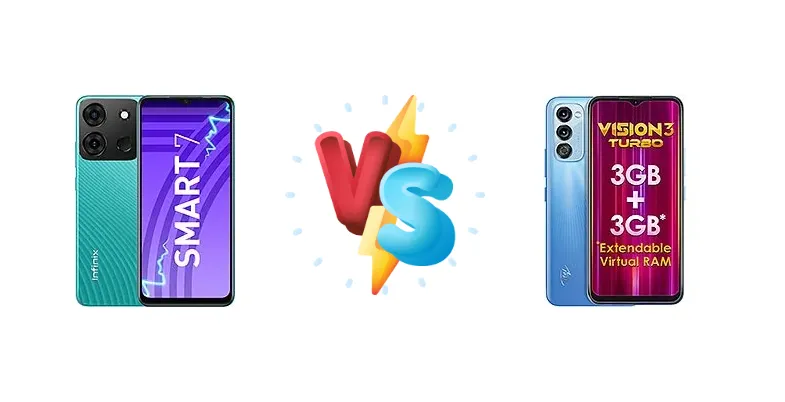
The sub-₹8,000 (approximately $100 USD) smartphone segment is fiercely competitive. Both the Infinix Smart 7 (India) and the itel Vision 3 Turbo aim to deliver the most features for the least amount of money. This comparison dissects their core specifications to determine which device offers the best overall experience for budget-conscious consumers.
🏆 Quick Verdict
For the average user prioritizing faster charging and potentially slightly better power efficiency, the itel Vision 3 Turbo emerges as the winner. Its 18W charging significantly reduces downtime compared to the Infinix Smart 7’s 10W charging, a crucial advantage in this price bracket. However, the difference is marginal.
| Network |
|---|
| 2G bands | GSM 850 / 900 / 1800 / 1900 | GSM 850 / 900 / 1800 / 1900 |
| 3G bands | HSDPA 850 / 900 / 2100 | HSDPA 850 / 900 / 2100 |
| 4G bands | 1, 3, 5, 8, 38, 40, 41 | LTE |
| Speed | HSPA, LTE | HSPA, LTE |
| Technology | GSM / HSPA / LTE | GSM / HSPA / LTE |
| Launch |
|---|
| Announced | 2023, February 22 | 2022 |
| Status | Available. Released 2023, February 27 | Available. Released 2022 |
| Body |
|---|
| Build | Glass front, plastic back, plastic frame | - |
| Dimensions | 164.2 x 75.6 x 9.4 mm (6.46 x 2.98 x 0.37 in) | - |
| SIM | Nano-SIM + Nano-SIM | Dual SIM |
| Weight | 207 g (7.30 oz) | - |
| Display |
|---|
| Resolution | 720 x 1612 pixels, 20:9 ratio (~267 ppi density) | 720 x 1600 pixels, 20:9 ratio (~266 ppi density) |
| Size | 6.6 inches, 104.6 cm2 (~84.3% screen-to-body ratio) | 6.6 inches, 105.2 cm2 |
| Type | IPS LCD, 500 nits | IPS LCD |
| Platform |
|---|
| CPU | Octa-core (4x1.6 GHz Cortex-A55 & 4x1.2 GHz Cortex-A55) | Octa-core (4x1.6 GHz Cortex-A55 & 4x1.2 GHz Cortex-A55) |
| Chipset | Unisoc SC9863A1 (22 nm) | Unisoc SC9863A (28 nm) |
| GPU | IMG8322 | IMG8322 |
| OS | Android 12, XOS 12 | Android 11 (Go edition) |
| Memory |
|---|
| Card slot | microSDXC (dedicated slot) | microSDXC |
| Internal | 64GB 3GB RAM, 64GB 4GB RAM, 128GB 4GB RAM | 64GB 3GB RAM |
| | eMMC 5.1 | - |
| Main Camera |
|---|
| Dual | 13 MP, AF
Auxiliary lens | - |
| Features | Dual-LED flash, HDR, panorama | LED flash |
| Single | 5 MP | 8 MP (wide)
Auxiliary lens |
| Video | 1080p@30fps | 1080p@30fps |
| Selfie camera |
|---|
| Features | LED flash | - |
| Single | 5 MP | 5 MP |
| Video | 720p@30fps | Yes |
| Sound |
|---|
| 3.5mm jack | Yes | - |
| 35mm jack | Yes | Yes |
| Loudspeaker | Yes | Yes |
| Comms |
|---|
| Bluetooth | 4.2, A2DP | Yes |
| NFC | No | No |
| Positioning | GPS | GPS |
| Radio | Unspecified | Unspecified |
| USB | USB Type-C 2.0 | microUSB |
| WLAN | Wi-Fi 802.11 b/g/n | Yes |
| Features |
|---|
| Sensors | Fingerprint (rear-mounted), accelerometer, proximity, compass | Fingerprint (rear-mounted), accelerometer |
| Battery |
|---|
| Charging | 10W wired | 18W wired |
| Type | 6000 mAh | 5000 mAh |
| Misc |
|---|
| Colors | Azure Blue, Emerald Green, Night Black | Blue |
| Models | X6517 | - |
| Price | About 80 EUR | - |
Infinix Smart 7 (India)
- Slightly more efficient 22nm chipset
- Potentially better thermal management
- Newer chipset version (SC9863A1)
- Slower 10W charging
- Likely similar display quality to itel
- Basic camera performance
itel Vision 3 Turbo
- Faster 18W charging
- Competitive price
- Adequate performance for basic tasks
- Older 28nm chipset
- Potentially slightly higher power consumption
- Basic camera performance
Display Comparison
Neither Infinix nor itel provide detailed display specifications beyond resolution. Given the price point, both likely utilize LCD panels. The absence of information regarding peak brightness, color gamut coverage, or PWM dimming rates suggests a focus on cost reduction. Bezels are expected to be substantial on both devices. Display quality will likely be similar, prioritizing visibility over color accuracy or advanced features.
Camera Comparison
Camera performance is expected to be basic on both devices. Detailed camera specs are unavailable, but the market segment suggests reliance on 5MP or 8MP main sensors paired with low-resolution auxiliary lenses. Image quality will be acceptable in well-lit conditions, but struggle in low light. The focus should be on capturing memories, not professional-grade photography. The absence of Optical Image Stabilization (OIS) on either device further limits low-light capabilities.
Performance
Both phones are powered by Unisoc octa-core processors with the same CPU core configuration (4x1.6 GHz Cortex-A55 & 4x1.2 GHz Cortex-A55). However, the itel Vision 3 Turbo uses the Unisoc SC9863A, fabricated on a 28nm process, while the Infinix Smart 7 (India) utilizes the SC9863A1 on a more efficient 22nm node. This smaller node size *should* translate to slightly lower power consumption and potentially better thermal management for the Infinix, though the real-world difference will likely be minimal. Both will handle basic Android Go applications adequately, but demanding tasks will result in noticeable lag. Neither device is geared towards gaming.
Battery Life
Battery capacity is not specified for either device, but both likely house batteries in the 4000-5000 mAh range, typical for this price point. The key differentiator is charging speed. The itel Vision 3 Turbo supports 18W wired charging, significantly faster than the Infinix Smart 7’s 10W charging. This means the itel can achieve a full charge in a considerably shorter timeframe, a significant convenience factor for users who rely heavily on their phones throughout the day. While a larger battery capacity is desirable, faster charging often provides a more noticeable benefit in daily use.
Buying Guide
Buy the Infinix Smart 7 (India) if you prioritize a slightly newer chipset architecture and are comfortable with slower charging speeds. This phone is ideal for users who primarily use their phone for basic tasks like calls, messaging, and light social media. Buy the itel Vision 3 Turbo if you value quicker top-ups and don't mind a slightly older, but still capable, chipset. This is the better choice for users who frequently find themselves needing to charge their phone throughout the day.
Frequently Asked Questions
❓ Will the Unisoc SC9863A in the itel Vision 3 Turbo struggle with multitasking?
The Unisoc SC9863A is designed for entry-level smartphones. While it can handle basic multitasking (switching between apps like messaging, calls, and a web browser), running multiple demanding applications simultaneously will likely result in noticeable slowdowns and lag. It's best suited for users who primarily use one app at a time.
❓ Is the 18W charging on the itel Vision 3 Turbo compatible with any charger I already own?
Most standard USB chargers will work with the itel Vision 3 Turbo, but to achieve the full 18W charging speed, you'll need a charger that supports USB Power Delivery (USB-PD) or Quick Charge protocols. Using a standard 5W charger will still charge the phone, but it will take significantly longer.
❓ Can either of these phones handle popular games like PUBG Mobile or Call of Duty Mobile?
While technically possible to *install* these games, the Unisoc processors in both the Infinix Smart 7 and itel Vision 3 Turbo are not powerful enough to provide a smooth gaming experience. Expect low frame rates, significant lag, and potential overheating. These phones are not designed for gaming.