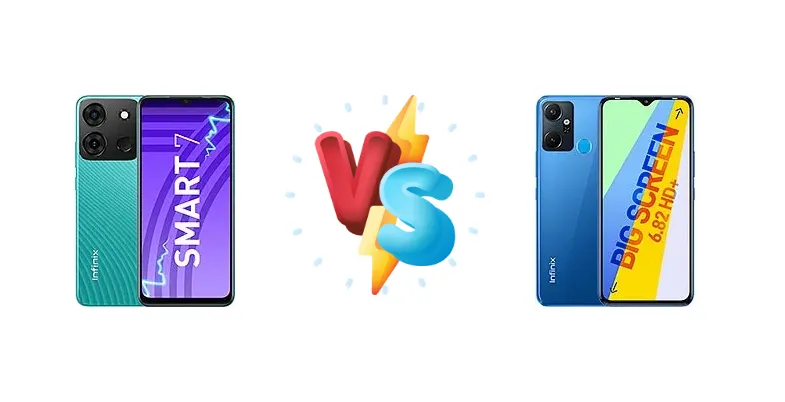
Infinix's Smart series consistently targets the ultra-budget segment, offering essential smartphone functionality at incredibly competitive prices. The Smart 7 and Smart 6 Plus represent two iterations of this strategy, but a closer look reveals key differences in their core components, particularly the chipset. This comparison dissects those differences to determine which device delivers the best value for users prioritizing affordability and basic smartphone tasks.
🏆 Quick Verdict
For the average user seeking a reliable, if basic, smartphone experience, the Infinix Smart 6 Plus emerges as the slightly better choice. Its MediaTek Helio G25, fabricated on a more efficient 12nm process, provides a noticeable performance edge over the Smart 7’s Unisoc SC9863A1, despite the clock speed differences, making everyday tasks smoother.
| Network |
|---|
| 2G bands | GSM 850 / 900 / 1800 / 1900 | GSM 850 / 900 / 1800 / 1900 |
| 3G bands | HSDPA 850 / 900 / 2100 | HSDPA 850 / 900 / 2100 |
| 4G bands | 1, 3, 5, 8, 38, 40, 41 | 1, 3, 5, 8, 38, 40, 41 |
| Speed | HSPA, LTE | HSPA, LTE |
| Technology | GSM / HSPA / LTE | GSM / HSPA / LTE |
| Launch |
|---|
| Announced | 2023, February 22 | 2022, July 29 |
| Status | Available. Released 2023, February 27 | Available. Released 2022, August 03 |
| Body |
|---|
| Build | Glass front, plastic back, plastic frame | Glass front, plastic back, plastic frame |
| Dimensions | 164.2 x 75.6 x 9.4 mm (6.46 x 2.98 x 0.37 in) | 172.6 x 77.7 x 8.7 mm (6.80 x 3.06 x 0.34 in) |
| SIM | Nano-SIM + Nano-SIM | Nano-SIM + Nano-SIM |
| Weight | 207 g (7.30 oz) | 202 g (7.13 oz) |
| Display |
|---|
| Protection | - | Panda Glass |
| Resolution | 720 x 1612 pixels, 20:9 ratio (~267 ppi density) | 720 x 1600 pixels, 20:9 ratio (~257 ppi density) |
| Size | 6.6 inches, 104.6 cm2 (~84.3% screen-to-body ratio) | 6.82 inches, 112.3 cm2 (~83.7% screen-to-body ratio) |
| Type | IPS LCD, 500 nits | IPS LCD, 440 nits (typ) |
| Platform |
|---|
| CPU | Octa-core (4x1.6 GHz Cortex-A55 & 4x1.2 GHz Cortex-A55) | Octa-core (4x2.0 GHz Cortex-A53 & 4x1.5 GHz Cortex-A53) |
| Chipset | Unisoc SC9863A1 (22 nm) | Mediatek MT6762G Helio G25 (12 nm) |
| GPU | IMG8322 | PowerVR GE8320 |
| OS | Android 12, XOS 12 | Android 12 (Go edition) |
| Memory |
|---|
| Card slot | microSDXC (dedicated slot) | microSDXC (dedicated slot) |
| Internal | 64GB 3GB RAM, 64GB 4GB RAM, 128GB 4GB RAM | 64GB 2GB RAM, 64GB 3GB RAM |
| | eMMC 5.1 | eMMC 5.1 |
| Main Camera |
|---|
| Dual | 13 MP, AF
Auxiliary lens | 8 MP, f/2.0, AF
Auxiliary lens |
| Features | Dual-LED flash, HDR, panorama | Dual-LED flash, HDR, panorama |
| Single | 5 MP | 5 MP, f/2.0 |
| Video | 1080p@30fps | 1080p@30fps |
| Selfie camera |
|---|
| Features | LED flash | LED flash |
| Single | 5 MP | 5 MP, f/2.0 |
| Video | 720p@30fps | 720p@30fps |
| Sound |
|---|
| 3.5mm jack | Yes | Yes |
| 35mm jack | Yes | Yes |
| Loudspeaker | Yes | Yes |
| Comms |
|---|
| Bluetooth | 4.2, A2DP | 5.0, A2DP, LE |
| NFC | No | No |
| Positioning | GPS | GPS |
| Radio | Unspecified | FM radio |
| USB | USB Type-C 2.0 | microUSB 2.0, OTG |
| WLAN | Wi-Fi 802.11 b/g/n | Wi-Fi 802.11 a/b/g/n |
| Features |
|---|
| Sensors | Fingerprint (rear-mounted), accelerometer, proximity, compass | Fingerprint (rear-mounted), accelerometer, proximity |
| Battery |
|---|
| Charging | 10W wired | - |
| Type | 6000 mAh | 5000 mAh |
| Misc |
|---|
| Colors | Azure Blue, Emerald Green, Night Black | Tranquil Sea Blue, Miracle Black |
| Models | X6517 | X6823C, X6823 |
| Price | About 80 EUR | About 100 EUR |
Infinix Smart 7 (India)
- Newer model, potentially longer software support
- Slightly higher CPU clock speed (on paper)
- Potentially lower price point at launch
- Less efficient Unisoc chipset
- Likely lower performance in real-world usage
- 22nm process may lead to more heat
Infinix Smart 6 Plus (India)
- More efficient MediaTek Helio G25 chipset
- 12nm process for better power management
- Smoother multitasking and app loading
- Older model
- Potentially shorter software support lifecycle
- May be slightly more expensive
Display Comparison
Neither Infinix explicitly details display specifications beyond size and resolution. Given the price point, both likely utilize IPS LCD panels. However, the absence of detailed specs like peak brightness or color gamut makes a direct comparison impossible. Bezels are expected to be substantial on both devices, typical for this segment. Color accuracy will likely be standard, prioritizing power efficiency over fidelity.
Camera Comparison
Both devices are expected to feature basic camera setups, likely dominated by a primary sensor. Detailed camera specs are scarce, but the focus should be on the primary sensor's megapixel count and aperture. Any secondary sensors (often 2MP macro or depth sensors) will offer limited utility. Image processing will likely be minimal, relying on software algorithms to enhance photos. The Helio G25’s ISP (Image Signal Processor) may offer slightly better image quality due to its more advanced architecture, but the difference will be marginal.
Performance
The core differentiator lies in the chipsets. The Infinix Smart 6 Plus utilizes the MediaTek Helio G25, built on a 12nm process. This smaller fabrication node generally translates to improved power efficiency and thermal performance compared to the Unisoc SC9863A1 in the Smart 7, which is manufactured on a 22nm process. While the Smart 7’s CPU has a slightly higher peak clock speed (1.6GHz vs 2.0GHz), the Helio G25’s Cortex-A53 cores are architecturally more efficient than the Smart 7’s Cortex-A55 cores. This means the G25 will likely handle multitasking and app loading more smoothly. The GPU within the Helio G25 also provides a slight advantage for basic gaming.
Battery Life
Both phones are likely equipped with similar battery capacities (around 5000mAh, based on Infinix’s typical offerings). However, the Smart 6 Plus’s more efficient chipset will likely result in slightly longer battery life during typical usage. Both devices feature 10W wired charging, which is slow by modern standards. Expect a full charge to take over 3 hours. The efficiency gains of the Helio G25 will translate to less power draw during charging and usage, potentially extending the overall lifespan of the battery.
Buying Guide
Buy the Infinix Smart 7 (India) if you prioritize a newer model and potentially longer software support, understanding that you'll be trading some raw performance. Buy the Infinix Smart 6 Plus (India) if you prefer a more responsive user experience for everyday tasks like browsing and social media, and are comfortable with a slightly older device. Both are excellent choices for first-time smartphone users or those needing a secondary device.
Frequently Asked Questions
❓ Will the Helio G25 in the Smart 6 Plus struggle with popular apps like WhatsApp and Facebook?
No, the Helio G25 is perfectly capable of handling everyday apps like WhatsApp, Facebook, and web browsing. While it's not a powerhouse, it provides a smooth and responsive experience for these common tasks, thanks to its efficient architecture and optimized power consumption.
❓ Is the 10W charging speed on either phone a significant drawback?
Yes, 10W charging is quite slow compared to modern standards. Expect a full charge to take over 3 hours. This is a compromise made to keep the cost down, and it's something to consider if you frequently need to top up your battery quickly. Both phones share this limitation.
❓ Can the Infinix Smart 7 handle light gaming, like casual puzzle games?
The Infinix Smart 7 can handle very light gaming, such as simple puzzle games or 2D titles. However, demanding 3D games will likely experience significant lag and frame drops due to the limitations of the Unisoc SC9863A1’s GPU. The Smart 6 Plus offers a slightly better gaming experience, but neither phone is designed for serious gaming.