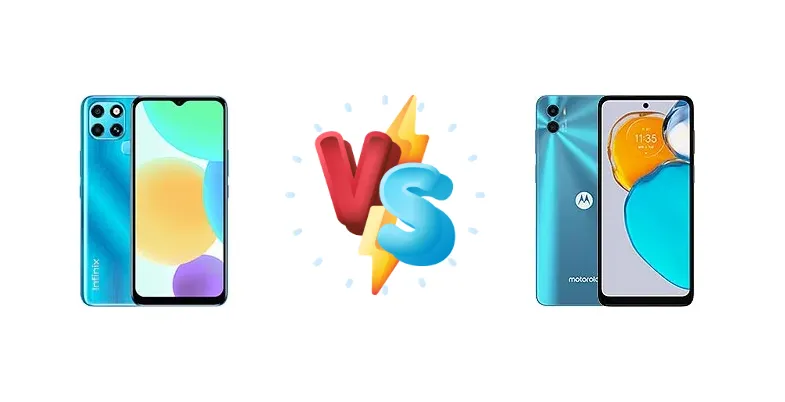
The sub-$150 smartphone market is fiercely competitive. Both the Infinix Smart 6 and Motorola Moto E22s aim to deliver essential smartphone functionality at an incredibly accessible price point. However, they take different approaches to achieving this, with the Infinix relying on a Unisoc chipset and the Motorola opting for a Mediatek Helio G37. This comparison will dissect their key differences to help you determine which device best suits your needs.
🏆 Quick Verdict
For the average user prioritizing responsiveness and slightly better gaming capabilities, the Motorola Moto E22s emerges as the stronger choice. Its Helio G37 chipset, fabricated on a more efficient 12nm process, provides a noticeable performance edge over the Infinix Smart 6’s Unisoc SC9863A, despite both phones sharing 10W charging and similar price points.
| Network |
|---|
| 2G bands | GSM 850 / 900 / 1800 / 1900 | GSM 850 / 900 / 1800 / 1900 |
| 3G bands | HSDPA 850 / 900 / 2100 | HSDPA 850 / 900 / 2100 |
| 4G bands | 1, 3, 5, 8, 38, 40, 41 | 1, 3, 5, 7, 8, 20, 38, 40, 41 |
| Speed | HSPA, LTE | HSPA 42.2/5.76 Mbps, LTE Cat4 150/50 Mbps |
| Technology | GSM / HSPA / LTE | GSM / HSPA / LTE |
| | 1, 2, 3, 4, 5, 7, 8, 20, 28, 38, 40, 41 | - |
| Launch |
|---|
| Announced | 2021, October 26 | 2022, August 24 |
| Status | Available. Released 2021, October 26 | Available. Released 2022, October 22 |
| Body |
|---|
| Build | Glass front, plastic back, plastic frame | Glass front, plastic frame, plastic back |
| Dimensions | 165.6 x 76.4 x 9.1 mm (6.52 x 3.01 x 0.36 in) | 164 x 75 x 8.5 mm (6.46 x 2.95 x 0.33 in) |
| SIM | Nano-SIM + Nano-SIM | Nano-SIM + Nano-SIM |
| Weight | - | 185 g (6.53 oz) |
| | - | Water-repellent coating |
| Display |
|---|
| Resolution | 720 x 1600 pixels, 20:9 ratio (~266 ppi density) | 720 x 1600 pixels, 20:9 ratio (~270 ppi density) |
| Size | 6.6 inches, 105.2 cm2 (~83.1% screen-to-body ratio) | 6.5 inches, 102.0 cm2 (~82.9% screen-to-body ratio) |
| Type | IPS LCD, 500 nits (typ) | IPS LCD, 90Hz |
| Platform |
|---|
| CPU | Octa-core (4x1.6 GHz Cortex-A55 & 4x1.2 GHz Cortex-A55) | Octa-core (4x2.3 GHz Cortex-A53 & 4x1.8 GHz Cortex-A53) |
| Chipset | Unisoc SC9863A (28 nm) | Mediatek MT6765V/CB Helio G37 (12 nm) |
| GPU | IMG8322 | PowerVR GE8320 |
| OS | Android 11 (Go edition), XOS 7.6 | Android 12 |
| Memory |
|---|
| Card slot | microSDXC (dedicated slot) | microSDXC (dedicated slot) |
| Internal | 32GB 2GB RAM, 64GB 3GB RAM | 64GB 4GB RAM |
| | eMMC 5.1 | eMMC 5.1 |
| Main Camera |
|---|
| Dual | 8 MP, AF
Auxiliary lens | 16 MP, f/2.2, (wide), 1.0µm, PDAF
Auxiliary lens |
| Features | Dual-LED flash | LED flash, HDR, panorama |
| Single | 5 MP | - |
| Video | 1080p@30fps | 1080p@30fps |
| Selfie camera |
|---|
| Features | LED flash | HDR |
| Single | 5 MP | 8 MP, f/2.2, (wide), 1/4.0, 1.12µm |
| Video | 720p@30fps | 1080p@30fps |
| Sound |
|---|
| 3.5mm jack | Yes | Yes |
| 35mm jack | Yes | Yes |
| Loudspeaker | Yes | Yes |
| Comms |
|---|
| Bluetooth | Yes | 5.0, A2DP, LE |
| NFC | Yes (market/region dependent) | No |
| Positioning | GPS | GPS, GLONASS, GALILEO |
| Radio | FM radio | Unspecified |
| USB | microUSB 2.0, OTG | USB Type-C 2.0 |
| WLAN | Wi-Fi 802.11 b/g/n | Wi-Fi 802.11 a/b/g/n/ac, dual-band |
| Features |
|---|
| Sensors | Fingerprint (rear-mounted), accelerometer, proximity | Fingerprint (side-mounted), accelerometer, compass |
| Battery |
|---|
| Charging | 10W wired | 10W wired |
| Type | 5000 mAh | Li-Po 5000 mAh |
| Misc |
|---|
| Colors | Purple, Ocean Blue, Light Sea Green, Polar Black | Iceberg Blue, Cosmic Black |
| Models | X6511B, X6511, X6511E | - |
| Price | About 100 EUR | About 110 EUR |
Infinix Smart 6
- Potentially lower price point
- Likely similar battery life to Moto E22s
- Functional for basic smartphone tasks
- Less powerful Unisoc SC9863A chipset
- Older 28nm fabrication process
- Potentially slower performance in demanding apps
Motorola Moto E22s
- More efficient Mediatek Helio G37 chipset
- Modern 12nm fabrication process
- Better performance for multitasking and gaming
- May be slightly more expensive than the Infinix Smart 6
- 10W charging is slow
- Camera quality likely similar to Infinix
Display Comparison
Neither device boasts a standout display. Both are likely to feature LCD panels, typical for this price bracket. However, details like resolution and peak brightness are missing. The key difference lies under the hood: the manufacturing process of the chipsets powering them impacts the overall system responsiveness, which indirectly affects perceived display smoothness. Without specific display specs, it's difficult to declare a clear winner, but the more powerful chipset in the Moto E22s *could* translate to slightly faster UI rendering.
Camera Comparison
Both phones are expected to feature basic camera setups, likely headlined by a single main sensor. Details are scarce, but it’s safe to assume image quality will be adequate for casual snapshots in good lighting conditions. The presence of a 2MP macro lens on either device is largely a marketing gimmick, offering minimal practical benefit. Without sensor size or aperture information, it’s impossible to definitively say which phone captures better images, but the more powerful ISP (Image Signal Processor) within the Helio G37 chipset of the Moto E22s *could* lead to slightly improved image processing and dynamic range.
Performance
The Motorola Moto E22s holds a significant advantage in performance. Its Mediatek Helio G37 (12nm) utilizes Cortex-A53 cores clocked at 2.3 GHz, while the Infinix Smart 6’s Unisoc SC9863A (28nm) features a mix of Cortex-A55 cores clocked lower at 1.6 GHz and 1.2 GHz. The 12nm fabrication process of the Helio G37 is considerably more efficient than the 28nm process of the Unisoc chip, resulting in better power efficiency and potentially less thermal throttling during sustained workloads. This translates to smoother multitasking and a more enjoyable gaming experience on the Moto E22s, even if both phones share the same amount of RAM (likely 2-3GB).
Battery Life
Both the Infinix Smart 6 and Motorola Moto E22s are equipped with 10W wired charging, indicating similar charging speeds. While battery capacity isn’t specified, both are likely to house around a 5000mAh battery, standard for this segment. The more efficient 12nm Helio G37 in the Moto E22s *could* contribute to slightly longer battery life, as it consumes less power during typical usage. However, real-world battery performance will heavily depend on individual usage patterns and network conditions.
Buying Guide
Buy the Infinix Smart 6 if you primarily need a phone for basic communication – calls, texts, and light social media – and value a potentially lower upfront cost. Buy the Motorola Moto E22s if you want a more responsive experience for everyday tasks, occasional gaming, and appreciate the benefits of a more modern chipset architecture, even if it means spending a little more.
Frequently Asked Questions
❓ Will the Helio G37 in the Moto E22s handle popular games like PUBG Mobile?
The Helio G37 is capable of running PUBG Mobile, but expect to play at lower graphics settings and frame rates to maintain a smooth experience. It's not a gaming powerhouse, but it's significantly better suited for gaming than the Unisoc SC9863A in the Infinix Smart 6.
❓ Is the 10W charging on either phone a major drawback?
Yes, 10W charging is quite slow by today's standards. Expect a full charge to take over 3 hours. Neither phone prioritizes fast charging, focusing instead on affordability. Consider this a trade-off for the low price point.
❓ How much storage do these phones typically come with, and can it be expanded?
Both phones likely ship with 32GB of internal storage, which is minimal. Fortunately, both typically support microSD card expansion, allowing you to add up to 512GB or 1TB of additional storage for photos, videos, and apps.
❓ Which phone is better for someone who primarily uses WhatsApp and Facebook?
For basic social media usage like WhatsApp and Facebook, both phones will perform adequately. However, the Motorola Moto E22s’ more responsive chipset will provide a smoother and more enjoyable experience when switching between apps and scrolling through feeds.