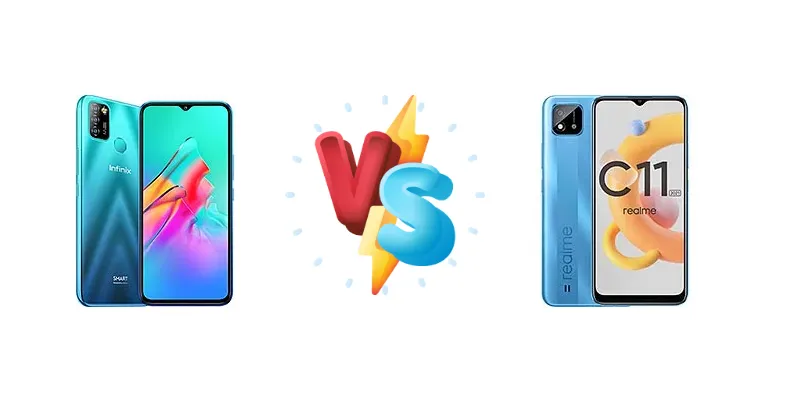
The sub-$100 smartphone market is fiercely competitive, and the Infinix Smart 5 and Realme C11 (2021) are key contenders. Both aim to deliver essential smartphone functionality at an incredibly low price point, but they take different approaches to achieving this. This comparison dives deep into their specifications to determine which device offers the best experience for the money.
🏆 Quick Verdict
For most users, the Realme C11 (2021) is the better choice. Its octa-core Unisoc SC9863A processor provides a noticeable performance advantage over the Infinix Smart 5’s quad-core Helio A20, resulting in smoother multitasking and app loading, despite the older, less efficient manufacturing process.
| Network |
|---|
| 2G bands | GSM 850 / 900 / 1800 / 1900 | GSM 850 / 900 / 1800 / 1900 |
| 3G bands | HSDPA 850 / 900 / 2100 | HSDPA 850 / 900 / 1900 / 2100 |
| 4G bands | 1, 3, 5, 7, 8, 20, 38, 40, 41 | 1, 3, 5, 8, 38, 40, 41 |
| Speed | HSPA 21.1/5.76 Mbps, LTE Cat4 150/50 Mbps | HSPA, LTE |
| Technology | GSM / HSPA / LTE | GSM / HSPA / LTE |
| Launch |
|---|
| Announced | 2020, August 13. Released 2020, August 20 | 2021, June 28 |
| Status | Discontinued | Available. Released 2021, June 28 |
| Body |
|---|
| Build | Glass front, plastic back, plastic frame | Glass front, plastic frame, plastic back |
| Dimensions | 165.4 x 76.4 x 8.8 mm (6.51 x 3.01 x 0.35 in) | 165.2 x 76.4 x 8.9 mm (6.50 x 3.01 x 0.35 in) |
| SIM | Nano-SIM + Nano-SIM | Nano-SIM + Nano-SIM |
| Weight | 183 g (6.46 oz) | 190 g (6.70 oz) |
| | - | Splash resistant design |
| Display |
|---|
| Resolution | 720 x 1600 pixels, 20:9 ratio (~266 ppi density) | 720 x 1600 pixels, 20:9 ratio (~269 ppi density) |
| Size | 6.6 inches, 105.2 cm2 (~83.2% screen-to-body ratio) | 6.52 inches, 102.6 cm2 (~81.3% screen-to-body ratio) |
| Type | IPS LCD | IPS LCD, 400 nits (typ) |
| Platform |
|---|
| CPU | Quad-core 1.8 GHz Cortex-A53 | Octa-core (4x1.6 GHz Cortex-A55 & 4x1.2 GHz Cortex-A55) |
| Chipset | Mediatek MT6761D Helio A20 (12 nm) | Unisoc SC9863A (28 nm) |
| GPU | PowerVR GE8320 | IMG8322 |
| OS | Android 10 (Go edition) | Android 11, Realme Go UI |
| Memory |
|---|
| Card slot | microSDXC (dedicated slot) | microSDXC (dedicated slot) |
| Internal | 32GB 2GB RAM, 64GB 3GB RAM | 32GB 2GB RAM, 64GB 4GB RAM |
| | eMMC 5.1 | eMMC 5.1 |
| Main Camera |
|---|
| Features | Triple-LED flash | LED flash, HDR, panorama |
| Single | - | 8 MP, f/2.0, (wide), AF |
| Triple | 13 MP + Auxiliary lenses (X657 model)
or
8 MP + Auxiliary lens (X657C model) | - |
| Video | 1080p@30fps | 1080p@30fps |
| Selfie camera |
|---|
| Features | Dual-LED flash | HDR, panorama |
| Single | 8 MP | 5 MP, f/2.2, (wide) |
| Video | 1080p@30fps | 1080p@30fps |
| Sound |
|---|
| 3.5mm jack | Yes | Yes |
| 35mm jack | Yes | Yes |
| Loudspeaker | Yes | Yes |
| Comms |
|---|
| Bluetooth | 4.2, A2DP | 4.2, A2DP |
| NFC | No | No |
| Positioning | GPS | GPS, GLONASS, GALILEO, BDS |
| Radio | FM radio | Unspecified |
| USB | microUSB 2.0 | microUSB 2.0, OTG |
| WLAN | Wi-Fi 802.11 a/b/g/n/ac, dual-band, Wi-Fi Direct | Wi-Fi 802.11 b/g/n |
| Features |
|---|
| Sensors | Fingerprint (rear-mounted), accelerometer, gyro, proximity | Accelerometer, gyro, proximity, compass |
| Battery |
|---|
| Charging | 10W wired | 10W wired
Reverse wired |
| Type | 5000 mAh | 5000 mAh |
| Misc |
|---|
| Colors | Ocean Wave, Quetzal Cyan, Midnight Black | Cool Blue, Cool Grey |
| Models | X657, X657C, MZ-Infinix X657C, MZ-Infinix X657B | RMX3231 |
| Price | About 70 EUR | About 80 EUR |
| Pricing |
|---|
| 32GB 2GB RAM | Rp 1,600,000 | - |
| 64GB 3GB RAM | Rp 1,525,000 | - |
Infinix Smart 5
- Potentially slightly better battery efficiency due to 12nm process.
- Lowest possible price point.
- 64GB storage option available.
- Quad-core processor limits performance.
- Less responsive user experience.
- Lacks reverse charging.
Realme C11 (2021)
- Octa-core processor delivers smoother performance.
- Reverse wired charging adds versatility.
- More responsive multitasking.
- 28nm process is less power efficient.
- May be slightly more expensive than the base Infinix model.
- No significant camera advantages.
Display Comparison
Neither device boasts a standout display. Both likely utilize LCD panels, a standard for this price bracket. However, detailed display specs like resolution and brightness are missing. The focus here is on usability, and the lack of detailed specs suggests both are adequate for basic viewing. Bezels are expected to be substantial on both, maximizing screen real estate within the budget constraints.
Camera Comparison
Camera performance is likely to be similar on both devices, with both likely featuring a primary sensor and potentially a secondary depth sensor. Detailed sensor information is unavailable, but given the price point, expectations should be tempered. The focus is on capturing basic snapshots in good lighting conditions. The absence of detailed camera specs suggests neither phone will excel in low-light photography or offer advanced features. Any secondary cameras (likely 2MP) are primarily for depth sensing and will offer limited standalone image quality.
Performance
The core difference lies in the chipset. The Realme C11 (2021) features the Unisoc SC9863A, an octa-core processor built on a 28nm process. While the 28nm node is less efficient than the Infinix’s Helio A20’s 12nm process, the eight cores (4x1.6 GHz Cortex-A55 & 4x1.2 GHz Cortex-A55) provide a significant advantage in multi-tasking and app responsiveness compared to the Helio A20’s quad-core 1.8 GHz Cortex-A53. This translates to a smoother user experience, especially when switching between apps. The Helio A20 is sufficient for very basic tasks, but will struggle with heavier workloads. The Realme C11's architecture is better suited for handling multiple processes simultaneously.
Battery Life
Both phones feature 10W wired charging, indicating similar charging speeds. While battery capacity isn't specified, both are likely in the 4000-5000 mAh range, typical for this segment. The Realme C11 (2021) adds the convenience of reverse wired charging, allowing it to act as a power bank for other devices – a useful feature for users who frequently travel or rely on multiple gadgets. The 12nm process of the Helio A20 *could* offer slightly better battery efficiency under light load, but the performance advantage of the Unisoc chip will likely negate this in real-world usage.
Buying Guide
Buy the Infinix Smart 5 if your primary need is a very basic smartphone for calls, texts, and light social media use, and you prioritize the lowest possible price. The 64GB/3GB RAM variant offers a slight storage and memory advantage for a minimal price increase. Buy the Realme C11 (2021) if you want a more responsive experience for everyday tasks, appreciate the convenience of reverse wired charging, and anticipate using more demanding apps, even if only occasionally.
Frequently Asked Questions
❓ Will the Realme C11 (2021) struggle with popular apps like WhatsApp and Facebook?
While not a powerhouse, the Realme C11 (2021)'s octa-core processor and likely 3GB of RAM (in the standard configuration) should handle WhatsApp, Facebook, and similar social media apps without significant issues. Expect some loading times, but it will be a more fluid experience than the Infinix Smart 5.
❓ Is the Unisoc SC9863A a reliable processor?
Unisoc has been steadily improving its processors, and the SC9863A is a capable chip for entry-level smartphones. It won't compete with Snapdragon or MediaTek's higher-end offerings, but it provides a solid foundation for basic smartphone tasks. It's a significant step up from the Helio A20 in the Infinix Smart 5.
❓ Can either of these phones handle basic mobile games?
Both phones can run basic mobile games, but don't expect high frame rates or detailed graphics. The Realme C11 (2021) will offer a slightly better gaming experience due to its more powerful processor, allowing for smoother gameplay in less demanding titles.
❓ What kind of storage expansion options are available on these phones?
Both phones likely support microSD card expansion, allowing you to increase storage capacity. However, the maximum supported microSD card size may vary. Check the product specifications for the exact limit.