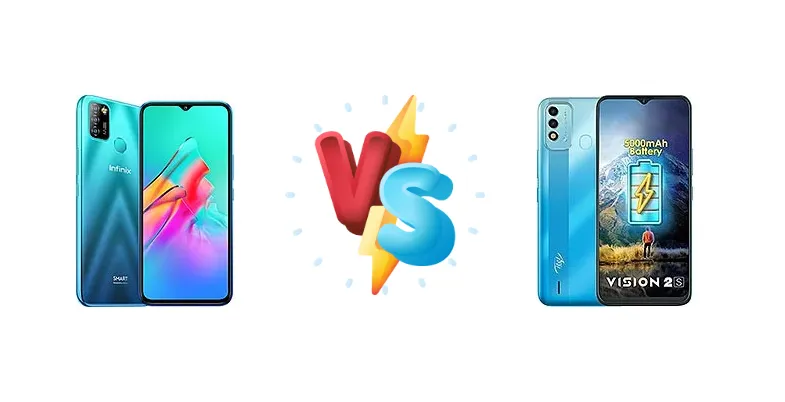
The sub-$100 smartphone market is fiercely competitive, and the Infinix Smart 5 and itel Vision 2S represent two compelling options for users prioritizing affordability. While both aim to deliver essential smartphone functionality, they take different approaches to achieving this, particularly in chipset choice and charging capabilities. This comparison dissects these differences to determine which device offers the best value.
🏆 Quick Verdict
For the average user prioritizing responsiveness in everyday tasks, the itel Vision 2S emerges as the better choice. Its octa-core Unisoc SC9863A processor, despite being built on a larger process node, offers a more modern architecture than the Infinix Smart 5’s quad-core Helio A20, resulting in a smoother user experience. However, the Smart 5’s slightly lower price point may appeal to the most budget-conscious buyers.
| Network |
|---|
| 2G bands | GSM 850 / 900 / 1800 / 1900 | GSM 850 / 900 / 1800 / 1900 |
| 3G bands | HSDPA 850 / 900 / 2100 | HSDPA 850 / 900 / 2100 |
| 4G bands | 1, 3, 5, 7, 8, 20, 38, 40, 41 | LTE |
| Speed | HSPA 21.1/5.76 Mbps, LTE Cat4 150/50 Mbps | HSPA, LTE |
| Technology | GSM / HSPA / LTE | GSM / HSPA / LTE |
| Launch |
|---|
| Announced | 2020, August 13. Released 2020, August 20 | 2021 |
| Status | Discontinued | Available. Released 2021 |
| Body |
|---|
| Build | Glass front, plastic back, plastic frame | - |
| Dimensions | 165.4 x 76.4 x 8.8 mm (6.51 x 3.01 x 0.35 in) | 166 x 76.3 x 8.9 mm (6.54 x 3.00 x 0.35 in) |
| SIM | Nano-SIM + Nano-SIM | Dual SIM |
| Weight | 183 g (6.46 oz) | - |
| Display |
|---|
| Resolution | 720 x 1600 pixels, 20:9 ratio (~266 ppi density) | 720 x 1600 pixels, 20:9 ratio (~269 ppi density) |
| Size | 6.6 inches, 105.2 cm2 (~83.2% screen-to-body ratio) | 6.52 inches, 102.6 cm2 (~81.0% screen-to-body ratio) |
| Type | IPS LCD | IPS LCD |
| Platform |
|---|
| CPU | Quad-core 1.8 GHz Cortex-A53 | Octa-core (4x1.6 GHz Cortex-A55 & 4x1.2 GHz Cortex-A55) |
| Chipset | Mediatek MT6761D Helio A20 (12 nm) | Unisoc SC9863A (28 nm) |
| GPU | PowerVR GE8320 | IMG8322 |
| OS | Android 10 (Go edition) | Android 11 (Go edition) |
| Memory |
|---|
| Card slot | microSDXC (dedicated slot) | microSDXC |
| Internal | 32GB 2GB RAM, 64GB 3GB RAM | 32GB 2GB RAM |
| | eMMC 5.1 | - |
| Main Camera |
|---|
| Dual | - | 8 MP
0.3 MP |
| Features | Triple-LED flash | LED flash |
| Triple | 13 MP + Auxiliary lenses (X657 model)
or
8 MP + Auxiliary lens (X657C model) | - |
| Video | 1080p@30fps | 1080p@30fps |
| Selfie camera |
|---|
| Features | Dual-LED flash | - |
| Single | 8 MP | 5 MP |
| Video | 1080p@30fps | Yes |
| Sound |
|---|
| 3.5mm jack | Yes | - |
| 35mm jack | Yes | Yes |
| Loudspeaker | Yes | Yes |
| Comms |
|---|
| Bluetooth | 4.2, A2DP | Yes |
| NFC | No | No |
| Positioning | GPS | GPS |
| Radio | FM radio | Unspecified |
| USB | microUSB 2.0 | microUSB |
| WLAN | Wi-Fi 802.11 a/b/g/n/ac, dual-band, Wi-Fi Direct | Yes |
| Features |
|---|
| Sensors | Fingerprint (rear-mounted), accelerometer, gyro, proximity | Fingerprint (rear-mounted), accelerometer |
| Battery |
|---|
| Charging | 10W wired | 18W wired |
| Type | 5000 mAh | 5000 mAh |
| Misc |
|---|
| Colors | Ocean Wave, Quetzal Cyan, Midnight Black | Gradation Purple, Gradation Blue, Deep Blue |
| Models | X657, X657C, MZ-Infinix X657C, MZ-Infinix X657B | - |
| Price | About 70 EUR | - |
| Pricing |
|---|
| 32GB 2GB RAM | Rp 1,600,000 | - |
| 64GB 3GB RAM | Rp 1,525,000 | - |
Infinix Smart 5
- Potentially lower price point.
- More power-efficient chipset (12nm process).
- Simple and straightforward user experience.
- Older processor architecture (Cortex-A53).
- Slower charging speed (10W).
- Less responsive multitasking.
itel Vision 2S
- More modern processor architecture (Cortex-A55).
- Faster charging speed (18W).
- Improved multitasking performance.
- Less power-efficient chipset (28nm process).
- Potentially slightly higher price.
- May not be as readily available in all markets.
Display Comparison
Neither device boasts a standout display. Both are likely to feature LCD panels, typical for this price bracket. The focus here isn't on resolution or color accuracy, but rather on usability. Without specific display specs, we can assume both offer adequate viewing angles for basic content consumption. The absence of features like high refresh rates or even full HD+ resolution is standard in this segment.
Camera Comparison
Camera performance is unlikely to be a key differentiator. Both phones likely feature basic camera setups focused on capturing usable images in good lighting conditions. Without detailed sensor information, it's safe to assume both rely on budget sensors. The itel Vision 2S’s potential for slightly better image processing due to its more capable chipset could give it a marginal edge, but don't expect flagship-level results from either device. The focus should be on functionality, not photographic quality.
Performance
The core difference lies in the chipsets. The Infinix Smart 5 utilizes the Mediatek Helio A20, a quad-core processor built on a 12nm process. While the 12nm node is more efficient, the A20’s Cortex-A53 cores are older architecture. Conversely, the itel Vision 2S features the Unisoc SC9863A, an octa-core chip (4x1.6 GHz Cortex-A55 & 4x1.2 GHz Cortex-A55) fabricated on a less efficient 28nm process. However, the Cortex-A55 cores are significantly more modern and efficient *per core* than the A53, and the eight cores provide superior multitasking capabilities. This translates to snappier app launches and smoother scrolling on the itel Vision 2S, even with the same 2GB/3GB RAM options.
Battery Life
The itel Vision 2S has a clear advantage in charging speed with its 18W wired charging support, compared to the Infinix Smart 5’s 10W charging. While battery capacity isn't specified, the faster charging is a significant benefit for users who need to quickly top up their phone. The larger process node of the Unisoc chip in the Vision 2S may lead to slightly higher power consumption, but the faster charging mitigates this concern, offering more usable uptime throughout the day.
Buying Guide
Buy the Infinix Smart 5 if you absolutely need the lowest possible price and are willing to accept compromises in performance for basic tasks like calling, texting, and light social media use. Buy the itel Vision 2S if you prioritize a more responsive user experience, even with basic apps, and value the convenience of faster 18W charging, making it ideal for users who rely heavily on their phone throughout the day.
Frequently Asked Questions
❓ Will the itel Vision 2S handle popular apps like WhatsApp and Facebook smoothly?
Yes, the itel Vision 2S’s octa-core Unisoc SC9863A processor with Cortex-A55 cores is well-suited for running everyday apps like WhatsApp, Facebook, and basic web browsing. The more modern architecture provides a noticeable improvement in responsiveness compared to the Infinix Smart 5’s older processor.
❓ How long will it take to fully charge the Infinix Smart 5 with its 10W charger?
Given the 10W charging rate and likely battery capacity (estimated around 4000-5000mAh), expect a full charge to take approximately 3-4 hours. This is significantly slower than the itel Vision 2S’s 18W charging, which should complete a full charge in around 2-2.5 hours.
❓ Is the Unisoc SC9863A chipset reliable for long-term use?
Unisoc has been steadily improving its chipset offerings. The SC9863A is a capable processor for basic smartphone tasks and is generally considered reliable for everyday use. While it doesn't compete with Qualcomm or MediaTek's higher-end chips, it provides a solid experience for the price point.