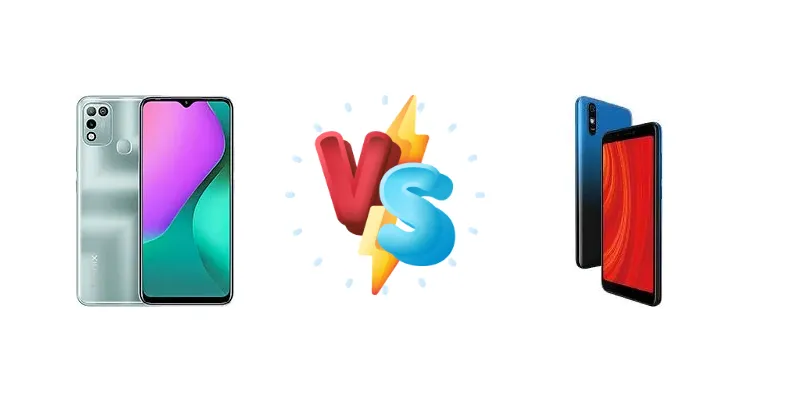
The sub-₹8,000 smartphone segment in India is fiercely competitive. Both the Infinix Smart 5 (India) and Lava Z61 Pro aim to deliver essential smartphone functionality at an incredibly low price point. However, they take different approaches to achieving this, with the Infinix prioritizing a more modern chipset while Lava focuses on a simpler, potentially more stable experience. This comparison dives deep into the specifications to determine which device offers the best value.
🏆 Quick Verdict
For the average user prioritizing responsiveness and occasional gaming, the Infinix Smart 5 (India) is the better choice. Its Mediatek Helio G25 chipset, while not a powerhouse, offers a significant performance advantage over the Lava Z61 Pro’s unspecified processor, making everyday tasks smoother. However, the Lava Z61 Pro may appeal to those seeking a simpler, potentially more reliable experience with a focus on longevity.
| Network |
|---|
| 2G bands | GSM 850 / 900 / 1800 / 1900 | GSM 900 / 1800 |
| 3G bands | HSDPA 850 / 900 / 2100 | HSDPA 900 / 2100 |
| 4G bands | 1, 3, 5, 8, 38, 40, 41 | 1, 3, 5, 8, 40, 41 |
| Speed | HSPA, LTE | HSPA 42.2/5.76 Mbps, LTE Cat4 150/50 Mbps |
| Technology | GSM / HSPA / LTE | GSM / HSPA / LTE |
| Launch |
|---|
| Announced | 2021, February 11 | 2020, July 09. Released 2020, July |
| Status | Available. Released 2021, February 18 | Discontinued |
| Body |
|---|
| Build | Glass front, plastic back, plastic frame | Glass front, plastic back, plastic frame |
| Dimensions | 171.8 x 78 x 8.9 mm (6.76 x 3.07 x 0.35 in) | 147 x 71.8 x 9.2 mm (5.79 x 2.83 x 0.36 in) |
| SIM | Nano-SIM + Nano-SIM | Nano-SIM + Nano-SIM |
| Weight | 207 g (7.30 oz) | 160 g (5.64 oz) |
| Display |
|---|
| Resolution | 720 x 1640 pixels (~263 ppi density) | 720 x 1440 pixels, 18:9 ratio (~295 ppi density) |
| Size | 6.82 inches, 110.5 cm2 (~82.4% screen-to-body ratio) | 5.45 inches, 76.7 cm2 (~72.6% screen-to-body ratio) |
| Type | IPS LCD, 440 nits (typ) | TFT LCD |
| Platform |
|---|
| CPU | Octa-core (4x2.0 GHz Cortex-A53 & 4x1.5 GHz Cortex-A53) | Octa-core 1.6 GHz processor |
| Chipset | Mediatek MT6762G Helio G25 (12 nm) | - |
| GPU | PowerVR GE8320 | - |
| OS | Android 10 (Go edition), XOS 7 | Android 9.0 (Pie) |
| Memory |
|---|
| Card slot | microSDXC (dedicated slot) | microSDXC (dedicated slot) |
| Internal | 32GB 2GB RAM | 16GB 2GB RAM |
| | eMMC 5.1 | eMMC 5.1 |
| Main Camera |
|---|
| Dual | 13 MP, f/1.8, (wide), 1/3.1", 1.12µm, AF
Auxiliary lens | - |
| Features | Quad-LED flash, panorama, HDR | LED flash, HDR, panorama |
| Single | 8 MP, f/2.0, (wide) | 8 MP, f/2.0, (wide), 1.12µ |
| Video | 1080p@30fps | 1080p@30fps |
| Selfie camera |
|---|
| Features | LED flash | LED flash |
| Single | 8 MP, f/2.0, (wide) | 5 MP, f/2.2, (wide), 1.12µ |
| Video | 1080p@30fps | - |
| Sound |
|---|
| 3.5mm jack | Yes | Yes |
| 35mm jack | Yes | Yes |
| Loudspeaker | Yes | Yes |
| Comms |
|---|
| Bluetooth | 5.0, A2DP, LE | 4.2, A2DP, LE |
| NFC | No | No |
| Positioning | GPS | GPS, GLONASS |
| Radio | FM radio | FM radio |
| USB | microUSB 2.0 | microUSB 2.0, OTG |
| WLAN | Wi-Fi 802.11 a/b/g/n, Wi-Fi Direct | Wi-Fi 802.11 b/g/n, Wi-Fi Direct |
| Features |
|---|
| Sensors | Fingerprint (rear-mounted), accelerometer, gyro, proximity, compass | Accelerometer, proximity |
| Battery |
|---|
| Charging | 10W wired | 5W, 100% in 3h 30 min |
| Type | 6000 mAh | Li-Po 3100 mAh |
| Misc |
|---|
| Colors | Aegean Blue, Morandi Green, Obsidian Black, Purple | Midnight Blue, Amber Red |
| Models | X688C | - |
| Price | About 80 EUR | About 70 EUR |
| SAR | 0.25 W/kg (head) 0.56 W/kg (body) | - |
Infinix Smart 5 (India)
- More powerful Mediatek Helio G25 chipset
- Faster 10W charging
- Potentially smoother multitasking experience
- Software support may be less consistent than Lava
- Build quality may be more plastic-focused
Lava Z61 Pro
- Potentially longer software support from an Indian manufacturer
- Simpler user experience
- May offer better build quality for the price
- Significantly slower processor
- Very slow 5W charging
- Limited performance for demanding apps
Display Comparison
Neither Infinix nor Lava provide detailed display specifications beyond the basic panel size. However, the absence of any mention of high refresh rates or advanced panel technologies like IPS LCD with high brightness suggests both devices utilize basic displays. The focus here is purely on functionality, not visual fidelity. The lack of detailed specs makes a direct comparison impossible, but we can assume both displays are optimized for power efficiency rather than vibrant colors or high peak brightness.
Camera Comparison
Both devices likely feature basic camera setups geared towards casual photography. Neither manufacturer highlights any advanced camera features like Optical Image Stabilization (OIS) or large sensor sizes. The absence of detailed camera specifications suggests image quality will be heavily reliant on software processing, and likely limited in low-light conditions. Given the price point, expecting flagship-level camera performance is unrealistic. The focus is on providing a functional camera for basic snapshots.
Performance
The Infinix Smart 5 (India) boasts a Mediatek MT6762G Helio G25 (12 nm) chipset with an octa-core CPU configuration split into 4x2.0 GHz Cortex-A53 and 4x1.5 GHz Cortex-A53 cores. This architecture, while based on older Cortex-A53 cores, benefits from the 12nm manufacturing process, offering a degree of efficiency. In contrast, the Lava Z61 Pro only specifies an octa-core 1.6 GHz processor. Without knowing the specific chipset, it’s difficult to assess its performance, but a 1.6 GHz clock speed generally indicates lower processing power than the Helio G25’s 2.0 GHz cores. This translates to a noticeably smoother experience on the Infinix for app launching, scrolling, and multitasking. The Helio G25 also includes an integrated GPU that provides a better gaming experience, even if limited to low settings.
Battery Life
The Infinix Smart 5 (India) supports 10W wired charging, while the Lava Z61 Pro is limited to 5W charging, taking 3 hours and 30 minutes to reach 100%. While neither device boasts a large battery capacity (specs not provided), the faster charging speed of the Infinix is a significant advantage. This means less downtime and quicker top-ups when needed. The slower charging on the Lava Z61 Pro could be a drawback for users who frequently use their phone throughout the day.
Buying Guide
Buy the Infinix Smart 5 (India) if you need a phone capable of handling basic multitasking, social media, and light gaming without significant lag. It’s ideal for first-time smartphone users or those on a very tight budget who want a bit more processing power. Buy the Lava Z61 Pro if you prioritize simplicity, potentially longer software support (given Lava’s focus on Indian manufacturing), and are primarily using the phone for calls, texts, and very basic app usage. It’s a good option for users who are less tech-savvy and want a straightforward experience.
Frequently Asked Questions
❓ Is the Mediatek Helio G25 in the Infinix Smart 5 (India) capable of playing PUBG Mobile?
While the Helio G25 can technically run PUBG Mobile, it will require significantly reduced graphics settings and frame rates. Expect a playable experience at low settings, but don't anticipate a smooth or visually impressive gaming session. It's best suited for casual gaming rather than competitive play.
❓ How reliable is Lava’s software support for the Z61 Pro, given they are a relatively smaller manufacturer?
Lava has been emphasizing its 'Make in India' initiative and is focusing on providing consistent software updates and support for its devices. While their track record is still developing, they are actively working to build trust with consumers in this area. However, it's unlikely to match the update frequency of larger brands like Xiaomi or Samsung.
❓ Does the Infinix Smart 5 (India) support VoWiFi (WiFi Calling)?
The specifications do not explicitly mention VoWiFi support. However, given the chipset and the increasing prevalence of VoWiFi in India, it's *possible* the device supports it, but this would depend on carrier compatibility and software updates. It's best to check with your mobile carrier for confirmation.