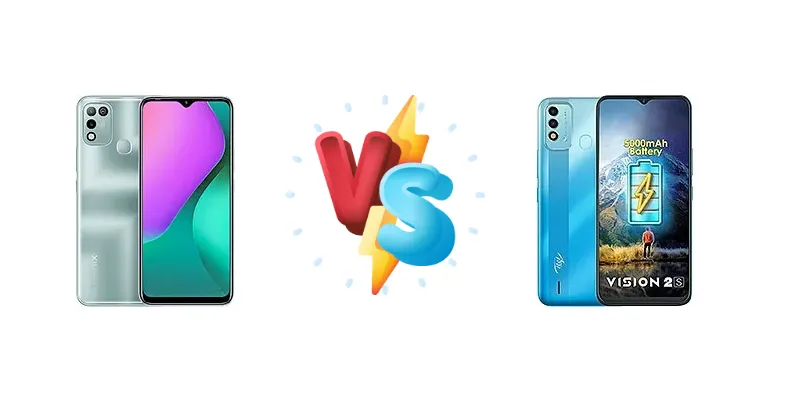
The sub-$100 smartphone market is fiercely competitive, and the Infinix Smart 5 (India) and itel Vision 2S represent two compelling options. While both aim to deliver essential smartphone functionality at an accessible price, they take different approaches to achieving this. The Smart 5 prioritizes a newer, albeit entry-level, MediaTek chipset, while the Vision 2S focuses on faster charging capabilities despite utilizing an older Unisoc processor.
🏆 Quick Verdict
For the average user prioritizing quick top-ups and minimizing downtime, the itel Vision 2S is the better choice. Its 18W charging significantly outperforms the Infinix Smart 5’s 10W, offsetting the performance difference from the older Unisoc chipset. However, users focused on slightly better sustained performance for light gaming may lean towards the Infinix.
| Network |
|---|
| 2G bands | GSM 850 / 900 / 1800 / 1900 | GSM 850 / 900 / 1800 / 1900 |
| 3G bands | HSDPA 850 / 900 / 2100 | HSDPA 850 / 900 / 2100 |
| 4G bands | 1, 3, 5, 8, 38, 40, 41 | LTE |
| Speed | HSPA, LTE | HSPA, LTE |
| Technology | GSM / HSPA / LTE | GSM / HSPA / LTE |
| Launch |
|---|
| Announced | 2021, February 11 | 2021 |
| Status | Available. Released 2021, February 18 | Available. Released 2021 |
| Body |
|---|
| Build | Glass front, plastic back, plastic frame | - |
| Dimensions | 171.8 x 78 x 8.9 mm (6.76 x 3.07 x 0.35 in) | 166 x 76.3 x 8.9 mm (6.54 x 3.00 x 0.35 in) |
| SIM | Nano-SIM + Nano-SIM | Dual SIM |
| Weight | 207 g (7.30 oz) | - |
| Display |
|---|
| Resolution | 720 x 1640 pixels (~263 ppi density) | 720 x 1600 pixels, 20:9 ratio (~269 ppi density) |
| Size | 6.82 inches, 110.5 cm2 (~82.4% screen-to-body ratio) | 6.52 inches, 102.6 cm2 (~81.0% screen-to-body ratio) |
| Type | IPS LCD, 440 nits (typ) | IPS LCD |
| Platform |
|---|
| CPU | Octa-core (4x2.0 GHz Cortex-A53 & 4x1.5 GHz Cortex-A53) | Octa-core (4x1.6 GHz Cortex-A55 & 4x1.2 GHz Cortex-A55) |
| Chipset | Mediatek MT6762G Helio G25 (12 nm) | Unisoc SC9863A (28 nm) |
| GPU | PowerVR GE8320 | IMG8322 |
| OS | Android 10 (Go edition), XOS 7 | Android 11 (Go edition) |
| Memory |
|---|
| Card slot | microSDXC (dedicated slot) | microSDXC |
| Internal | 32GB 2GB RAM | 32GB 2GB RAM |
| | eMMC 5.1 | - |
| Main Camera |
|---|
| Dual | 13 MP, f/1.8, (wide), 1/3.1", 1.12µm, AF
Auxiliary lens | 8 MP
0.3 MP |
| Features | Quad-LED flash, panorama, HDR | LED flash |
| Single | 8 MP, f/2.0, (wide) | - |
| Video | 1080p@30fps | 1080p@30fps |
| Selfie camera |
|---|
| Features | LED flash | - |
| Single | 8 MP, f/2.0, (wide) | 5 MP |
| Video | 1080p@30fps | Yes |
| Sound |
|---|
| 3.5mm jack | Yes | - |
| 35mm jack | Yes | Yes |
| Loudspeaker | Yes | Yes |
| Comms |
|---|
| Bluetooth | 5.0, A2DP, LE | Yes |
| NFC | No | No |
| Positioning | GPS | GPS |
| Radio | FM radio | Unspecified |
| USB | microUSB 2.0 | microUSB |
| WLAN | Wi-Fi 802.11 a/b/g/n, Wi-Fi Direct | Yes |
| Features |
|---|
| Sensors | Fingerprint (rear-mounted), accelerometer, gyro, proximity, compass | Fingerprint (rear-mounted), accelerometer |
| Battery |
|---|
| Charging | 10W wired | 18W wired |
| Type | 6000 mAh | 5000 mAh |
| Misc |
|---|
| Colors | Aegean Blue, Morandi Green, Obsidian Black, Purple | Gradation Purple, Gradation Blue, Deep Blue |
| Models | X688C | - |
| Price | About 80 EUR | - |
| SAR | 0.25 W/kg (head) 0.56 W/kg (body) | - |
Infinix Smart 5 (India)
- Slightly more powerful CPU for basic tasks
- More efficient 12nm chipset
- Potentially better sustained performance
- Significantly slower 10W charging
- Older Unisoc chipset is less power efficient
- Likely similar camera performance to itel Vision 2S
itel Vision 2S
- Faster 18W charging for quick top-ups
- More efficient Cortex-A55 cores
- Potentially longer battery life due to efficient cores
- Less powerful CPU compared to Infinix Smart 5
- Older 28nm manufacturing process
- Likely similar camera performance to Infinix Smart 5
Display Comparison
Neither device boasts a standout display. Both are likely to feature LCD panels, typical for this price bracket. The key difference lies under the hood. Without specific display specs, we can infer that both will likely target a 720p+ resolution. The focus here isn't on visual fidelity, but on basic usability. Bezels are expected to be substantial on both devices, maximizing screen real estate within a budget.
Camera Comparison
Camera performance is unlikely to be a strong suit for either device. Without detailed sensor information, it's safe to assume both will feature a primary camera alongside auxiliary lenses of limited utility. The focus should be on adequate performance in good lighting conditions. Image processing will likely be basic, prioritizing speed over detail. The absence of Optical Image Stabilization (OIS) on either device means low-light photography will be challenging.
Performance
The core difference lies in the chipsets. The Infinix Smart 5’s MediaTek Helio G25 (12nm) utilizes newer Cortex-A53 cores clocked at 2.0 GHz and 1.5 GHz, offering a theoretical performance advantage over the itel Vision 2S’s Unisoc SC9863A (28nm). The Unisoc chip uses Cortex-A55 cores, which are more efficient, but clocked lower at 1.6 GHz and 1.2 GHz. The 12nm process node of the Helio G25 is significantly more efficient than the 28nm node of the Unisoc, suggesting better thermal management and potentially longer sustained performance. However, the real-world difference will be minimal for everyday tasks. The older manufacturing process of the Unisoc chip will likely result in higher power consumption for similar workloads.
Battery Life
The itel Vision 2S’s 18W charging is the standout feature here. While battery capacity isn’t specified, the faster charging speed will significantly reduce the time spent tethered to a wall outlet. The Infinix Smart 5’s 10W charging is comparatively slow, requiring considerably longer to reach a full charge. This difference is crucial for users who prioritize convenience and quick power boosts. The more efficient 12nm process of the Helio G25 in the Infinix Smart 5 *may* partially offset the slower charging, leading to slightly better overall battery life, but the 18W charging of the itel Vision 2S is a more impactful benefit.
Buying Guide
Buy the Infinix Smart 5 (India) if you need a phone for basic tasks like calling, messaging, and light social media use, and you occasionally play less demanding mobile games. The Helio G25 offers a slight edge in CPU performance. Buy the itel Vision 2S if you prefer a phone that can be quickly charged, minimizing downtime and ensuring you're always connected, even if it means a small trade-off in raw processing power. This is ideal for users who rely heavily on their phone throughout the day and don't have consistent access to a charger.
Frequently Asked Questions
❓ Will the Unisoc SC9863A in the itel Vision 2S struggle with multitasking?
The Unisoc SC9863A is an entry-level chipset, so heavy multitasking with numerous apps open simultaneously may result in slowdowns. However, for basic tasks like switching between messaging, calling, and light browsing, it should perform adequately. Managing app usage and closing unused applications will help maintain smooth performance.
❓ How long does it realistically take to fully charge the Infinix Smart 5 with its 10W charger?
Given the 10W charging rate and assuming a typical battery capacity for this segment (around 4000-5000mAh), a full charge from 0% to 100% on the Infinix Smart 5 will likely take between 3 to 4 hours. This is a significant amount of downtime compared to the itel Vision 2S.
❓ Is the difference in CPU architecture (Cortex-A53 vs A55) noticeable in everyday use?
While Cortex-A55 cores are more efficient, the clock speed difference and the older manufacturing process of the Unisoc chip mean the real-world difference in everyday use will be minimal. Both phones are designed for basic tasks, and the performance gap won't be readily apparent during typical usage scenarios.