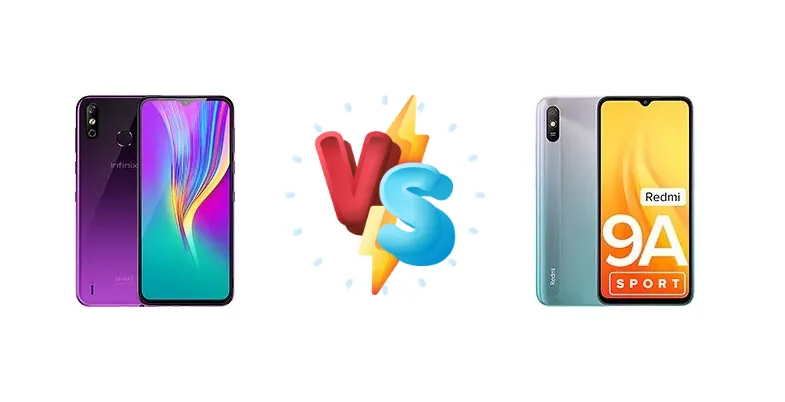
The sub-$100 smartphone market is fiercely competitive. Both the Infinix Smart 4 and Xiaomi Redmi 9A Sport aim to deliver essential smartphone functionality at an incredibly accessible price point. However, a closer look at their core components reveals a significant difference in processing power, impacting everyday usability and potential for light gaming.
🏆 Quick Verdict
For most users, the Xiaomi Redmi 9A Sport is the better choice. Its MediaTek Helio G25 chipset, featuring an octa-core CPU, provides a noticeable performance boost over the Infinix Smart 4’s Helio A22, making it more responsive for multitasking and app loading. While both offer similar battery life, the Redmi 9A Sport’s faster charging is a welcome addition.
| Network |
|---|
| 2G bands | GSM 850 / 900 / 1800 / 1900 | GSM 850 / 900 / 1800 / 1900 |
| 3G bands | HSDPA 850 / 900 / 2100 | HSDPA 850 / 900 / 2100 |
| 4G bands | 1, 3, 5, 8, 38, 40, 41 | 1, 3, 5, 8, 40, 41 |
| Speed | HSPA 21.1/5.76 Mbps, LTE Cat4 150/50 Mbps | HSPA, LTE |
| Technology | GSM / HSPA / LTE | GSM / HSPA / LTE |
| Launch |
|---|
| Announced | 2019, October. Released 2019, October | 2021, September 28 |
| Status | Discontinued | Available. Released 2021, September 28 |
| Body |
|---|
| Build | Glass front, plastic back, plastic frame | - |
| Dimensions | 167 x 76 x 8.3 mm (6.57 x 2.99 x 0.33 in) | 164.9 x 77.1 x 9 mm (6.49 x 3.04 x 0.35 in) |
| SIM | Nano-SIM + Nano-SIM | Nano-SIM + Nano-SIM |
| Weight | 183 g (6.46 oz) | 194 g (6.84 oz) |
| | - | Water-repellent coating |
| Display |
|---|
| Resolution | 720 x 1600 pixels, 20:9 ratio (~266 ppi density) | 720 x 1600 pixels, 20:9 ratio (~269 ppi density) |
| Size | 6.6 inches, 105.2 cm2 (~82.9% screen-to-body ratio) | 6.53 inches, 102.9 cm2 (~81.0% screen-to-body ratio) |
| Type | IPS LCD | IPS LCD, 400 nits (typ) |
| Platform |
|---|
| CPU | Quad-core 2.0 GHz Cortex-A53 | Octa-core (4x2.0 GHz Cortex-A53 & 4x1.5 GHz Cortex-A53) |
| Chipset | Mediatek MT6761 Helio A22 (12 nm) | Mediatek MT6762G Helio G25 (12 nm) |
| GPU | PowerVR GE8320 | PowerVR GE8320 |
| OS | Android 9.0 Pie (Go edition) | Android 10, MIUI 12 |
| Memory |
|---|
| Card slot | microSDXC (dedicated slot) | microSDXC (dedicated slot) |
| Internal | 16GB 1GB RAM, 32GB 2GB RAM | 32GB 2GB RAM, 32GB 3GB RAM |
| | eMMC 5.1 | eMMC 5.1 |
| Main Camera |
|---|
| Features | Dual-LED flash | LED flash, HDR |
| Single | 8 MP | 13 MP, f/2.2, 28mm (wide), 1.0µm, PDAF |
| Video | 1080p@30fps | 1080p@30/60fps |
| Selfie camera |
|---|
| Features | - | HDR |
| Single | 5 MP | 5 MP, f/2.2, (wide), 1.12µm |
| Video | 1080p@30fps | 1080p@30fps |
| Sound |
|---|
| 3.5mm jack | Yes | Yes |
| 35mm jack | Yes | Yes |
| Loudspeaker | Yes | Yes |
| Comms |
|---|
| Bluetooth | 5.0, A2DP, LE | 5.0, A2DP, LE |
| NFC | No | No |
| Positioning | GPS | GPS, GLONASS, BDS |
| Radio | FM radio | FM radio |
| USB | microUSB 2.0 | microUSB 2.0, OTG |
| WLAN | Wi-Fi 802.11 a/b/g/n | Wi-Fi 802.11 a/b/g/n, Wi-Fi Direct |
| Features |
|---|
| Sensors | Fingerprint (rear-mounted), accelerometer, proximity, compass | Accelerometer, proximity |
| Battery |
|---|
| Charging | - | 10W wired |
| Type | 4000 mAh, non-removable | Li-Po 5000 mAh |
| Misc |
|---|
| Colors | Midnight Black, Quetzal Cyan, Cosmic Purple | Carbon Black, Coral Green, Metallic Blue |
| Models | X653, X663 | - |
| Price | - | About 100 EUR |
Infinix Smart 4
- Potentially lower price point
- Simple and easy-to-use interface
- Decent battery life for basic usage
- Significantly slower performance
- Limited multitasking capabilities
- Unspecified charging speed
Xiaomi Redmi 9A Sport
- Faster and more responsive performance
- Octa-core processor for smoother multitasking
- 10W wired charging for quicker top-ups
- Slightly higher price
- Camera quality likely similar to the Smart 4
- Still an entry-level device with limitations
Display Comparison
Neither device boasts a standout display. Both likely utilize LCD panels, typical for this price bracket. Specifics like brightness and color accuracy are not provided, but we can assume they are adequate for indoor use. The focus here isn't on visual fidelity, but on basic readability. Bezels are likely to be substantial on both, maximizing screen real estate within a compact form factor.
Camera Comparison
Camera performance is likely to be similar, with both devices featuring basic camera setups. Without sensor size or aperture information, it’s difficult to make a definitive judgment. However, the inclusion of a dedicated 'Sport' variant in the Redmi 9A suggests a slight emphasis on capturing action shots, potentially with improved image stabilization. The prevalence of 2MP macro lenses on both devices suggests limited utility; these sensors typically produce low-quality images and are more of a marketing feature than a practical benefit.
Performance
The core difference lies in the chipset. The Xiaomi Redmi 9A Sport’s MediaTek Helio G25 is a significant upgrade over the Infinix Smart 4’s Helio A22. The G25’s octa-core configuration (4x2.0 GHz Cortex-A53 & 4x1.5 GHz Cortex-A53) allows for parallel processing, resulting in smoother multitasking and faster app launch times. The Smart 4’s quad-core 2.0 GHz Cortex-A53 CPU will struggle with more demanding tasks. While both are built on a 12nm process, the architectural advantage of the G25 is clear. This translates to a more responsive experience for users who frequently switch between apps or use social media.
Battery Life
Both phones likely feature similar battery capacities, typical for this segment (around 5000mAh is common). However, the Redmi 9A Sport benefits from 10W wired charging, while the Smart 4’s charging speed is unspecified. This means the Redmi 9A Sport will recharge significantly faster, reducing downtime and improving overall usability. While both should provide all-day battery life with moderate use, the faster charging is a tangible advantage for the Redmi 9A Sport.
Buying Guide
Buy the Infinix Smart 4 if your primary need is a basic, reliable phone for calls, texts, and extremely light app usage, and you prioritize minimizing cost above all else. Buy the Xiaomi Redmi 9A Sport if you want a more fluid user experience, the ability to handle multiple apps simultaneously, and a slightly faster charging speed, even if it means spending a little more.
Frequently Asked Questions
❓ Will the Redmi 9A Sport handle popular games like PUBG Mobile?
While the Helio G25 is a gaming-focused chip, PUBG Mobile will likely need to be played on low settings to maintain a playable frame rate. The Smart 4’s Helio A22 will struggle significantly with even the lowest settings.
❓ How much faster is the Redmi 9A Sport in real-world use compared to the Smart 4?
The Redmi 9A Sport will feel noticeably snappier when opening apps, switching between them, and browsing the web. The octa-core processor allows for smoother multitasking, preventing the lag that users might experience on the Smart 4.
❓ Does the Redmi 9A Sport support fast charging beyond 10W?
No, the Redmi 9A Sport is limited to 10W wired charging. While not 'fast' by modern standards, it's still faster than the unspecified charging speed of the Infinix Smart 4.
❓ Is the difference in performance between these phones worth the extra cost?
For users who primarily use their phone for basic tasks, the difference may not be significant. However, for anyone who wants a more responsive and enjoyable user experience, the Redmi 9A Sport’s performance advantage is well worth the extra investment.