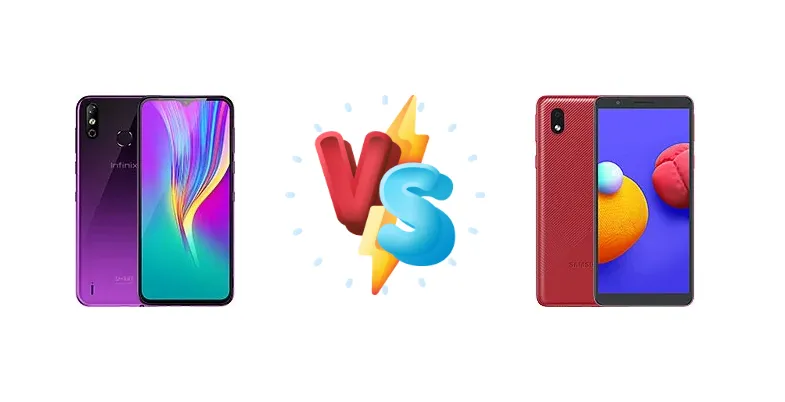
The Infinix Smart 4 and Samsung Galaxy A01 Core represent the absolute bottom end of the smartphone market, targeting first-time buyers or those needing a very basic secondary device. Both aim for affordability, but significant differences in their underlying hardware dictate a clear performance gap. This comparison dissects those differences to determine which offers the best value.
🏆 Quick Verdict
For the average user, the Infinix Smart 4 emerges as the better choice. Its Mediatek Helio A22 chipset, built on a more modern 12nm process, delivers noticeably improved performance compared to the Galaxy A01 Core’s older 28nm MT6739, making it more responsive for everyday tasks.
| Network |
|---|
| 2G bands | GSM 850 / 900 / 1800 / 1900 | GSM 850 / 900 / 1800 / 1900 |
| 3G bands | HSDPA 850 / 900 / 2100 | HSDPA 850 / 900 / 2100 |
| 4G bands | 1, 3, 5, 8, 38, 40, 41 | 1, 3, 5, 7, 8, 20, 28, 38, 40, 41 |
| Speed | HSPA 21.1/5.76 Mbps, LTE Cat4 150/50 Mbps | HSPA 21.1/5.76 Mbps, LTE |
| Technology | GSM / HSPA / LTE | GSM / HSPA / LTE |
| Launch |
|---|
| Announced | 2019, October. Released 2019, October | 2020, July 21. Released 2020, August 06 |
| Status | Discontinued | Discontinued |
| Body |
|---|
| Build | Glass front, plastic back, plastic frame | Plastic back, plastic frame |
| Dimensions | 167 x 76 x 8.3 mm (6.57 x 2.99 x 0.33 in) | 141.7 x 67.5 x 8.6 mm (5.58 x 2.66 x 0.34 in) |
| SIM | Nano-SIM + Nano-SIM | · Nano-SIM· Nano-SIM + Nano-SIM |
| Weight | 183 g (6.46 oz) | 150 g (5.29 oz) |
| Display |
|---|
| Resolution | 720 x 1600 pixels, 20:9 ratio (~266 ppi density) | 720 x 1480 pixels, 18.5:9 ratio (~311 ppi density) |
| Size | 6.6 inches, 105.2 cm2 (~82.9% screen-to-body ratio) | 5.3 inches, 71.3 cm2 (~74.5% screen-to-body ratio) |
| Type | IPS LCD | PLS LCD |
| Platform |
|---|
| CPU | Quad-core 2.0 GHz Cortex-A53 | Quad-core 1.5 GHz Cortex-A53 |
| Chipset | Mediatek MT6761 Helio A22 (12 nm) | Mediatek MT6739 (28 nm) |
| GPU | PowerVR GE8320 | PowerVR GE8100 |
| OS | Android 9.0 Pie (Go edition) | Android 10 (Go edition) |
| Memory |
|---|
| Card slot | microSDXC (dedicated slot) | microSDXC (dedicated slot) |
| Internal | 16GB 1GB RAM, 32GB 2GB RAM | 16GB 1GB RAM, 16GB 2GB RAM, 32GB 2GB RAM |
| | eMMC 5.1 | eMMC 5.1 |
| Main Camera |
|---|
| Features | Dual-LED flash | LED flash |
| Single | 8 MP | 8 MP, f/2.2, AF |
| Video | 1080p@30fps | 1080p@30fps |
| Selfie camera |
|---|
| Single | 5 MP | 5 MP, f/2.4 |
| Video | 1080p@30fps | - |
| Sound |
|---|
| 3.5mm jack | Yes | Yes |
| 35mm jack | Yes | Yes |
| Loudspeaker | Yes | Yes |
| Comms |
|---|
| Bluetooth | 5.0, A2DP, LE | 5.0, A2DP, LE |
| NFC | No | No |
| Positioning | GPS | GPS |
| Radio | FM radio | FM radio |
| USB | microUSB 2.0 | microUSB 2.0 |
| WLAN | Wi-Fi 802.11 a/b/g/n | Wi-Fi 802.11 b/g/n, Wi-Fi Direct |
| Features |
|---|
| Sensors | Fingerprint (rear-mounted), accelerometer, proximity, compass | Accelerometer |
| Battery |
|---|
| Type | 4000 mAh, non-removable | Li-Ion 3000 mAh |
| Misc |
|---|
| Colors | Midnight Black, Quetzal Cyan, Cosmic Purple | Black, Blue, Red |
| Models | X653, X663 | SM-A013F, SM-A013F/DS, SM-A013G, SM-A013G/DS, SM-A013M |
| Price | - | About 150 EUR |
| SAR EU | - | 0.64 W/kg (head) 1.18 W/kg (body) |
Infinix Smart 4
- More powerful and efficient Helio A22 chipset
- 12nm fabrication process for better battery life
- Higher CPU clock speed for improved responsiveness
- Likely similar display quality to the A01 Core
- Camera performance likely limited by budget sensors
Samsung Galaxy A01 Core
- Samsung brand recognition
- Potentially simpler software experience (depending on region)
- May be slightly cheaper in some markets
- Older and less efficient MT6739 chipset
- 28nm fabrication process leads to lower battery life
- Noticeably slower performance compared to the Smart 4
Display Comparison
Neither device boasts a standout display. Both likely utilize LCD panels, and specific details like resolution and brightness are not provided. However, the focus here is on the chipset's ability to drive the display smoothly. The A22 in the Smart 4 has a slight advantage in GPU performance, potentially leading to marginally smoother scrolling and animations, though this will be limited by the overall system resources.
Camera Comparison
Both phones likely feature basic camera setups, and detailed sensor information is unavailable. Given the market segment, image quality will be limited. It's safe to assume both rely heavily on software processing to enhance images. Without specific sensor details, it’s difficult to declare a clear winner, but the slightly more powerful GPU in the Smart 4 *could* contribute to marginally faster image processing times. Expect both to struggle in low-light conditions.
Performance
The core difference lies in the chipsets. The Infinix Smart 4’s Mediatek Helio A22 (12nm) features a quad-core 2.0 GHz Cortex-A53 CPU. This is a significant upgrade over the Samsung Galaxy A01 Core’s Mediatek MT6739 (28nm) with its quad-core 1.5 GHz Cortex-A53 CPU. The 12nm fabrication process of the Helio A22 is far more efficient, resulting in better power management and less heat generation under load. This translates to sustained performance and reduced throttling. The higher clock speed further contributes to faster application loading and overall responsiveness. The MT6739’s older 28nm process is less efficient, leading to more heat and potential performance drops during extended use.
Battery Life
Battery capacity details are missing for both devices. However, the more efficient 12nm Helio A22 in the Infinix Smart 4 will likely result in better battery life, even with a similar capacity battery to the Galaxy A01 Core. The MT6739’s 28nm process consumes more power, reducing overall runtime. Charging wattage is also unknown, but the efficiency gain of the A22 will be more impactful than a minor difference in charging speed.
Buying Guide
Buy the Infinix Smart 4 if you prioritize responsiveness and a slightly smoother user experience, even within the constraints of Android Go. It’s the better option for those who occasionally use social media or light web browsing. Buy the Samsung Galaxy A01 Core if brand recognition and a potentially simpler software experience are paramount, and your usage is *extremely* limited to basic calling and messaging. Be prepared for noticeable lag with even moderate multitasking.
Frequently Asked Questions
❓ Will the Samsung Galaxy A01 Core struggle with WhatsApp and Facebook?
Yes, the MT6739 chipset in the Galaxy A01 Core is likely to exhibit noticeable lag when running apps like WhatsApp and Facebook, especially with multiple chats or tabs open. The Infinix Smart 4’s Helio A22 will handle these tasks more smoothly, though still not flawlessly.
❓ Is the performance difference between the Helio A22 and MT6739 noticeable in everyday use?
Absolutely. The Helio A22’s faster CPU clock speed and more efficient 12nm process translate to quicker app loading times, smoother scrolling, and a more responsive overall experience. The MT6739 will feel sluggish in comparison, particularly when multitasking.
❓ Can either of these phones handle basic mobile gaming?
Both phones can handle *very* basic 2D games. However, demanding 3D games will likely be unplayable or suffer from extremely low frame rates. The Helio A22 in the Smart 4 will offer a slightly better gaming experience, but don't expect anything beyond casual gaming.