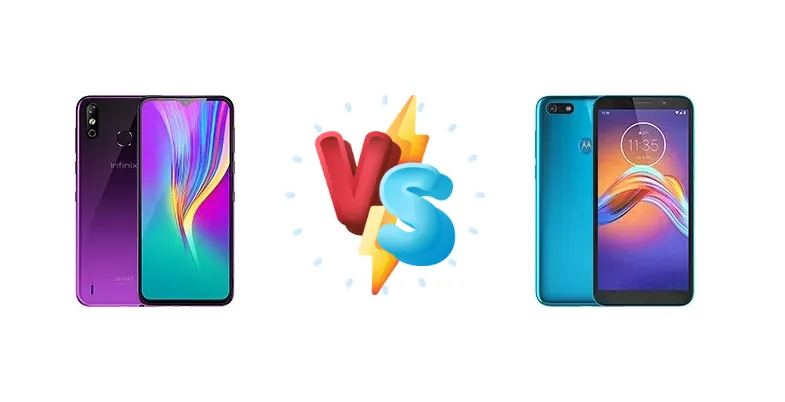
The Infinix Smart 4 and Motorola Moto E6 Play represent the extreme end of the smartphone price spectrum. Both aim to deliver essential smartphone functionality at a remarkably low cost, but they achieve this with significantly different hardware. This comparison dissects those differences, focusing on how the chipset choices impact real-world performance and usability.
🏆 Quick Verdict
For the average user prioritizing responsiveness and a smoother experience, the Infinix Smart 4 emerges as the better choice. Its newer Mediatek Helio A22 chipset, built on a 12nm process, provides a noticeable performance advantage over the Moto E6 Play’s older, 28nm Mediatek MT6739, despite the slightly lower clock speed.
| Network |
|---|
| 2G bands | GSM 850 / 900 / 1800 / 1900 | GSM 850 / 900 / 1800 / 1900 |
| 3G bands | HSDPA 850 / 900 / 2100 | HSDPA 850 / 900 / 1900 / 2100 |
| 4G bands | 1, 3, 5, 8, 38, 40, 41 | 1, 3, 5, 7, 8, 20, 38, 40, 41 |
| Speed | HSPA 21.1/5.76 Mbps, LTE Cat4 150/50 Mbps | HSPA, LTE |
| Technology | GSM / HSPA / LTE | GSM / HSPA / LTE |
| Launch |
|---|
| Announced | 2019, October. Released 2019, October | 2019, October. Released 2019, November |
| Status | Discontinued | Discontinued |
| Body |
|---|
| Build | Glass front, plastic back, plastic frame | Glass front, plastic back, plastic frame |
| Dimensions | 167 x 76 x 8.3 mm (6.57 x 2.99 x 0.33 in) | 146.5 x 70.9 x 8.3 mm (5.77 x 2.79 x 0.33 in) |
| SIM | Nano-SIM + Nano-SIM | Nano-SIM + Nano-SIM |
| Weight | 183 g (6.46 oz) | 140 g (4.94 oz) |
| Display |
|---|
| Resolution | 720 x 1600 pixels, 20:9 ratio (~266 ppi density) | 720 x 1440 pixels, 18:9 ratio (~295 ppi density) |
| Size | 6.6 inches, 105.2 cm2 (~82.9% screen-to-body ratio) | 5.5 inches, 77.0 cm2 (~74.1% screen-to-body ratio) |
| Type | IPS LCD | IPS LCD |
| Platform |
|---|
| CPU | Quad-core 2.0 GHz Cortex-A53 | Quad-core 1.5 GHz Cortex-A53 |
| Chipset | Mediatek MT6761 Helio A22 (12 nm) | Mediatek MT6739 (28 nm) |
| GPU | PowerVR GE8320 | PowerVR GE8100 |
| OS | Android 9.0 Pie (Go edition) | Android 9.0 (Pie) |
| Memory |
|---|
| Card slot | microSDXC (dedicated slot) | microSDXC (dedicated slot) |
| Internal | 16GB 1GB RAM, 32GB 2GB RAM | 32GB 2GB RAM |
| | eMMC 5.1 | eMMC 5.1 |
| Main Camera |
|---|
| Features | Dual-LED flash | LED flash, HDR, panorama |
| Single | 8 MP | 13 MP, f/2.2, 1/3.1", 1.12µm, PDAF |
| Video | 1080p@30fps | 1080p@30fps |
| Selfie camera |
|---|
| Features | - | HDR |
| Single | 5 MP | 5 MP, f/2.2, 1/5.0", 1.12µm |
| Video | 1080p@30fps | 1080p@30fps |
| Sound |
|---|
| 3.5mm jack | Yes | Yes |
| 35mm jack | Yes | Yes |
| Loudspeaker | Yes | Yes |
| Comms |
|---|
| Bluetooth | 5.0, A2DP, LE | 4.2, A2DP, LE |
| NFC | No | No |
| Positioning | GPS | GPS, GLONASS |
| Radio | FM radio | FM radio |
| USB | microUSB 2.0 | microUSB 2.0, OTG |
| WLAN | Wi-Fi 802.11 a/b/g/n | Wi-Fi 802.11 b/g/n |
| Features |
|---|
| Sensors | Fingerprint (rear-mounted), accelerometer, proximity, compass | Fingerprint (rear-mounted), accelerometer, proximity |
| Battery |
|---|
| Type | 4000 mAh, non-removable | Li-Po 3000 mAh, non-removable |
| Misc |
|---|
| Colors | Midnight Black, Quetzal Cyan, Cosmic Purple | Turquoise Blue, Anthracite |
| Models | X653, X663 | XT2029, XT2029-1 |
| Price | - | About 160 EUR |
| SAR EU | - | 0.55 W/kg (head) 1.78 W/kg (body) |
Infinix Smart 4
- More efficient chipset (Helio A22)
- Potentially better sustained performance
- Likely longer battery life
- Brand recognition is lower than Motorola
- Software updates may be less frequent
Motorola Moto E6 Play
- Established brand reputation (Motorola)
- Potentially cleaner software experience
- Wider availability in some markets
- Less powerful and efficient chipset (MT6739)
- Slower performance and potential for throttling
- Shorter battery life
Display Comparison
Neither device boasts a standout display. Both likely feature LCD panels with resolutions around 720x1440, typical for this price point. However, display quality beyond resolution isn't specified. The focus here is on the internal hardware, as display differences are likely minimal and unquantifiable without direct testing. Bezels are expected to be substantial on both devices, maximizing screen real estate within a compact form factor.
Camera Comparison
Camera performance on both devices is expected to be basic. Details are lacking, but both likely feature a primary camera and potentially a secondary depth sensor. The absence of specific sensor sizes or apertures makes a direct comparison difficult. However, the chipset’s image signal processor (ISP) plays a crucial role, and the Helio A22’s newer architecture likely offers slightly better image processing capabilities than the MT6739. Expect acceptable results in good lighting conditions, but struggles in low light.
Performance
The core difference lies in the chipsets. The Infinix Smart 4’s Mediatek Helio A22 (12nm) is a significant upgrade over the Motorola Moto E6 Play’s Mediatek MT6739 (28nm). The 12nm fabrication process is far more efficient, meaning the Helio A22 consumes less power for the same level of performance, and generates less heat. While the MT6739 has a slightly higher clock speed (1.5 GHz vs 2.0 GHz), the architectural improvements and process node of the Helio A22 translate to a more fluid user experience. The Cortex-A53 cores are identical in both, but the A22’s efficiency allows for sustained performance without significant throttling. This impacts app loading times, multitasking, and overall system responsiveness.
Battery Life
Battery capacity isn't specified for either device, but both likely house batteries in the 3000-4000 mAh range. The Infinix Smart 4’s more efficient Helio A22 chipset will translate to longer battery life in real-world usage. The 12nm process reduces power consumption, allowing the phone to operate for a longer duration on a single charge. While charging wattage is unknown for both, the efficiency gains of the A22 will also mean faster charging times from the same power adapter.
Buying Guide
Buy the Infinix Smart 4 if you need a phone that feels reasonably responsive for basic tasks like messaging, social media, and light web browsing. Its more efficient chipset also suggests better long-term performance as software updates roll out. Buy the Motorola Moto E6 Play if you prioritize brand recognition and a potentially simpler, more streamlined software experience, understanding that you’ll be making a trade-off in processing power and efficiency.
Frequently Asked Questions
❓ Will the Infinix Smart 4 struggle with popular apps like WhatsApp and Facebook?
While not a powerhouse, the Helio A22 chipset in the Infinix Smart 4 is sufficient for running essential apps like WhatsApp and Facebook smoothly. The 12nm process helps maintain performance even with multiple apps open, unlike the Moto E6 Play which may exhibit noticeable lag.
❓ Is the Motorola Moto E6 Play a good choice for someone who primarily makes phone calls and sends texts?
Yes, the Moto E6 Play is perfectly adequate for basic communication tasks like calls and texts. However, the slower processor may result in slightly longer app loading times and a less responsive user interface compared to the Infinix Smart 4, even for these simple functions.
❓ Can either of these phones handle basic mobile gaming?
Both phones can handle very basic 2D games. However, demanding 3D games will likely be unplayable or suffer from significant frame rate drops. The Infinix Smart 4’s Helio A22 will offer a slightly better gaming experience due to its more efficient architecture, but don’t expect high performance.