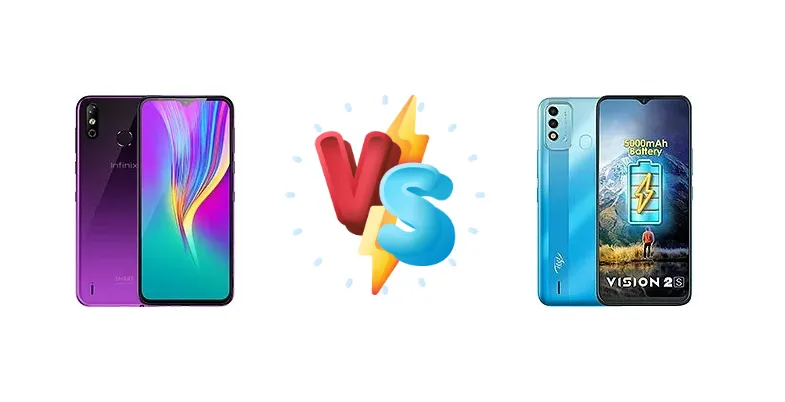
The Infinix Smart 4 and itel Vision 2S represent the extreme end of the budget smartphone market, targeting first-time smartphone buyers or those needing a reliable secondary device. While both aim for affordability, they take different approaches to hardware, particularly in their chipset choices. This comparison dissects those differences to determine which phone delivers the best experience for the price.
🏆 Quick Verdict
For the average user prioritizing multitasking and a slightly smoother experience, the itel Vision 2S emerges as the better choice. Its octa-core Unisoc SC9863A chipset, despite being built on a less efficient 28nm process, offers a performance advantage over the quad-core Mediatek Helio A22 in the Infinix Smart 4, and the inclusion of 18W charging is a significant benefit.
| Network |
|---|
| 2G bands | GSM 850 / 900 / 1800 / 1900 | GSM 850 / 900 / 1800 / 1900 |
| 3G bands | HSDPA 850 / 900 / 2100 | HSDPA 850 / 900 / 2100 |
| 4G bands | 1, 3, 5, 8, 38, 40, 41 | LTE |
| Speed | HSPA 21.1/5.76 Mbps, LTE Cat4 150/50 Mbps | HSPA, LTE |
| Technology | GSM / HSPA / LTE | GSM / HSPA / LTE |
| Launch |
|---|
| Announced | 2019, October. Released 2019, October | 2021 |
| Status | Discontinued | Available. Released 2021 |
| Body |
|---|
| Build | Glass front, plastic back, plastic frame | - |
| Dimensions | 167 x 76 x 8.3 mm (6.57 x 2.99 x 0.33 in) | 166 x 76.3 x 8.9 mm (6.54 x 3.00 x 0.35 in) |
| SIM | Nano-SIM + Nano-SIM | Dual SIM |
| Weight | 183 g (6.46 oz) | - |
| Display |
|---|
| Resolution | 720 x 1600 pixels, 20:9 ratio (~266 ppi density) | 720 x 1600 pixels, 20:9 ratio (~269 ppi density) |
| Size | 6.6 inches, 105.2 cm2 (~82.9% screen-to-body ratio) | 6.52 inches, 102.6 cm2 (~81.0% screen-to-body ratio) |
| Type | IPS LCD | IPS LCD |
| Platform |
|---|
| CPU | Quad-core 2.0 GHz Cortex-A53 | Octa-core (4x1.6 GHz Cortex-A55 & 4x1.2 GHz Cortex-A55) |
| Chipset | Mediatek MT6761 Helio A22 (12 nm) | Unisoc SC9863A (28 nm) |
| GPU | PowerVR GE8320 | IMG8322 |
| OS | Android 9.0 Pie (Go edition) | Android 11 (Go edition) |
| Memory |
|---|
| Card slot | microSDXC (dedicated slot) | microSDXC |
| Internal | 16GB 1GB RAM, 32GB 2GB RAM | 32GB 2GB RAM |
| | eMMC 5.1 | - |
| Main Camera |
|---|
| Dual | - | 8 MP
0.3 MP |
| Features | Dual-LED flash | LED flash |
| Single | 8 MP | - |
| Video | 1080p@30fps | 1080p@30fps |
| Selfie camera |
|---|
| Single | 5 MP | 5 MP |
| Video | 1080p@30fps | Yes |
| Sound |
|---|
| 3.5mm jack | Yes | - |
| 35mm jack | Yes | Yes |
| Loudspeaker | Yes | Yes |
| Comms |
|---|
| Bluetooth | 5.0, A2DP, LE | Yes |
| NFC | No | No |
| Positioning | GPS | GPS |
| Radio | FM radio | Unspecified |
| USB | microUSB 2.0 | microUSB |
| WLAN | Wi-Fi 802.11 a/b/g/n | Yes |
| Features |
|---|
| Sensors | Fingerprint (rear-mounted), accelerometer, proximity, compass | Fingerprint (rear-mounted), accelerometer |
| Battery |
|---|
| Charging | - | 18W wired |
| Type | 4000 mAh, non-removable | 5000 mAh |
| Misc |
|---|
| Colors | Midnight Black, Quetzal Cyan, Cosmic Purple | Gradation Purple, Gradation Blue, Deep Blue |
| Models | X653, X663 | - |
Infinix Smart 4
- Potentially better battery life due to 12nm process
- Simpler user experience for basic tasks
- Lower price point (likely)
- Slower performance with quad-core processor
- Slower charging speeds
- Less capable for multitasking
itel Vision 2S
- Faster performance with octa-core processor
- 18W fast charging support
- Smoother multitasking experience
- Less efficient 28nm process may impact battery life
- Potentially higher price point
- Unisoc chipset may have less software support
Display Comparison
Neither device is expected to boast a high-quality display. Details regarding panel type, resolution, and brightness are not provided, suggesting both utilize basic LCD panels. The focus here is on functionality rather than visual fidelity. Bezels are likely to be substantial on both, reflecting their budget positioning. Color accuracy is unlikely to be a strong point on either device.
Camera Comparison
Camera performance is unlikely to be a key differentiator. Both phones likely feature basic camera setups, and details are scarce. Without sensor size or aperture information, it's difficult to make a meaningful comparison. The presence of a 2MP macro camera on either device is largely a marketing gimmick, offering limited practical benefit due to the small sensor size and low resolution. Image processing will likely be basic on both, prioritizing speed over quality.
Performance
The core difference lies in the chipsets. The Infinix Smart 4’s Mediatek Helio A22 (12nm) features a quad-core Cortex-A53 CPU clocked at 2.0 GHz. This is a relatively older architecture, optimized for power efficiency but limited in raw performance. Conversely, the itel Vision 2S utilizes the Unisoc SC9863A (28nm) with an octa-core configuration – four Cortex-A55 cores at 1.6 GHz and four at 1.2 GHz. While the 28nm process is less efficient, the eight cores provide a significant advantage in multitasking and handling more complex applications. The Cortex-A55 architecture is also more modern and efficient per core than the A53. This translates to a smoother user experience on the itel Vision 2S, particularly when switching between apps or running multiple processes simultaneously. The lack of RAM specifications makes it difficult to assess memory bandwidth, but the chipset difference will be the primary performance bottleneck.
Battery Life
Battery capacity is not specified for either device, but given their budget nature, it's reasonable to assume capacities around 4000-5000 mAh. However, the itel Vision 2S has a clear advantage with its 18W wired charging support. This will significantly reduce charging times compared to the Infinix Smart 4, which likely supports only standard 5W or 10W charging. While the Helio A22’s 12nm process *could* offer slightly better battery life during light use, the convenience of faster charging on the itel Vision 2S is a more impactful benefit for most users.
Buying Guide
Buy the Infinix Smart 4 if you need a phone for extremely basic tasks – calls, texts, and light social media – and prioritize simplicity. Its Mediatek Helio A22 chipset is sufficient for these workloads, and the phone will likely offer slightly better battery life due to the more efficient 12nm process. Buy the itel Vision 2S if you prefer a phone capable of handling more demanding apps, occasional gaming, and appreciate the convenience of faster 18W charging. The octa-core processor provides a noticeable performance boost for everyday use.
Frequently Asked Questions
❓ Will the itel Vision 2S be able to run popular social media apps like Facebook and WhatsApp smoothly?
Yes, the octa-core Unisoc SC9863A processor in the itel Vision 2S is more than capable of running Facebook, WhatsApp, and similar social media applications without significant lag. The additional cores provide headroom for multitasking and ensure a smoother experience compared to the quad-core processor in the Infinix Smart 4.
❓ Is the 18W charging on the itel Vision 2S compatible with any USB charger, or do I need a specific one?
The itel Vision 2S supports 18W charging via the USB-C port. While it *will* charge with a standard 5W or 10W charger, you'll need a charger that specifically supports USB Power Delivery (USB-PD) or Quick Charge (QC) protocols to achieve the full 18W charging speed. Using a compatible charger will significantly reduce charging times.
❓ Can the Infinix Smart 4 handle basic mobile games like Candy Crush or Subway Surfers?
The Infinix Smart 4 can handle very basic mobile games like Candy Crush or Subway Surfers, but don't expect a high-performance gaming experience. The Mediatek Helio A22 processor is limited in its graphical capabilities, and you may encounter frame drops or lag in more demanding games. Lowering the graphics settings within the game can help improve performance.