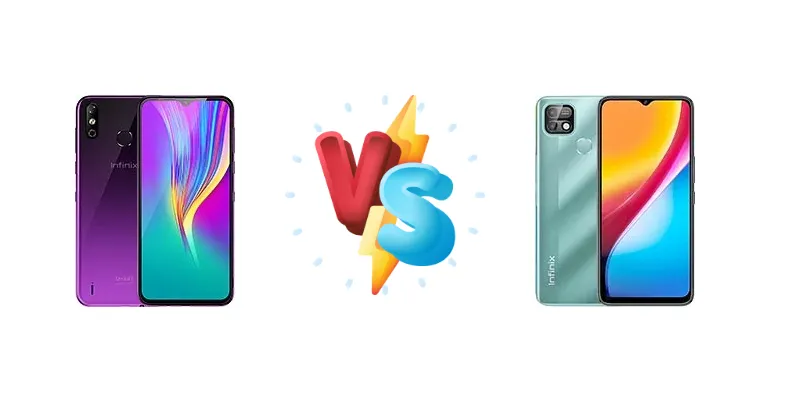
The Infinix Smart series consistently targets the ultra-budget segment, offering essential smartphone functionality at incredibly low price points. The Smart 4 and Smart 5 Pro represent two iterations of this approach, but a significant shift in chipset choice separates them. This comparison dissects the differences between the Mediatek Helio A22-powered Smart 4 and the Unisoc SC9863A-equipped Smart 5 Pro, revealing which device delivers the best value for your money.
🏆 Quick Verdict
For most users, the Infinix Smart 5 Pro is the better choice. While the Smart 4 offers a simpler, potentially more stable software experience, the Smart 5 Pro’s octa-core processor provides a noticeable performance boost in everyday tasks and light multitasking, justifying the slightly higher price.
| Network |
|---|
| 2G bands | GSM 850 / 900 / 1800 / 1900 | GSM 850 / 900 / 1800 / 1900 |
| 3G bands | HSDPA 850 / 900 / 2100 | HSDPA 850 / 900 / 2100 |
| 4G bands | 1, 3, 5, 8, 38, 40, 41 | 1, 3, 5, 8, 38, 40, 41 |
| Speed | HSPA 21.1/5.76 Mbps, LTE Cat4 150/50 Mbps | HSPA 21.1/5.76 Mbps, LTE Cat4 150/50 Mbps |
| Technology | GSM / HSPA / LTE | GSM / HSPA / LTE |
| | - | 1, 2, 3, 4, 5, 7, 8, 20, 28, 38, 41, 40, 66 |
| Launch |
|---|
| Announced | 2019, October. Released 2019, October | 2021, November 17 |
| Status | Discontinued | Available. Released 2021, November 17 |
| Body |
|---|
| Build | Glass front, plastic back, plastic frame | Glass front, plastic back, plastic frame |
| Dimensions | 167 x 76 x 8.3 mm (6.57 x 2.99 x 0.33 in) | 164.4 x 75.6 x 9.5 mm (6.47 x 2.98 x 0.37 in) |
| SIM | Nano-SIM + Nano-SIM | Nano-SIM + Nano-SIM |
| Weight | 183 g (6.46 oz) | - |
| Display |
|---|
| Resolution | 720 x 1600 pixels, 20:9 ratio (~266 ppi density) | 720 x 1600 pixels, 20:9 ratio (~269 ppi density) |
| Size | 6.6 inches, 105.2 cm2 (~82.9% screen-to-body ratio) | 6.52 inches, 102.6 cm2 (~82.6% screen-to-body ratio) |
| Type | IPS LCD | IPS LCD, 500 nits (peak) |
| Platform |
|---|
| CPU | Quad-core 2.0 GHz Cortex-A53 | Octa-core (4x1.6 GHz Cortex-A55 & 4x1.2 GHz Cortex-A55) |
| Chipset | Mediatek MT6761 Helio A22 (12 nm) | Unisoc SC9863A (28 nm) |
| GPU | PowerVR GE8320 | IMG8322 |
| OS | Android 9.0 Pie (Go edition) | Android 11 (Go edition), XOS 7.6 |
| Memory |
|---|
| Card slot | microSDXC (dedicated slot) | microSDXC (dedicated slot) |
| Internal | 16GB 1GB RAM, 32GB 2GB RAM | 32GB 2GB RAM |
| | eMMC 5.1 | eMMC 5.1 |
| Main Camera |
|---|
| Dual | - | 13 MP, f/1.8, AF
Auxiliary lens |
| Features | Dual-LED flash | Quad-LED flash |
| Single | 8 MP | 8 MP |
| Video | 1080p@30fps | 1440p@30fps |
| Selfie camera |
|---|
| Features | - | Dual-LED flash |
| Single | 5 MP | 8 MP |
| Video | 1080p@30fps | 1080p@30fps |
| Sound |
|---|
| 3.5mm jack | Yes | Yes |
| 35mm jack | Yes | Yes |
| Loudspeaker | Yes | Yes |
| Comms |
|---|
| Bluetooth | 5.0, A2DP, LE | 4.2, A2DP |
| NFC | No | No |
| Positioning | GPS | GPS |
| Radio | FM radio | FM radio |
| USB | microUSB 2.0 | microUSB 2.0 |
| WLAN | Wi-Fi 802.11 a/b/g/n | Wi-Fi 802.11 b/g/n |
| Features |
|---|
| Sensors | Fingerprint (rear-mounted), accelerometer, proximity, compass | Fingerprint (rear-mounted), accelerometer, proximity |
| Battery |
|---|
| Charging | - | 10W wired |
| Type | 4000 mAh, non-removable | 6000 mAh |
| Misc |
|---|
| Colors | Midnight Black, Quetzal Cyan, Cosmic Purple | Morandi Green, Heart of Ocean |
| Models | X653, X663 | - |
| Price | - | About 70 EUR |
Infinix Smart 4
- Potentially simpler and more stable software experience.
- More power-efficient chipset (12nm process).
- Lower price point.
- Significantly slower performance in multitasking.
- Less responsive user interface.
- Older processor architecture.
Infinix Smart 5 Pro
- Faster octa-core processor for improved performance.
- More responsive user experience.
- 10W wired charging for quicker top-ups.
- More modern processor architecture (Cortex-A55).
- Less power-efficient chipset (28nm process).
- Potentially shorter battery life under heavy load.
- Slightly higher price.
Display Comparison
Neither device boasts a standout display. Both are likely to feature similar LCD panels with resolutions around 720x1640. However, display quality isn't a key differentiator here, as both target the lowest price bracket. The focus is on functionality, not fidelity. Expect similar viewing angles and color reproduction, with neither offering features like high refresh rates or HDR support.
Camera Comparison
Camera performance is likely to be similar on both devices, with both likely featuring a primary sensor around 8-13MP. The inclusion of a 2MP macro lens on the Smart 5 Pro is largely a marketing gimmick, offering minimal practical benefit. Image processing will be basic on both, relying heavily on software algorithms to enhance photos. Don't expect exceptional low-light performance or detailed images from either device. The Unisoc SC9863A in the Smart 5 Pro *may* offer slightly better image signal processing capabilities, but the difference will be marginal.
Performance
The core difference lies in the chipset. The Infinix Smart 4 utilizes the Mediatek Helio A22, a quad-core processor built on a 12nm process. This is a basic chip designed for minimal power consumption. The Smart 5 Pro, however, steps up to the Unisoc SC9863A, an octa-core processor fabricated on a larger 28nm node. While the 28nm process is less efficient, the eight cores (split into 4x1.6 GHz Cortex-A55 and 4x1.2 GHz Cortex-A55) provide a significant advantage in multi-threaded tasks. This translates to smoother app switching, faster web page loading, and a more responsive user interface on the Smart 5 Pro. The Cortex-A55 architecture in the Smart 5 Pro is also more modern and efficient than the Cortex-A53 in the Smart 4, even accounting for the process node difference.
Battery Life
Both devices likely house batteries in the 4000-5000 mAh range. However, the Smart 5 Pro includes 10W wired charging, while the Smart 4’s charging speed is unspecified but likely slower. The less efficient 28nm process of the Unisoc SC9863A will likely result in slightly shorter battery life on the Smart 5 Pro, but the faster charging can partially offset this. Expect both phones to comfortably last a full day with moderate usage, but heavy users may need to top up the Smart 5 Pro before the end of the day.
Buying Guide
Buy the Infinix Smart 4 if you prioritize absolute simplicity and a potentially longer software support lifespan, and your usage is limited to basic calling, texting, and very light app usage. Buy the Infinix Smart 5 Pro if you want a more responsive experience for social media, web browsing, and occasional gaming, and you appreciate the benefits of an octa-core processor for improved multitasking.
Frequently Asked Questions
❓ Will the Unisoc SC9863A in the Smart 5 Pro struggle with popular apps like WhatsApp and Facebook?
No, the Unisoc SC9863A is perfectly capable of running popular apps like WhatsApp and Facebook smoothly. The octa-core configuration provides ample processing power for these everyday tasks, offering a noticeably more responsive experience compared to the quad-core Helio A22 in the Smart 4.
❓ Is the 10W charging on the Smart 5 Pro a significant improvement over the Smart 4?
While 10W isn't fast charging by modern standards, it's a definite improvement over the likely slower charging speed of the Smart 4. It will reduce the time it takes to fully charge the device, which is particularly useful for users who frequently find themselves needing to top up their battery throughout the day.
❓ Can the Infinix Smart 5 Pro handle light gaming, like casual puzzle games?
Yes, the Smart 5 Pro can handle light gaming, such as puzzle games and simple arcade titles, without significant issues. However, don't expect to play demanding 3D games at high settings; the Unisoc SC9863A is not a gaming-focused processor.
❓ Which phone is likely to receive more software updates?
The Infinix Smart 4, being an older model, may have a shorter software support lifespan. Infinix may prioritize updates for the newer Smart 5 Pro, offering bug fixes and security patches for a longer period. However, given the budget nature of both devices, don't expect major Android version upgrades.