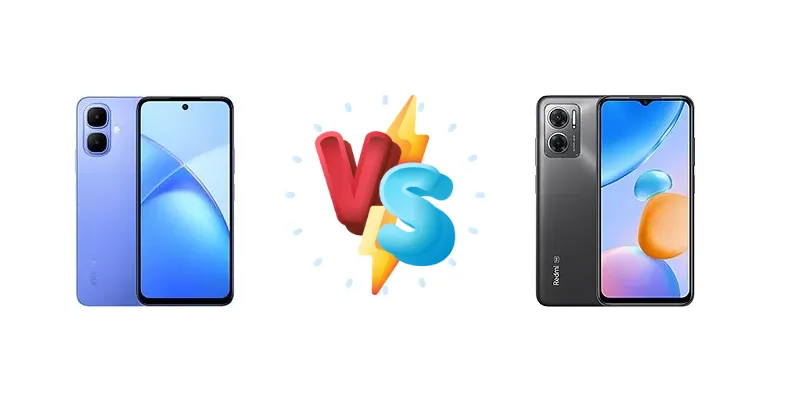
The sub-$200 5G smartphone market is heating up, and the Infinix Smart 10 and Xiaomi Redmi 10 5G are two key contenders. Both aim to deliver 5G connectivity without breaking the bank, but they take different approaches to achieving this. This comparison dives deep into their core components to determine which offers the best overall experience.
🏆 Quick Verdict
For most users, the Xiaomi Redmi 10 5G emerges as the better choice. Its Mediatek Dimensity 700, built on a more efficient 7nm process, provides a noticeable performance advantage over the Infinix Smart 10’s Unisoc T7250, translating to smoother multitasking and gaming. While the Smart 10 offers reverse wired charging, the Redmi 10 5G’s superior processing power makes it the more compelling option.
| Network |
|---|
| 2G bands | GSM 850 / 900 / 1800 / 1900 | GSM 850 / 900 / 1800 / 1900 |
| 3G bands | HSDPA 850 / 900 / 1700(AWS) / 1900 / 2100 | HSDPA 850 / 900 / 1700(AWS) / 1900 / 2100 |
| 4G bands | 1, 2, 3, 4, 5, 7, 8, 20, 28, 38, 40, 41 | 1, 2, 3, 4, 5, 7, 8, 20, 28, 38, 40, 41 |
| 5G bands | - | 1, 3, 5, 7, 8, 20, 28, 38, 40, 41, 77, 78 SA/NSA |
| Speed | HSPA, LTE | HSPA, LTE, 5G |
| Technology | GSM / HSPA / LTE | GSM / HSPA / LTE / 5G |
| Launch |
|---|
| Announced | 2025, June 16 | 2022, March 29 |
| Status | Available. Released 2025, June 16 | Available. Released 2022, September 23 |
| Body |
|---|
| Build | Glass front, plastic back, plastic frame | - |
| Dimensions | 165.6 x 77 x 8.3 mm (6.52 x 3.03 x 0.33 in) | 164 x 76.1 x 8.9 mm (6.46 x 3.00 x 0.35 in) |
| SIM | Nano-SIM + Nano-SIM | Nano-SIM + Nano-SIM |
| Weight | 187 g (6.60 oz) | 200 g (7.05 oz) |
| Display |
|---|
| Protection | - | Corning Gorilla Glass 3 |
| Resolution | 720 x 1600 pixels, 20:9 ratio (~263 ppi density) | 1080 x 2408 pixels, 20:9 ratio (~401 ppi density) |
| Size | 6.67 inches, 107.4 cm2 (~84.2% screen-to-body ratio) | 6.58 inches, 104.3 cm2 (~83.6% screen-to-body ratio) |
| Type | IPS LCD, 120Hz, 700 nits (HBM) | IPS LCD, 90Hz |
| Platform |
|---|
| CPU | Octa-core (2x1.8 GHz Cortex-A75 & 6x1.6 GHz Cortex-A55) | Octa-core (2x2.2 GHz Cortex-A76 & 6x2.0 GHz Cortex-A55) |
| Chipset | Unisoc T7250 (12 nm) | Mediatek Dimensity 700 (7 nm) |
| GPU | Mali-G57 MP1 | Mali-G57 MC2 |
| OS | Android 15/15 (Go edition), XOS 15.1 | Android 12, MIUI 13 |
| Memory |
|---|
| Card slot | microSDXC (dedicated slot) | microSDXC (dedicated slot) |
| Internal | 64GB 3GB RAM, 64GB 4GB RAM, 128GB 4GB RAM, 128GB 6GB RAM, 256GB 4GB RAM, 256GB 8GB RAM | 64GB 4GB RAM, 128GB 4GB RAM, 128GB 6GB RAM |
| | - | UFS 2.2 |
| Main Camera |
|---|
| Dual | - | 50 MP, f/1.8, (wide), PDAF
Auxiliary lens |
| Features | Dual-LED flash, panorama | LED flash, HDR, panorama |
| Single | 8 MP, f/2.0, (wide), 1/4.0", 1.12µm, AF | 5 MP, f/2.2 |
| Video | 1440p@30fps, 1080p@30fps | 1080p@30fps |
| Selfie camera |
|---|
| Features | - | HDR |
| Single | 8 MP, f/2.0, (wide), 1/4.0", 1.12µm | 5 MP, f/2.2 |
| Video | 1440p@30fps, 1080p@30fps | 1080p@30fps |
| Sound |
|---|
| 3.5mm jack | - | Yes |
| 35mm jack | Yes | Yes |
| Loudspeaker | Yes, with stereo speakers | Yes |
| | - | 24-bit/192kHz audio |
| Comms |
|---|
| Bluetooth | Yes | 5.1, A2DP, LE |
| Infrared port | Yes | Yes |
| NFC | Yes (data transfer only; not for payments - market/region dependent) | Yes (market/region dependent) |
| Positioning | GPS | GPS, GLONASS, BDS, GALILEO |
| Radio | FM radio | FM radio |
| USB | USB Type-C 2.0, OTG | USB Type-C 2.0, OTG |
| WLAN | Wi-Fi 802.11 a/b/g/n/ac, dual-band | Wi-Fi 802.11 a/b/g/n/ac, dual-band, Wi-Fi Direct |
| Features |
|---|
| Sensors | Fingerprint (side-mounted), accelerometer, proximity, compass | Fingerprint (side-mounted), accelerometer, proximity, compass |
| Battery |
|---|
| Charging | 15W wired
Reverse wired | 18W wired |
| Type | 5000 mAh | Li-Po 5000 mAh |
| Misc |
|---|
| Colors | Sleek Black Titanium Silver, Iris Blue, Twilight Gold | Graphite Gray, Chrome Silver, Aurora Green |
| Models | X6725 | 22041219G, 22041219NY |
| Price | About 60 EUR | About 100 EUR |
| SAR | - | 1.09 W/kg (head) 1.09 W/kg (body) |
| SAR EU | - | 0.60 W/kg (head) 0.99 W/kg (body) |
Infinix Smart 10
- Reverse wired charging offers added versatility.
- Potentially lower price point.
- Unisoc chipset provides basic functionality.
- Less powerful Unisoc T7250 chipset.
- Slower 15W charging.
- Likely inferior image processing.
Xiaomi Redmi 10 5G
- More powerful and efficient Mediatek Dimensity 700.
- Faster 18W charging.
- Better overall performance for gaming and multitasking.
- Lacks reverse wired charging.
- May be slightly more expensive.
- Standard budget phone camera performance.
Display Comparison
Neither device boasts a standout display. Both likely utilize LCD panels, common in this price bracket. However, the focus here is on the underlying performance, as display specs are not provided. Bezels are expected to be relatively thick on both, and color accuracy will likely be standard for budget devices. The absence of high refresh rates is also anticipated.
Camera Comparison
Without detailed camera specifications, it’s difficult to make a definitive judgment. However, given the price point, both phones likely feature a primary sensor paired with auxiliary lenses of limited utility. The Redmi 10 5G, benefiting from its more powerful ISP within the Dimensity 700, likely has an edge in image processing, potentially delivering better dynamic range and noise reduction. The Smart 10’s Unisoc chipset may struggle to keep up in challenging lighting conditions.
Performance
The core difference lies in the chipsets. The Xiaomi Redmi 10 5G’s Mediatek Dimensity 700 (7nm) is a significant step up from the Infinix Smart 10’s Unisoc T7250 (12nm). The 7nm process allows for greater transistor density and improved power efficiency, meaning the Dimensity 700 can deliver more performance with less heat. The CPU configuration further reinforces this: the Redmi 10 5G features 2x2.2 GHz Cortex-A76 cores, while the Smart 10 has 2x1.8 GHz Cortex-A75 cores. The A76 is a more modern and efficient architecture, resulting in faster single-core and multi-core performance. This translates to snappier app launches and a more responsive user experience on the Redmi 10 5G.
Battery Life
The Infinix Smart 10’s 15W charging is slower than the Redmi 10 5G’s 18W charging. While battery capacity isn’t specified, the more efficient Dimensity 700 in the Redmi 10 5G will likely result in comparable, if not better, real-world battery life despite potentially having a similar capacity. The Smart 10’s inclusion of reverse wired charging is a unique feature, allowing it to act as a power bank for other devices, but this comes at the cost of slower overall charging speeds.
Buying Guide
Buy the Infinix Smart 10 if you prioritize reverse wired charging functionality and are primarily focused on basic smartphone tasks like calling, texting, and light social media use. Buy the Xiaomi Redmi 10 5G if you value smoother performance for gaming, streaming, and multitasking, and want a more future-proof 5G experience thanks to the more efficient chipset.
Frequently Asked Questions
❓ Will the Unisoc T7250 in the Infinix Smart 10 struggle with demanding apps like PUBG Mobile?
Yes, the Unisoc T7250 is likely to struggle with graphically intensive games like PUBG Mobile, even at lower settings. The Dimensity 700 in the Redmi 10 5G offers a significantly better gaming experience due to its more powerful GPU and efficient architecture.
❓ How much faster is the 18W charging on the Redmi 10 5G compared to the 15W charging on the Smart 10?
While the difference doesn't sound massive, 18W charging will noticeably reduce the time it takes to fully charge the Redmi 10 5G. Expect a 0-100% charge to be approximately 15-20% faster on the Redmi 10 5G, depending on battery capacity.
❓ Is the reverse wired charging on the Infinix Smart 10 useful for everyday use?
Reverse wired charging is a niche feature. It's useful in emergencies to top up a friend's phone or a wireless earbud case, but it significantly drains the Smart 10's battery and isn't a replacement for a dedicated power bank.
❓ Does the Redmi 10 5G support carrier aggregation for faster 5G speeds?
The Mediatek Dimensity 700 generally supports carrier aggregation, which can significantly improve 5G speeds in areas with good network coverage. However, specific carrier aggregation band support varies by region and carrier.