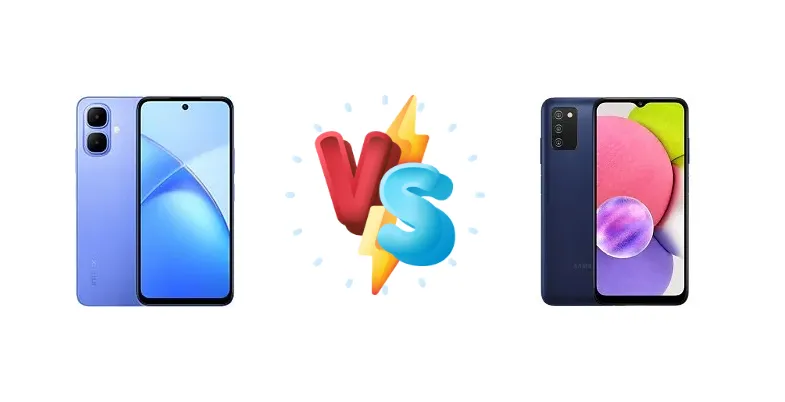
The sub-$150 smartphone market is fiercely competitive. Both the Infinix Smart 10 and Samsung Galaxy A03s aim to deliver essential smartphone functionality at an accessible price point. However, they take different approaches to achieving this, with the Infinix prioritizing processing power and the Samsung focusing on a more balanced experience. This comparison will dissect their key specifications to determine which device best suits your needs.
🏆 Quick Verdict
For the average user prioritizing responsiveness and occasional multitasking, the Infinix Smart 10 emerges as the better choice. Its Unisoc T7250 chipset, featuring Cortex-A75 cores, offers a noticeable performance advantage over the Samsung Galaxy A03s’ Helio P35, despite both phones sharing a 12nm process. While battery life is comparable, the Infinix’s faster CPU provides a smoother user experience.
| Network |
|---|
| 2G bands | GSM 850 / 900 / 1800 / 1900 | GSM 850 / 900 / 1800 / 1900 |
| 3G bands | HSDPA 850 / 900 / 1700(AWS) / 1900 / 2100 | HSDPA 850 / 900 / 2100 |
| 4G bands | 1, 2, 3, 4, 5, 7, 8, 20, 28, 38, 40, 41 | 1, 3, 5, 7, 8, 20, 28, 38, 40, 41 |
| Speed | HSPA, LTE | HSPA 42.2/5.76 Mbps, LTE Cat4 150/50 Mbps |
| Technology | GSM / HSPA / LTE | GSM / HSPA / LTE |
| | - | 2, 4, 5, 7, 12, 13, 14, 25, 26, 41, 66, 71 - SM-A037U |
| Launch |
|---|
| Announced | 2025, June 16 | 2021, August 18 |
| Status | Available. Released 2025, June 16 | Available. Released 2021, August 18 |
| Body |
|---|
| Build | Glass front, plastic back, plastic frame | Glass front, plastic frame, plastic back |
| Dimensions | 165.6 x 77 x 8.3 mm (6.52 x 3.03 x 0.33 in) | 164.2 x 75.9 x 9.1 mm (6.46 x 2.99 x 0.36 in) |
| SIM | Nano-SIM + Nano-SIM | Nano-SIM + Nano-SIM |
| Weight | 187 g (6.60 oz) | 196 g (6.91 oz) |
| Display |
|---|
| Resolution | 720 x 1600 pixels, 20:9 ratio (~263 ppi density) | 720 x 1600 pixels, 20:9 ratio (~270 ppi density) |
| Size | 6.67 inches, 107.4 cm2 (~84.2% screen-to-body ratio) | 6.5 inches, 102.0 cm2 (~81.8% screen-to-body ratio) |
| Type | IPS LCD, 120Hz, 700 nits (HBM) | PLS LCD |
| Platform |
|---|
| CPU | Octa-core (2x1.8 GHz Cortex-A75 & 6x1.6 GHz Cortex-A55) | Octa-core (4x2.35 GHz Cortex-A53 & 4x1.8 GHz Cortex-A53) |
| Chipset | Unisoc T7250 (12 nm) | Mediatek MT6765 Helio P35 (12 nm) |
| GPU | Mali-G57 MP1 | PowerVR GE8320 |
| OS | Android 15/15 (Go edition), XOS 15.1 | Android 11, upgradable to Android 13, One UI 5.1 Core |
| Memory |
|---|
| Card slot | microSDXC (dedicated slot) | microSDXC (dedicated slot) |
| Internal | 64GB 3GB RAM, 64GB 4GB RAM, 128GB 4GB RAM, 128GB 6GB RAM, 256GB 4GB RAM, 256GB 8GB RAM | 32GB 2GB RAM, 32GB 3GB RAM, 32GB 4GB RAM, 64GB 3GB RAM, 64GB 4GB RAM |
| | - | eMMC 5.1 |
| Main Camera |
|---|
| Features | Dual-LED flash, panorama | LED flash |
| Single | 8 MP, f/2.0, (wide), 1/4.0", 1.12µm, AF | 5 MP, f/2.2 |
| Triple | - | 13 MP, f/2.2, (wide), AF
2 MP (macro)
Auxiliary lens |
| Video | 1440p@30fps, 1080p@30fps | 1080p@30fps |
| Selfie camera |
|---|
| Single | 8 MP, f/2.0, (wide), 1/4.0", 1.12µm | 5 MP, f/2.2 |
| Video | 1440p@30fps, 1080p@30fps | 1080p@30fps |
| Sound |
|---|
| 3.5mm jack | - | Yes |
| 35mm jack | Yes | Yes |
| Loudspeaker | Yes, with stereo speakers | Yes |
| Comms |
|---|
| Bluetooth | Yes | 5.0, A2DP |
| Infrared port | Yes | - |
| NFC | Yes (data transfer only; not for payments - market/region dependent) | Yes (market/region dependent) |
| Positioning | GPS | GPS, GLONASS, GALILEO, BDS |
| Radio | FM radio | No |
| USB | USB Type-C 2.0, OTG | USB Type-C 2.0 |
| WLAN | Wi-Fi 802.11 a/b/g/n/ac, dual-band | Wi-Fi 802.11 b/g/n, Wi-Fi Direct |
| Features |
|---|
| Sensors | Fingerprint (side-mounted), accelerometer, proximity, compass | Fingerprint (side-mounted), accelerometer, proximity |
| Battery |
|---|
| Charging | 15W wired
Reverse wired | 15W wired |
| Type | 5000 mAh | Li-Po 5000 mAh |
| Misc |
|---|
| Colors | Sleek Black Titanium Silver, Iris Blue, Twilight Gold | Black, Blue, White |
| Models | X6725 | SM-A037F, SM-A037F/DS, SM-A037M, SM-A037G, SM-A037U, SM-S134DL, SM-A037W, SM-A037U1, SM-S135DL |
| Price | About 60 EUR | $ 65.65 / £ 82.99 / ₹ 10,800 |
| SAR EU | - | 0.36 W/kg (head) 1.09 W/kg (body) |
| Tests |
|---|
| Battery life | - |
Endurance rating 122h
|
| Camera | - |
Photo / Video |
| Display | - |
Contrast ratio: 1718:1 (nominal) |
| Loudspeaker | - |
-27.4 LUFS (Good)
|
| Performance | - |
AnTuTu: 103465 (v8), 101299 (v9)
GeekBench: 889 (v5.1)
GFXBench: 5.5fps (ES 3.1 onscreen) |
Infinix Smart 10
- More powerful processor for smoother performance
- Cortex-A75 cores offer better responsiveness
- Reverse wired charging adds versatility
- Display brightness likely lower than Samsung A03s
- Brand recognition is lower than Samsung
Samsung Galaxy A03s
- Brighter display for better outdoor visibility
- Established brand reputation and support
- Potentially more refined image processing
- Less powerful processor leading to potential lag
- Helio P35 chipset is less efficient
- 2MP macro camera offers limited value
Display Comparison
Both the Infinix Smart 10 and Samsung Galaxy A03s feature displays with a 1718:1 contrast ratio, suggesting similar visual pop. However, the Samsung Galaxy A03s boasts a measured peak brightness of 488 nits, offering better visibility in direct sunlight. While the Infinix’s brightness isn’t specified, the A03s’ advantage here is tangible. Both likely utilize IPS LCD panels, common in this price bracket, and lack high refresh rates or advanced features like LTPO. Bezels are expected to be substantial on both devices, reflecting their budget positioning.
Camera Comparison
Both devices offer basic photo and video capabilities, but details are sparse. The emphasis here shouldn’t be on image quality, as both will likely struggle in low-light conditions. The presence of a 2MP macro camera on the A03s is largely a marketing gimmick, offering minimal practical benefit. Without specific sensor size information, it’s difficult to definitively declare a winner, but the image processing algorithms employed by Samsung are generally more refined, potentially leading to slightly more pleasing results in optimal conditions. However, the performance gap is unlikely to be substantial.
Performance
The core difference lies in the chipsets. The Infinix Smart 10’s Unisoc T7250 utilizes a combination of Cortex-A75 (1.8 GHz) and Cortex-A55 (1.6 GHz) cores, offering a more powerful architecture than the Samsung Galaxy A03s’ MediaTek Helio P35, which relies solely on Cortex-A53 cores (2.35 GHz and 1.8 GHz). While the Helio P35 has a higher clock speed on some cores, the A75 cores in the Unisoc T7250 provide significantly better single-core performance, crucial for app launch times and general responsiveness. This translates to a smoother experience for everyday tasks. Both phones likely feature limited RAM configurations, impacting multitasking capabilities, but the more efficient chipset in the Infinix will mitigate this to some extent.
Battery Life
Both the Infinix Smart 10 and Samsung Galaxy A03s achieve an endurance rating of 122 hours, indicating comparable battery life under similar usage patterns. Both support 15W wired charging, suggesting similar charging speeds. The actual 0-100% charge time will depend on the charger used and battery health, but users shouldn’t expect rapid charging capabilities. The similar endurance ratings suggest that battery life will be dictated more by usage habits than by a significant difference in battery capacity or efficiency.
Buying Guide
Buy the Infinix Smart 10 if you need a phone capable of handling more demanding apps and multitasking without significant lag. It’s ideal for users who frequently switch between applications or enjoy light gaming. Buy the Samsung Galaxy A03s if you prioritize a well-established brand reputation and a slightly brighter display, and your usage is primarily focused on basic tasks like calls, messaging, and social media.
Frequently Asked Questions
❓ Will the Unisoc T7250 in the Infinix Smart 10 struggle with popular games like PUBG Mobile?
While the Unisoc T7250 isn't a gaming powerhouse, it can handle PUBG Mobile at lower settings. Expect frame rate drops during intense action, but it's playable. The Helio P35 in the A03s will likely offer an even less smooth experience, requiring even lower settings.
❓ Does the Samsung Galaxy A03s overheat during prolonged use, like video recording or navigation?
The Helio P35 is known for being relatively efficient, so overheating isn't a major concern with the Samsung Galaxy A03s. However, prolonged use will likely result in some thermal throttling, reducing performance slightly. The Infinix Smart 10's Unisoc T7250 may experience similar throttling under heavy load.
❓ Is the 15W charging on either phone fast enough for quick top-ups throughout the day?
15W charging is relatively slow by modern standards. Expect a full charge to take around 2-3 hours. It's best suited for overnight charging rather than quick top-ups. Neither phone offers fast charging capabilities.
❓ How does the software experience differ between the Infinix Smart 10 and Samsung Galaxy A03s?
The Samsung Galaxy A03s runs One UI, Samsung's custom Android skin, which is generally considered more polished and feature-rich. The Infinix Smart 10 likely runs a customized version of Android with Infinix's own UI, which may include more bloatware and a less refined user experience. Software updates are also typically faster and more frequent on Samsung devices.