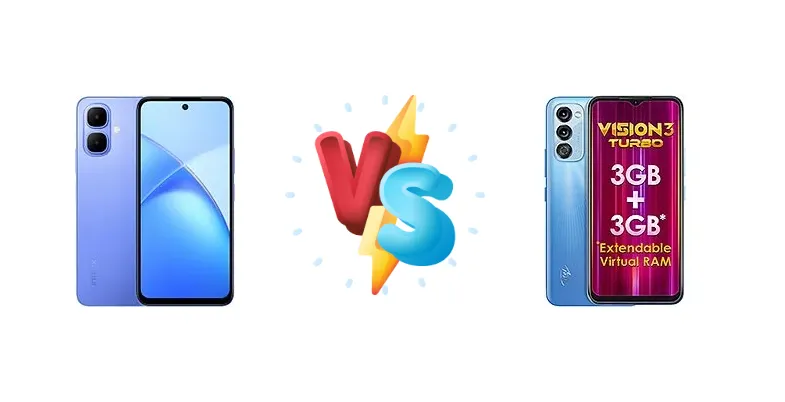
The sub-$150 smartphone market is fiercely competitive. Both the Infinix Smart 10 and the itel Vision 3 Turbo aim to deliver essential smartphone functionality at an incredibly accessible price point. However, significant differences in their underlying hardware suggest vastly different user experiences. This comparison dissects those differences to determine which device offers the best value.
🏆 Quick Verdict
For the average user prioritizing responsiveness and future-proofing, the Infinix Smart 10 emerges as the better choice. Its Unisoc T7250 chipset, built on a more modern 12nm process, provides a noticeable performance advantage over the itel Vision 3 Turbo’s older 28nm Unisoc SC9863A, despite the latter’s slightly faster charging.
| Network |
|---|
| 2G bands | GSM 850 / 900 / 1800 / 1900 | GSM 850 / 900 / 1800 / 1900 |
| 3G bands | HSDPA 850 / 900 / 1700(AWS) / 1900 / 2100 | HSDPA 850 / 900 / 2100 |
| 4G bands | 1, 2, 3, 4, 5, 7, 8, 20, 28, 38, 40, 41 | LTE |
| Speed | HSPA, LTE | HSPA, LTE |
| Technology | GSM / HSPA / LTE | GSM / HSPA / LTE |
| Launch |
|---|
| Announced | 2025, June 16 | 2022 |
| Status | Available. Released 2025, June 16 | Available. Released 2022 |
| Body |
|---|
| Build | Glass front, plastic back, plastic frame | - |
| Dimensions | 165.6 x 77 x 8.3 mm (6.52 x 3.03 x 0.33 in) | - |
| SIM | Nano-SIM + Nano-SIM | Dual SIM |
| Weight | 187 g (6.60 oz) | - |
| Display |
|---|
| Resolution | 720 x 1600 pixels, 20:9 ratio (~263 ppi density) | 720 x 1600 pixels, 20:9 ratio (~266 ppi density) |
| Size | 6.67 inches, 107.4 cm2 (~84.2% screen-to-body ratio) | 6.6 inches, 105.2 cm2 |
| Type | IPS LCD, 120Hz, 700 nits (HBM) | IPS LCD |
| Platform |
|---|
| CPU | Octa-core (2x1.8 GHz Cortex-A75 & 6x1.6 GHz Cortex-A55) | Octa-core (4x1.6 GHz Cortex-A55 & 4x1.2 GHz Cortex-A55) |
| Chipset | Unisoc T7250 (12 nm) | Unisoc SC9863A (28 nm) |
| GPU | Mali-G57 MP1 | IMG8322 |
| OS | Android 15/15 (Go edition), XOS 15.1 | Android 11 (Go edition) |
| Memory |
|---|
| Card slot | microSDXC (dedicated slot) | microSDXC |
| Internal | 64GB 3GB RAM, 64GB 4GB RAM, 128GB 4GB RAM, 128GB 6GB RAM, 256GB 4GB RAM, 256GB 8GB RAM | 64GB 3GB RAM |
| Main Camera |
|---|
| Features | Dual-LED flash, panorama | LED flash |
| Single | 8 MP, f/2.0, (wide), 1/4.0", 1.12µm, AF | 8 MP (wide)
Auxiliary lens |
| Video | 1440p@30fps, 1080p@30fps | 1080p@30fps |
| Selfie camera |
|---|
| Single | 8 MP, f/2.0, (wide), 1/4.0", 1.12µm | 5 MP |
| Video | 1440p@30fps, 1080p@30fps | Yes |
| Sound |
|---|
| 35mm jack | Yes | Yes |
| Loudspeaker | Yes, with stereo speakers | Yes |
| Comms |
|---|
| Bluetooth | Yes | Yes |
| Infrared port | Yes | - |
| NFC | Yes (data transfer only; not for payments - market/region dependent) | No |
| Positioning | GPS | GPS |
| Radio | FM radio | Unspecified |
| USB | USB Type-C 2.0, OTG | microUSB |
| WLAN | Wi-Fi 802.11 a/b/g/n/ac, dual-band | Yes |
| Features |
|---|
| Sensors | Fingerprint (side-mounted), accelerometer, proximity, compass | Fingerprint (rear-mounted), accelerometer |
| Battery |
|---|
| Charging | 15W wired
Reverse wired | 18W wired |
| Type | 5000 mAh | 5000 mAh |
| Misc |
|---|
| Colors | Sleek Black Titanium Silver, Iris Blue, Twilight Gold | Blue |
| Models | X6725 | - |
| Price | About 60 EUR | - |
Infinix Smart 10
- More powerful Unisoc T7250 chipset
- More efficient 12nm manufacturing process
- Better CPU architecture (Cortex-A75 cores)
- Slower 15W charging
- Likely similar display quality to the competition
itel Vision 3 Turbo
- Faster 18W charging
- Potentially longer standby time (due to lower performance)
- Competitive price point
- Less powerful Unisoc SC9863A chipset
- Less efficient 28nm manufacturing process
- Slower app launch speeds and multitasking
Display Comparison
Neither device boasts a standout display. Both are likely to feature LCD panels, typical for this price bracket. However, details regarding resolution and brightness are missing. The focus here is on internal components, and display quality is likely similar, leaning towards functional rather than immersive. Bezels are expected to be substantial on both devices, maximizing screen real estate within a budget.
Camera Comparison
Given the price point, camera expectations should be tempered. Details on sensor sizes and image processing are unavailable. However, it's safe to assume both phones will feature basic camera setups. The presence of a 2MP macro lens on either device is largely marketing fluff; image quality will be limited. The primary sensor’s quality will be the determining factor, and without specific details, it’s difficult to declare a clear winner. Image processing will likely be minimal on both, relying heavily on software algorithms to enhance photos.
Performance
The core difference lies in the chipsets. The Infinix Smart 10’s Unisoc T7250 (12nm) utilizes a more efficient manufacturing process and a more sophisticated CPU architecture – specifically, Cortex-A75 cores alongside A55s. This contrasts sharply with the itel Vision 3 Turbo’s Unisoc SC9863A (28nm), which relies solely on Cortex-A55 cores. The A75 cores in the Smart 10 provide a significant boost in single-core performance, crucial for app launch speeds and general responsiveness. The 28nm process of the SC9863A will likely result in higher power consumption for similar tasks, and potentially more thermal throttling under sustained load. The Smart 10 will offer a smoother experience for multitasking and moderately demanding apps.
Battery Life
The itel Vision 3 Turbo’s 18W charging is a slight advantage over the Infinix Smart 10’s 15W charging. However, the efficiency of the Unisoc T7250 in the Smart 10 could offset this difference. A more efficient chipset consumes less power, potentially leading to comparable real-world battery life despite the lower charging wattage. The actual battery capacity of both devices is unknown, but the 28nm process of the Vision 3 Turbo’s chipset will likely necessitate a larger battery to achieve similar longevity to the Smart 10.
Buying Guide
Buy the Infinix Smart 10 if you need a phone capable of handling everyday tasks with relative ease, and appreciate a chipset that offers a longer lifespan in terms of software updates and app compatibility. Buy the itel Vision 3 Turbo if your primary concern is maximizing battery life with minimal usage, and you prioritize the convenience of slightly faster 18W charging over overall performance.
Frequently Asked Questions
❓ Will the Infinix Smart 10 struggle with popular apps like WhatsApp and Facebook?
The Unisoc T7250 chipset in the Smart 10 is capable of running these apps smoothly. While it won't offer a flagship-level experience, it provides sufficient processing power for everyday social media use and communication. The Cortex-A75 cores are key to this responsiveness.
❓ Is the 18W charging on the itel Vision 3 Turbo significantly faster in real-world use?
While 18W is faster than 15W on paper, the difference in charging speed may not be dramatic. The less efficient chipset in the Vision 3 Turbo could mean it needs to charge for a longer duration overall to reach the same battery percentage, potentially negating some of the benefit of faster wattage.
❓ Can either of these phones handle light gaming?
Both phones can handle very light gaming, but don't expect a great experience. The Unisoc T7250 in the Infinix Smart 10 will offer slightly better performance for less demanding titles, but neither phone is designed for graphically intensive games. Expect low frame rates and potential lag.