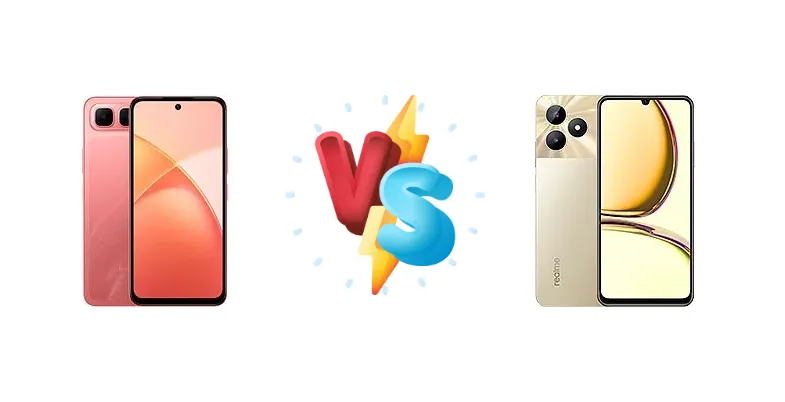
The sub-₹10,000 (approximately $120 USD) smartphone segment is fiercely competitive. Both the Infinix Smart 10 Plus and the Realme C53 (India) aim to deliver a compelling experience without breaking the bank. This comparison dissects their key specifications to determine which device offers the best value for budget-conscious consumers.
🏆 Quick Verdict
For the average user prioritizing consistent performance in everyday tasks, the Realme C53 (India) edges out the Infinix Smart 10 Plus. While both utilize Unisoc chipsets, the C53’s slightly faster Cortex-A55 cores provide a smoother experience, despite both phones sharing the same 18W charging.
| Network |
|---|
| 2G bands | GSM 850 / 900 / 1800 / 1900 | GSM 850 / 900 / 1800 / 1900 |
| 3G bands | HSDPA 850 / 900 / 1700(AWS) / 1900 / 2100 | HSDPA 850 / 900 / 2100 |
| 4G bands | 1, 2, 3, 4, 5, 7, 8, 20, 28, 38, 40, 41 | 1, 3, 5, 8, 38, 40, 41 |
| Speed | HSPA, LTE | HSPA, LTE |
| Technology | GSM / HSPA / LTE | GSM / HSPA / LTE |
| Launch |
|---|
| Announced | 2025, June 16 | 2023, July 19 |
| Status | Available. Released 2025, June 16 | Available. Released 2023, July 26 |
| Body |
|---|
| Build | Glass front, plastic back, plastic frame | Glass front, plastic frame, plastic back |
| Dimensions | 165.6 x 77 x 8 mm (6.52 x 3.03 x 0.31 in) | 167.2 x 76.7 x 8 mm (6.58 x 3.02 x 0.31 in) |
| SIM | Nano-SIM + Nano-SIM | Nano-SIM + Nano-SIM |
| Weight | 198 g (6.98 oz) | 186 g (6.56 oz) |
| Display |
|---|
| Resolution | 720 x 1600 pixels, 20:9 ratio (~263 ppi density) | 1080 x 2400 pixels, 20:9 ratio (~390 ppi density) |
| Size | 6.67 inches, 107.4 cm2 (~84.2% screen-to-body ratio) | 6.74 inches, 109.7 cm2 (~85.5% screen-to-body ratio) |
| Type | IPS LCD, 120Hz, 700 nits (HBM) | IPS LCD, 90Hz, 560 nits (peak) |
| Platform |
|---|
| CPU | Octa-core (2x1.8 GHz Cortex-A75 & 6x1.6 GHz Cortex-A55) | Octa-core (2x1.8 GHz Cortex-A75 & 6x1.8 GHz Cortex-A55) |
| Chipset | Unisoc T7250 (12 nm) | Unisoc Tiger T612 (12 nm) |
| GPU | Mali-G57 MP1 | Mali-G57 |
| OS | Android 15, XOS 15.1 | Android 13, Realme UI |
| Memory |
|---|
| Card slot | microSDXC (dedicated slot) | microSDXC (dedicated slot) |
| Internal | 128GB 4GB RAM, 128GB 8GB RAM | 64GB 6GB RAM, 128GB 4GB RAM, 128GB 6GB RAM |
| Main Camera |
|---|
| Dual | - | 108 MP, (wide), PDAF
Auxiliary lens |
| Features | Dual-LED flash, panorama | LED flash, HDR, panorama |
| Single | 8 MP, f/2.0, (wide), 1/4.0", 1.12µm, AF | - |
| Video | 1440p@30fps, 1080p@30fps | 1080p@30fps |
| Selfie camera |
|---|
| Features | - | HDR |
| Single | 8 MP, f/2.0, (wide), 1/4.0", 1.12µm | 8 MP, (wide) |
| Video | 1440p@30fps, 1080p@30fps | 720p@30fps |
| Sound |
|---|
| 35mm jack | Yes | Yes |
| Loudspeaker | Yes, with stereo speakers | Yes |
| Comms |
|---|
| Bluetooth | Yes | 5.0, A2DP, LE |
| Infrared port | Yes | - |
| NFC | Yes (data transfer only; not for payments - market/region dependent) | No |
| Positioning | GPS | GPS, GLONASS, GALILEO |
| Radio | FM radio | Unspecified |
| USB | USB Type-C 2.0, OTG | USB Type-C 2.0 |
| WLAN | Wi-Fi 802.11 a/b/g/n/ac, dual-band | Wi-Fi 802.11 a/b/g/n/ac, dual-band |
| Features |
|---|
| Sensors | Fingerprint (side-mounted), accelerometer, proximity, compass | Fingerprint (side-mounted), accelerometer, gyro, proximity, compass |
| Battery |
|---|
| Charging | 18W wired
Reverse wired | 18W wired |
| Type | 6000 mAh | 5000 mAh |
| Misc |
|---|
| Colors | Sleek Black, Titanium Silver, Iris Blue, Ruby Red | Gold, Black |
| Models | X6725B_C, X6725B | RMX3762 |
| Price | About 70 EUR | About 110 EUR |
Infinix Smart 10 Plus
- Reverse wired charging offers added versatility.
- Potentially lower price point depending on market.
- Unisoc T7250 is a proven, reliable chipset.
- Slightly slower Cortex-A55 cores compared to the Realme C53.
- Likely similar display quality to the Realme C53.
Realme C53 (India)
- Faster Cortex-A55 cores for improved responsiveness.
- Slightly better multitasking performance.
- Realme’s UI is generally well-optimized.
- Lacks reverse wired charging functionality.
- May be slightly more expensive than the Infinix Smart 10 Plus.
Display Comparison
Neither device boasts a standout display. Both are expected to feature LCD panels, typical for this price bracket. Detailed specifications like resolution and peak brightness are missing, but we can assume they are similar, aiming for a functional viewing experience rather than visual fidelity. Bezels are likely to be substantial on both, maximizing screen real estate within a budget. Color accuracy will likely be standard, prioritizing power efficiency over color calibration.
Camera Comparison
Camera performance is likely to be similar, focusing on basic photography needs. Both devices will likely feature a primary camera alongside depth and potentially macro sensors. Given the price point, image processing will prioritize speed over detail. The absence of OIS (Optical Image Stabilization) on either device means low-light performance will be limited. The 2MP macro cameras commonly found in this segment offer limited practical utility, serving more as a feature checkbox than a genuine photographic tool. Sensor size is unknown, but smaller sensors are expected.
Performance
The core difference lies in the chipsets. Both the Infinix Smart 10 Plus (Unisoc T7250) and Realme C53 (Unisoc Tiger T612) employ an octa-core configuration with 2x 1.8 GHz Cortex-A75 and 6x Cortex-A55 cores. However, the Realme C53’s T612 features 6x 1.8 GHz Cortex-A55 cores, compared to the Infinix’s 6x 1.6 GHz Cortex-A55 cores. This 200MHz clock speed difference on the efficiency cores translates to slightly snappier responsiveness during multitasking and app loading. Both utilize a 12nm process, suggesting similar power efficiency. RAM configurations are crucial, but unspecified; faster LPDDR4X RAM would benefit both devices.
Battery Life
Both the Infinix Smart 10 Plus and Realme C53 (India) are equipped with 18W wired charging. Actual charging times will depend on the included charger and battery capacity (unspecified). The 18W charging is adequate for this segment, providing a reasonable top-up time. Battery life will heavily depend on usage patterns, but both devices should comfortably last a full day with moderate use. The Infinix Smart 10 Plus’s inclusion of reverse wired charging is a unique advantage, allowing it to function as a power bank for other devices.
Buying Guide
Buy the Infinix Smart 10 Plus if you prioritize reverse wired charging for topping up accessories or emergency power sharing. Buy the Realme C53 (India) if you prefer a slightly more responsive user experience for daily tasks and light multitasking, benefiting from the marginally faster Cortex-A55 cores within its Unisoc Tiger T612 chipset.
Frequently Asked Questions
❓ Will the Unisoc Tiger T612 in the Realme C53 handle popular apps like WhatsApp and Facebook smoothly?
Yes, the Unisoc Tiger T612 is more than capable of handling everyday apps like WhatsApp, Facebook, and web browsing without significant lag. The slightly faster Cortex-A55 cores contribute to a smoother experience compared to the Infinix Smart 10 Plus, especially when multitasking between these applications.
❓ Is the 18W charging on either phone fast enough for quick top-ups throughout the day?
While 18W charging isn't the fastest available, it's adequate for this price segment. Expect a full charge to take around 2-3 hours. A 30-minute charge will provide a noticeable boost, enough for several hours of moderate use. The Infinix Smart 10 Plus’s reverse charging capability allows you to use it as a portable power bank in emergencies.
❓ Can either of these phones handle basic mobile gaming like PUBG Mobile or Call of Duty Mobile?
Both phones can run PUBG Mobile and Call of Duty Mobile, but you'll need to lower the graphics settings to medium or low to achieve playable frame rates. Expect some stuttering during intense action sequences. The Realme C53’s slightly more powerful chipset may offer a marginally better gaming experience, but neither phone is designed for demanding gaming.