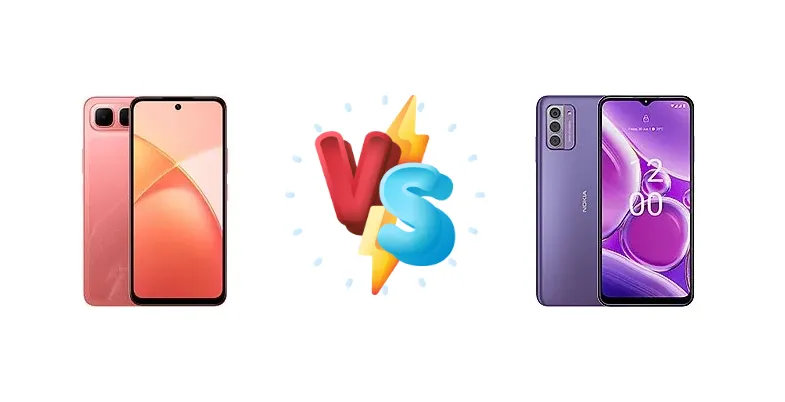
The sub-$200 smartphone market is fiercely competitive, and the Infinix Smart 10 Plus and Nokia G42 represent compelling options for users seeking 5G connectivity without breaking the bank. This comparison dissects their core components – from chipsets to charging – to determine which device offers the most robust experience for everyday tasks and beyond.
🏆 Quick Verdict
For the average user prioritizing 5G connectivity and a slightly more refined software experience, the Nokia G42 emerges as the better choice. Its Snapdragon 480+ chipset, built on a more efficient 8nm process, provides a performance edge and potentially better thermal management, despite the Infinix offering reverse wired charging.
| Network |
|---|
| 2G bands | GSM 850 / 900 / 1800 / 1900 | GSM 850 / 900 / 1800 / 1900 |
| 3G bands | HSDPA 850 / 900 / 1700(AWS) / 1900 / 2100 | HSDPA 850 / 900 / 1700(AWS) / 1900 / 2100 |
| 4G bands | 1, 2, 3, 4, 5, 7, 8, 20, 28, 38, 40, 41 | 1, 2, 3, 4, 5, 7, 8, 12, 17, 13, 20, 28, 38, 39, 40, 41, 66 |
| 5G bands | - | 1, 2, 3, 5, 7, 8, 28, 40, 41, 66, 77, 78 SA/NSA |
| Speed | HSPA, LTE | HSPA, LTE, 5G |
| Technology | GSM / HSPA / LTE | GSM / HSPA / LTE / 5G |
| Launch |
|---|
| Announced | 2025, June 16 | 2023, June 28 |
| Status | Available. Released 2025, June 16 | Available. Released 2023, June 28 |
| Body |
|---|
| Build | Glass front, plastic back, plastic frame | Glass front, plastic back, plastic frame |
| Dimensions | 165.6 x 77 x 8 mm (6.52 x 3.03 x 0.31 in) | 165 x 75.8 x 8.6 mm (6.50 x 2.98 x 0.34 in) |
| SIM | Nano-SIM + Nano-SIM | · Nano-SIM· Nano-SIM + Nano-SIM |
| Weight | 198 g (6.98 oz) | 193.8 g (6.84 oz) |
| Display |
|---|
| Protection | - | Corning Gorilla Glass 3 |
| Resolution | 720 x 1600 pixels, 20:9 ratio (~263 ppi density) | 720 x 1612 pixels, 20:9 ratio (~269 ppi density) |
| Size | 6.67 inches, 107.4 cm2 (~84.2% screen-to-body ratio) | 6.56 inches, 103.4 cm2 (~82.7% screen-to-body ratio) |
| Type | IPS LCD, 120Hz, 700 nits (HBM) | IPS LCD, 90Hz, 450 nits (typ), 560 nits (peak) |
| Platform |
|---|
| CPU | Octa-core (2x1.8 GHz Cortex-A75 & 6x1.6 GHz Cortex-A55) | Octa-core (2x2.2 GHz Kryo 460 & 6x1.8 GHz Kryo 460) |
| Chipset | Unisoc T7250 (12 nm) | Qualcomm SM4350-AC Snapdragon 480+ 5G (8 nm) |
| GPU | Mali-G57 MP1 | Adreno 619 |
| OS | Android 15, XOS 15.1 | Android 13, upgradable to Android 14 |
| Memory |
|---|
| Card slot | microSDXC (dedicated slot) | microSDXC |
| Internal | 128GB 4GB RAM, 128GB 8GB RAM | 128GB 4GB RAM, 128GB 6GB RAM, 256GB 8GB RAM |
| Main Camera |
|---|
| Features | Dual-LED flash, panorama | LED flash, HDR, panorama |
| Single | 8 MP, f/2.0, (wide), 1/4.0", 1.12µm, AF | - |
| Triple | - | 50 MP, f/1.8, (wide), AF
2 MP (macro)
Auxiliary lens |
| Video | 1440p@30fps, 1080p@30fps | 1080p@30fps |
| Selfie camera |
|---|
| Single | 8 MP, f/2.0, (wide), 1/4.0", 1.12µm | 8 MP |
| Video | 1440p@30fps, 1080p@30fps | Yes |
| Sound |
|---|
| 35mm jack | Yes | Yes |
| Loudspeaker | Yes, with stereo speakers | Yes |
| Comms |
|---|
| Bluetooth | Yes | 5.1, A2DP, LE |
| Infrared port | Yes | - |
| NFC | Yes (data transfer only; not for payments - market/region dependent) | Yes (market/region dependent) |
| Positioning | GPS | GPS, GLONASS, GALILEO, BDS |
| Radio | FM radio | FM radio |
| USB | USB Type-C 2.0, OTG | USB Type-C 2.0, OTG |
| WLAN | Wi-Fi 802.11 a/b/g/n/ac, dual-band | Wi-Fi 802.11 a/b/g/n/ac/6, dual-band |
| Features |
|---|
| Sensors | Fingerprint (side-mounted), accelerometer, proximity, compass | Fingerprint (side-mounted), accelerometer, proximity, compass |
| Battery |
|---|
| Charging | 18W wired
Reverse wired | 20W wired, PD3.0, QC3 |
| Type | 6000 mAh | Li-Po 5000 mAh |
| Misc |
|---|
| Colors | Sleek Black, Titanium Silver, Iris Blue, Ruby Red | Gray, Purple, Red |
| Models | X6725B_C, X6725B | - |
| Price | About 70 EUR | $ 545.00 / £ 124.99 |
Infinix Smart 10 Plus
- Reverse wired charging offers added utility.
- Potentially lower price point.
- Unisoc chipset provides adequate performance for basic tasks.
- Less efficient 12nm chipset.
- Slower charging speed (18W).
- Potentially lower performance compared to Snapdragon 480+.
Nokia G42
- More efficient 8nm Snapdragon 480+ chipset.
- Faster 20W charging with PD3.0/QC3.
- Better overall performance and responsiveness.
- Lacks reverse wired charging.
- May be slightly more expensive.
- Software updates may be slower compared to some competitors.
Display Comparison
Neither device boasts a standout display. Both likely utilize LCD panels, common in this price bracket. However, the lack of detailed display specs (resolution, brightness) necessitates focusing on the chipset's impact on UI smoothness. The Nokia G42's more powerful GPU will contribute to a more fluid experience when scrolling and navigating the interface, even if the panel itself is similar.
Camera Comparison
Without detailed camera specs beyond the chipsets, a direct comparison is limited. Both phones likely feature basic camera setups geared towards social media sharing. The image signal processor (ISP) within the Snapdragon 480+ is generally more advanced than Unisoc’s offerings, potentially leading to better image processing, particularly in low-light conditions. However, the real-world difference will depend heavily on software optimization, which is difficult to assess without testing.
Performance
The core difference lies in the chipsets. The Nokia G42’s Qualcomm Snapdragon 480+ (8nm) is a clear upgrade over the Infinix Smart 10 Plus’s Unisoc T7250 (12nm). The 8nm process node translates to improved power efficiency and potentially lower operating temperatures under sustained load. While both feature octa-core CPUs with similar core configurations (2x performance cores, 6x efficiency cores), the Snapdragon’s Kryo 460 cores operate at a higher clock speed (2.2 GHz vs 1.8 GHz), resulting in faster single-core and multi-core performance. This will be noticeable in app launch times and overall system responsiveness.
Battery Life
The battery capacity isn't specified, making a direct mAh comparison impossible. However, the Nokia G42’s 20W charging with PD3.0 and QC3 support offers a significant advantage over the Infinix Smart 10 Plus’s 18W charging. PD3.0 and QC3 are fast charging standards that allow for quicker and more efficient charging, potentially reducing 0-100% charge times considerably. The Infinix's reverse wired charging is a niche feature, useful for topping up accessories, but doesn't offset the Nokia's faster charging speed.
Buying Guide
Buy the Infinix Smart 10 Plus if you need a phone primarily for basic communication, social media, and occasional light gaming, and value the convenience of reverse wired charging to top up other devices. Buy the Nokia G42 if you prioritize smoother multitasking, a more responsive user interface, and future-proofing with a more modern 5G chipset, even if it means sacrificing reverse charging capabilities.
Frequently Asked Questions
❓ Will the Nokia G42 handle demanding games like PUBG Mobile smoothly?
While the Snapdragon 480+ isn't a gaming powerhouse, it's capable of running PUBG Mobile at medium settings with reasonable frame rates. Expect some occasional stuttering during intense firefights, but the experience should be playable. The Infinix Smart 10 Plus will likely struggle with consistent performance in demanding titles.
❓ How much faster is the charging on the Nokia G42 compared to the Infinix Smart 10 Plus?
The Nokia G42's 20W charging with PD3.0/QC3 will significantly reduce charging times. While exact figures depend on the charger and battery capacity, expect a 0-100% charge to be at least 30-45 minutes faster on the Nokia G42 compared to the Infinix Smart 10 Plus's 18W charging.
❓ Does the Unisoc T7250 chipset in the Infinix Smart 10 Plus support 5G?
Yes, the Unisoc T7250 does support 5G connectivity. However, the Snapdragon 480+ in the Nokia G42 is a more mature and generally more efficient 5G implementation, potentially offering better signal strength and data speeds.
❓ Is the reverse wired charging on the Infinix Smart 10 Plus useful in everyday scenarios?
Reverse wired charging is a convenient feature for topping up accessories like wireless earbuds or smartwatches. However, it's a relatively slow charging method and isn't a replacement for a dedicated power bank or charger. It's a nice-to-have, but not a deal-breaker.