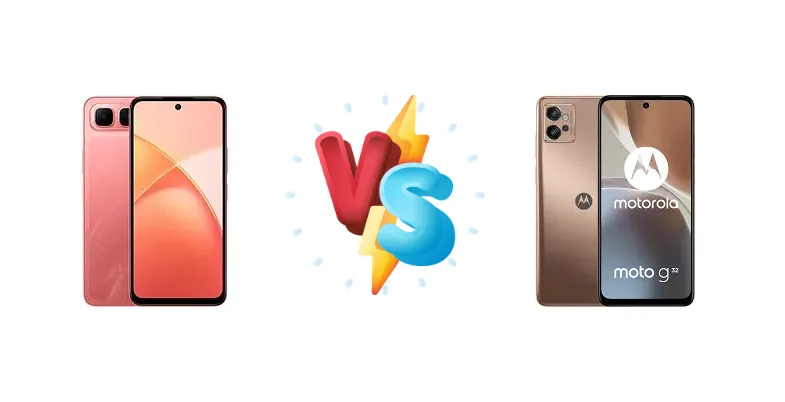
The sub-$150 smartphone market is fiercely competitive. The Infinix Smart 10 Plus and Motorola Moto G32 both aim to deliver essential features at an accessible price point, but they take different approaches. The Infinix leverages a Unisoc chipset for cost efficiency, while the Motorola opts for Qualcomm's Snapdragon 680, promising a more refined experience. This comparison dissects their key differences to help you choose the right device.
🏆 Quick Verdict
For most users, the Motorola Moto G32 emerges as the better choice. Its Snapdragon 680, built on a more efficient 6nm process, provides noticeably smoother performance and better thermal management than the Infinix Smart 10 Plus’s Unisoc T7250. While the Infinix offers reverse wired charging, the Moto G32’s faster 30W charging and overall efficiency make it a more compelling package.
| Network |
|---|
| 2G bands | GSM 850 / 900 / 1800 / 1900 | GSM 850 / 900 / 1800 / 1900 |
| 3G bands | HSDPA 850 / 900 / 1700(AWS) / 1900 / 2100 | HSDPA 850 / 900 / 1900 / 2100 |
| 4G bands | 1, 2, 3, 4, 5, 7, 8, 20, 28, 38, 40, 41 | 1, 3, 5, 7, 8, 20, 28, 38, 40, 41 |
| Speed | HSPA, LTE | HSPA, LTE |
| Technology | GSM / HSPA / LTE | GSM / HSPA / LTE |
| Launch |
|---|
| Announced | 2025, June 16 | 2022, July 28 |
| Status | Available. Released 2025, June 16 | Available. Released 2022, August 16 |
| Body |
|---|
| Build | Glass front, plastic back, plastic frame | Glass front, plastic frame, plastic back |
| Dimensions | 165.6 x 77 x 8 mm (6.52 x 3.03 x 0.31 in) | 161.8 x 73.8 x 8.5 mm (6.37 x 2.91 x 0.33 in) |
| SIM | Nano-SIM + Nano-SIM | · Nano-SIM· Nano-SIM + Nano-SIM |
| Weight | 198 g (6.98 oz) | 184 g (6.49 oz) |
| | - | Water-repellent design |
| Display |
|---|
| Resolution | 720 x 1600 pixels, 20:9 ratio (~263 ppi density) | 1080 x 2400 pixels, 20:9 ratio (~405 ppi density) |
| Size | 6.67 inches, 107.4 cm2 (~84.2% screen-to-body ratio) | 6.5 inches, 102.0 cm2 (~85.4% screen-to-body ratio) |
| Type | IPS LCD, 120Hz, 700 nits (HBM) | IPS LCD, 90Hz |
| Platform |
|---|
| CPU | Octa-core (2x1.8 GHz Cortex-A75 & 6x1.6 GHz Cortex-A55) | Octa-core (4x2.4 GHz Kryo 265 Gold & 4x1.9 GHz Kryo 265 Silver) |
| Chipset | Unisoc T7250 (12 nm) | Qualcomm SM6225 Snapdragon 680 4G (6 nm) |
| GPU | Mali-G57 MP1 | Adreno 610 |
| OS | Android 15, XOS 15.1 | Android 12, upgradable to Android 13 |
| Memory |
|---|
| Card slot | microSDXC (dedicated slot) | microSDXC (dedicated slot) |
| Internal | 128GB 4GB RAM, 128GB 8GB RAM | 64GB 4GB RAM, 128GB 4GB RAM, 128GB 6GB RAM, 128GB 8GB RAM, 256GB 8GB RAM |
| Main Camera |
|---|
| Features | Dual-LED flash, panorama | LED flash, HDR, panorama |
| Single | 8 MP, f/2.0, (wide), 1/4.0", 1.12µm, AF | - |
| Triple | - | 50 MP, f/1.8 (wide), 1/2.76", 0.64µm, PDAF
8 MP, f/2.2, 118˚ (ultrawide), 1/4.0", 1.12µm
2 MP, f/2.4, (macro/depth) |
| Video | 1440p@30fps, 1080p@30fps | 1080p@30fps |
| Selfie camera |
|---|
| Single | 8 MP, f/2.0, (wide), 1/4.0", 1.12µm | 16 MP, f/2.4, (wide), 1.0µm |
| Video | 1440p@30fps, 1080p@30fps | 1080p@30fps |
| Sound |
|---|
| 3.5mm jack | - | Yes |
| 35mm jack | Yes | Yes |
| Loudspeaker | Yes, with stereo speakers | Yes, with stereo speakers |
| Comms |
|---|
| Bluetooth | Yes | 5.2, A2DP, LE |
| Infrared port | Yes | - |
| NFC | Yes (data transfer only; not for payments - market/region dependent) | Yes (market/region dependent) |
| Positioning | GPS | GPS, GLONASS, GALILEO |
| Radio | FM radio | FM radio |
| USB | USB Type-C 2.0, OTG | USB Type-C 2.0 |
| WLAN | Wi-Fi 802.11 a/b/g/n/ac, dual-band | Wi-Fi 802.11 a/b/g/n/ac, dual-band, Wi-Fi Direct |
| Features |
|---|
| Sensors | Fingerprint (side-mounted), accelerometer, proximity, compass | Fingerprint (side-mounted), accelerometer, gyro, proximity, compass |
| Battery |
|---|
| Charging | 18W wired
Reverse wired | 30W wired |
| Type | 6000 mAh | Li-Po 5000 mAh |
| Misc |
|---|
| Colors | Sleek Black, Titanium Silver, Iris Blue, Ruby Red | Mineral Grey, Satin Silver, Rose Gold |
| Models | X6725B_C, X6725B | XT2235-2, XT2235-3 |
| Price | About 70 EUR | ₹ 8,990 |
Infinix Smart 10 Plus
- Reverse wired charging – a unique feature in this price range.
- Potentially lower price point due to Unisoc chipset.
- Likely large battery capacity for extended usage.
- Less efficient Unisoc T7250 chipset leads to potential throttling.
- Slower 18W charging.
- Potentially less refined software experience.
Motorola Moto G32
- More efficient Snapdragon 680 chipset for smoother performance.
- Faster 30W charging for quicker top-ups.
- Qualcomm’s ISP offers potentially better image processing.
- Lacks reverse wired charging functionality.
- May be slightly more expensive than the Infinix.
- No standout display features.
Display Comparison
Neither device boasts a standout display. Both likely utilize LCD panels, common in this segment. However, details like peak brightness and color gamut coverage are missing. The focus here is on processing power, not visual fidelity. Bezels are expected to be relatively thick on both, prioritizing affordability over an immersive viewing experience. Without specific display specs, it's difficult to declare a clear winner; both will likely suffice for basic media consumption.
Camera Comparison
Camera performance is likely to be similar, relying heavily on software processing. Both phones likely feature a primary camera and multiple secondary sensors (details missing). The absence of Optical Image Stabilization (OIS) on either device suggests image stabilization will be primarily digital, potentially resulting in softer images in low light. Without sensor size information, it’s difficult to assess image quality definitively, but the Snapdragon 680’s ISP (Image Signal Processor) generally offers better image processing capabilities than those found in Unisoc chipsets, giving the Moto G32 a slight edge.
Performance
The core difference lies in the chipsets. The Motorola Moto G32’s Qualcomm Snapdragon 680 (6nm) has a significant architectural advantage over the Infinix Smart 10 Plus’s Unisoc T7250 (12nm). The 6nm process inherently offers better power efficiency and thermal performance, meaning the Moto G32 is less likely to throttle under sustained load. The Snapdragon 680’s CPU configuration – 4x2.4 GHz Kryo 265 Gold & 4x1.9 GHz Kryo 265 Silver – also provides a performance edge over the Unisoc’s 2x1.8 GHz Cortex-A75 & 6x1.6 GHz Cortex-A55. This translates to snappier app launches, smoother multitasking, and a more enjoyable gaming experience on the Moto G32.
Battery Life
While battery capacity isn’t specified, both phones likely house batteries in the 5000mAh range, typical for this price point. The key differentiator is charging speed. The Motorola Moto G32’s 30W wired charging is significantly faster than the Infinix Smart 10 Plus’s 18W charging. This means the Moto G32 can replenish its battery much quicker, reducing downtime. The Infinix’s inclusion of reverse wired charging is a unique feature, allowing it to act as a power bank for other devices, but this comes at the cost of slower overall charging speeds.
Buying Guide
Buy the Infinix Smart 10 Plus if you prioritize reverse wired charging functionality – a rare feature in this price bracket – and are willing to accept slightly slower performance. Buy the Motorola Moto G32 if you value a more responsive user experience, faster charging speeds, and a chipset known for its power efficiency, making it ideal for daily tasks and moderate gaming.
Frequently Asked Questions
❓ Will the Unisoc T7250 in the Infinix Smart 10 Plus struggle with demanding apps like PUBG Mobile?
The Unisoc T7250 can run PUBG Mobile, but expect to play at lower graphics settings and potentially experience frame drops during intense moments. The Snapdragon 680 in the Moto G32 offers a more stable and enjoyable gaming experience, allowing for higher settings and smoother gameplay.
❓ How long does it realistically take to fully charge the Motorola Moto G32 with the 30W charger?
While a precise time requires testing, the Motorola Moto G32 should fully charge from 0% to 100% in approximately 60-75 minutes with the included 30W charger. This is significantly faster than the Infinix Smart 10 Plus, which will likely take over 2 hours with its 18W charger.
❓ Is the reverse wired charging on the Infinix Smart 10 Plus useful for charging accessories like Bluetooth earbuds?
Yes, the reverse wired charging is useful for topping up accessories like Bluetooth earbuds or smartwatches. However, the charging speed will be limited by the 18W output, so it won't be as fast as using a dedicated charger for those devices.
❓ Does the Motorola Moto G32 support VoLTE and VoWiFi for improved call quality?
The Motorola Moto G32 generally supports VoLTE (Voice over LTE) and VoWiFi (Voice over Wi-Fi) depending on carrier compatibility. This ensures clearer call quality and the ability to make calls even with a weak cellular signal, provided your carrier supports these technologies.