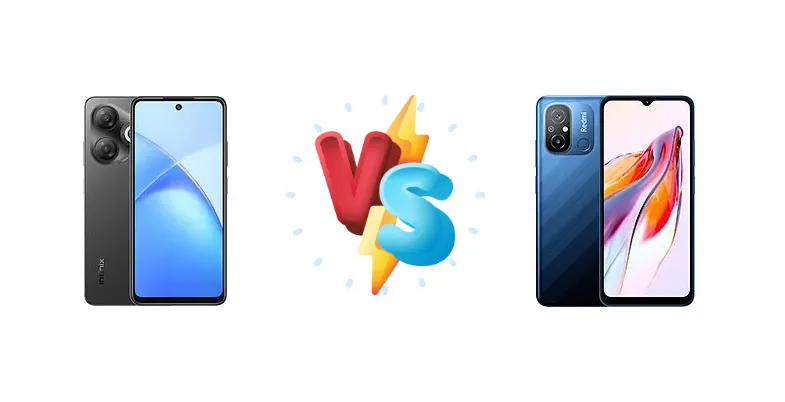
The Infinix Smart 10 HD and Xiaomi Redmi 12C represent the fiercely competitive sub-$150 smartphone market. Both aim to deliver essential smartphone functionality at an incredibly accessible price point. This comparison dissects their core components to determine which device offers the best balance of performance and features for everyday users.
🏆 Quick Verdict
For most users, the Xiaomi Redmi 12C emerges as the slightly better choice. Its Mediatek Helio G85 chipset, with higher clocked Cortex-A75 cores, provides a noticeable performance edge in demanding tasks, making it more responsive for gaming and multitasking, despite both phones sharing the same 10W charging.
| Network |
|---|
| 2G bands | GSM 850 / 900 / 1800 / 1900 | GSM 850 / 900 / 1800 / 1900 |
| 3G bands | HSDPA 850 / 900 / 1700(AWS) / 1900 / 2100 | HSDPA 850 / 900 / 2100 |
| 4G bands | 1, 2, 3, 4, 5, 7, 8, 20, 28, 38, 40, 41 | 1, 3, 5, 7, 8, 20, 28, 38, 40, 41 - International |
| Speed | HSPA, LTE | HSPA, LTE |
| Technology | GSM / HSPA / LTE | GSM / CDMA / HSPA / EVDO / LTE |
| | - | CDMA2000 1xEV-DO |
| Launch |
|---|
| Announced | 2025, June 16 | 2022, December 31 |
| Status | Available. Released 2025, June 16 | Available. Released 2023, January 01 |
| Body |
|---|
| Build | Glass front, plastic back, plastic frame | - |
| Dimensions | 163.6 x 75.6 x 8.5 mm (6.44 x 2.98 x 0.33 in) | 168.8 x 76.4 x 8.8 mm (6.65 x 3.01 x 0.35 in) |
| SIM | Nano-SIM + Nano-SIM | Nano-SIM + Nano-SIM |
| Weight | 184 g (6.49 oz) | 192 g (6.77 oz) |
| Display |
|---|
| Resolution | 720 x 1612 pixels, 20:9 ratio (~267 ppi density) | 720 x 1650 pixels (~268 ppi density) |
| Size | 6.6 inches, 104.6 cm2 (~84.6% screen-to-body ratio) | 6.71 inches, 106.5 cm2 (~82.6% screen-to-body ratio) |
| Type | IPS LCD, 90Hz, 500 nits (peak) | IPS LCD, 500 nits (typ) |
| Platform |
|---|
| CPU | Octa-core (2x1.6 GHz Cortex-A75 & 6x1.6 GHz Cortex-A55) | Octa-core (2x2.0 GHz Cortex-A75 & 6x1.8 GHz Cortex-A55) |
| Chipset | (12 nm) | Mediatek MT6769Z Helio G85 (12 nm) |
| GPU | Mali-G57 MC1 | Mali-G52 MC2 |
| OS | Android 14 (Go edition) | Android 12, MIUI 13 |
| Memory |
|---|
| Card slot | microSDXC (dedicated slot) | microSDXC (dedicated slot) |
| Internal | 64GB 2GB RAM | 32GB 2GB RAM, 32GB 3GB RAM, 32GB 4GB RAM, 64GB 3GB RAM, 64GB 4GB RAM, 128GB 3GB RAM, 128GB 4GB RAM, 128GB 6GB RAM |
| | - | eMMC 5.1 |
| Main Camera |
|---|
| Dual | - | 50 MP, (wide), PDAF
0.08 MP (depth) |
| Features | Quad-LED flash | LED flash, HDR |
| Single | 13 MP, f/1.9, 27mm (wide), AF | 50 MP, f/1.8, (wide), 1/2.76", PDAF
Auxiliary lens |
| Video | 1080p@30fps | 1080p@30fps |
| Selfie camera |
|---|
| Single | 8 MP, f/2.0, (wide), 1/4.0", 1.12µm | 5 MP, f/2.2, (wide) |
| Video | 1080p@30fps | 1080p@30fps |
| Sound |
|---|
| 3.5mm jack | - | Yes |
| 35mm jack | Yes | Yes |
| Loudspeaker | Yes | Yes |
| Comms |
|---|
| Bluetooth | Yes | 5.1, A2DP, LE |
| Infrared port | Yes | - |
| NFC | No | Yes (market/region dependent) |
| Positioning | GPS | GPS, GLONASS, BDS, GALILEO |
| Radio | FM radio | FM radio |
| USB | USB Type-C 2.0, OTG | microUSB 2.0 |
| WLAN | Wi-Fi 802.11 a/b/g/n/ac | Wi-Fi 802.11 a/b/g/n/ac, dual-band, Wi-Fi Direct |
| Features |
|---|
| Sensors | Fingerprint (side-mounted), accelerometer, proximity, compass | Fingerprint (rear-mounted), accelerometer |
| | - | Virtual proximity sensing |
| Battery |
|---|
| Charging | 10W wired
Reverse wired | 10W wired |
| Type | 5000 mAh | Li-Po 5000 mAh |
| Misc |
|---|
| Colors | Timber Black, Shiny Gold, Crystal Green, Galaxy White | Graphite Gray, Ocean Blue, Mint Green, Lavender Purple |
| Models | X6525D | 22120RN86G, 22120RN86I, 22126RN91Y, 2212ARNC4L |
| Price | About 60 EUR | £ 132.99 / € 107.41 |
| SAR | - | 1.08 W/kg (head) 0.64 W/kg (body) |
| SAR EU | - | 0.98 W/kg (head) 0.99 W/kg (body) |
Infinix Smart 10 HD
- Potentially lower price point
- Reverse wired charging capability
- Simple and straightforward user experience
- Slower processor performance
- Likely lower camera quality
- 10W charging is slow
Xiaomi Redmi 12C
- Faster processor for smoother performance
- Likely better camera quality with larger sensor
- Optimized chipset for casual gaming
- May be slightly more expensive
- 10W charging is slow
- Software experience can be cluttered with Xiaomi's MIUI
Display Comparison
Neither device boasts a standout display. Both likely utilize LCD panels, common in this price bracket. The absence of detailed display specs necessitates focusing on performance impact. A smoother experience on the Redmi 12C, due to the faster processor, will translate to slightly more fluid scrolling and animations, even if the panel characteristics are similar.
Camera Comparison
Both phones likely feature basic camera setups, with the Redmi 12C often sporting a 50MP main sensor, while the Smart 10 HD typically features an 8MP sensor. While megapixel count isn't everything, a larger sensor generally captures more light, resulting in better image quality, especially in low-light conditions. The Redmi 12C’s larger sensor, combined with Mediatek’s image signal processor, will likely produce more detailed and vibrant photos. The inclusion of 2MP macro/depth sensors on both devices is largely marketing fluff and shouldn’t heavily influence purchasing decisions.
Performance
The core difference lies in the chipsets. The Xiaomi Redmi 12C’s Mediatek Helio G85 features two Cortex-A75 cores clocked at 2.0 GHz, compared to the Infinix Smart 10 HD’s 1.6 GHz Cortex-A75 cores. This 20% clock speed increase, coupled with slightly faster Cortex-A55 cores (1.8 GHz vs 1.6 GHz), translates to a tangible performance advantage for the Redmi 12C in CPU-intensive tasks. While both are 12nm chips, the Helio G85’s architecture is optimized for gaming, offering a better experience for casual mobile gamers. The identical RAM configurations (assumed to be 2-4GB based on market segment) mean the CPU difference will be the primary bottleneck.
Battery Life
Both devices are equipped with 10W wired charging, indicating similar charging speeds – expect around 3-4 hours for a full charge. Battery capacity is not specified, but both likely fall in the 5000mAh range, typical for this segment. The Redmi 12C’s more efficient chipset may result in slightly better battery life during moderate use, but the difference will likely be minimal. The 10W charging is a significant limitation for both, making overnight charging the norm.
Buying Guide
Buy the Infinix Smart 10 HD if you prioritize a potentially lower price point and are primarily focused on basic tasks like calls, messaging, and light social media use. Buy the Xiaomi Redmi 12C if you value a smoother user experience, slightly better gaming performance, and a more responsive interface, even if it means spending a little extra.
Frequently Asked Questions
❓ Will the Redmi 12C handle popular games like PUBG Mobile or Call of Duty?
The Helio G85 in the Redmi 12C is capable of running PUBG Mobile and Call of Duty at low to medium settings with acceptable frame rates. However, don't expect a high-end gaming experience; you'll likely need to compromise on graphics quality for smoother gameplay. The Infinix Smart 10 HD will struggle more with these titles.
❓ How does the software experience differ between the Infinix Smart 10 HD and the Xiaomi Redmi 12C?
The Infinix Smart 10 HD typically runs a lighter version of Android, offering a cleaner and more streamlined experience. The Xiaomi Redmi 12C runs MIUI, Xiaomi’s custom Android skin, which is feature-rich but can be more resource-intensive and include pre-installed bloatware. This can impact performance on a budget device.
❓ Is the reverse wired charging on the Infinix Smart 10 HD useful?
Reverse wired charging allows the Infinix Smart 10 HD to act as a power bank for other devices. However, with only 10W output, it's a very slow charging method and best suited for emergencies or topping up accessories like wireless earbuds.
❓ What kind of storage options are available on these phones?
Both phones typically come with 32GB or 64GB of internal storage, expandable via microSD card. Given the limited internal storage, a microSD card is highly recommended for storing photos, videos, and apps.