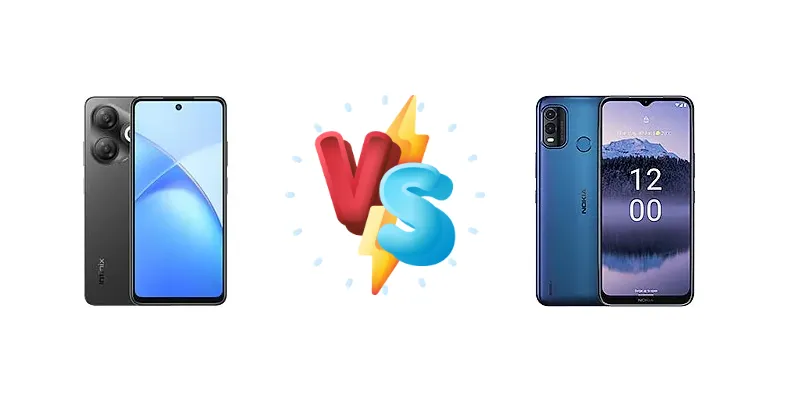
The sub-$150 smartphone market is fiercely competitive. Both the Infinix Smart 10 HD and the Nokia G11 Plus aim to deliver essential smartphone functionality at an accessible price point. While their core specifications appear remarkably similar, a closer examination reveals nuanced differences that will appeal to distinct user profiles.
🏆 Quick Verdict
For the average user prioritizing a recognizable brand with a potentially longer software support lifecycle, the Nokia G11 Plus is the slightly better choice. However, the Infinix Smart 10 HD offers comparable performance and the inclusion of reverse wired charging, making it a strong contender for those seeking maximum value.
| Network |
|---|
| 2G bands | GSM 850 / 900 / 1800 / 1900 | GSM 850 / 900 / 1800 / 1900 |
| 3G bands | HSDPA 850 / 900 / 1700(AWS) / 1900 / 2100 | HSDPA 850 / 900 / 2100 - International |
| 4G bands | 1, 2, 3, 4, 5, 7, 8, 20, 28, 38, 40, 41 | 1, 3, 5, 7, 8, 20, 28, 38, 40, 41 - International |
| Speed | HSPA, LTE | HSPA 42.2/5.76 Mbps, LTE Cat4 150/50 Mbps |
| Technology | GSM / HSPA / LTE | GSM / HSPA / LTE |
| | - | 1, 3, 5, 8, 40, 41 - India |
| Launch |
|---|
| Announced | 2025, June 16 | 2022, June 29 |
| Status | Available. Released 2025, June 16 | Available. Released 2022, July 20 |
| Body |
|---|
| Build | Glass front, plastic back, plastic frame | Glass front, plastic frame, plastic back |
| Dimensions | 163.6 x 75.6 x 8.5 mm (6.44 x 2.98 x 0.33 in) | 164.8 x 75.9 x 8.6 mm (6.49 x 2.99 x 0.34 in) |
| SIM | Nano-SIM + Nano-SIM | · Nano-SIM· Nano-SIM + Nano-SIM |
| Weight | 184 g (6.49 oz) | 192 g (6.77 oz) |
| | - | Splash protection |
| Display |
|---|
| Resolution | 720 x 1612 pixels, 20:9 ratio (~267 ppi density) | 720 x 1600 pixels, 20:9 ratio (~269 ppi density) |
| Size | 6.6 inches, 104.6 cm2 (~84.6% screen-to-body ratio) | 6.52 inches, 102.6 cm2 (~82.1% screen-to-body ratio) |
| Type | IPS LCD, 90Hz, 500 nits (peak) | IPS LCD, 90Hz, 400 nits (typ) |
| Platform |
|---|
| CPU | Octa-core (2x1.6 GHz Cortex-A75 & 6x1.6 GHz Cortex-A55) | Octa-core (2x1.6 GHz Cortex-A75 & 6x1.6 GHz Cortex-A55) |
| Chipset | (12 nm) | Unisoc T606 (12 nm) |
| GPU | Mali-G57 MC1 | Mali-G57 MP1 |
| OS | Android 14 (Go edition) | Android 12, upgradable to Android 13 |
| Memory |
|---|
| Card slot | microSDXC (dedicated slot) | microSDXC (dedicated slot) |
| Internal | 64GB 2GB RAM | 32GB 3GB RAM, 64GB 3GB RAM, 64GB 4GB RAM, 128GB 3GB RAM |
| | - | eMMC 5.1 |
| Main Camera |
|---|
| Dual | - | 50 MP, f/1.8, (wide), 1/2.67", PDAF
Auxiliary lens |
| Features | Quad-LED flash | LED flash |
| Single | 13 MP, f/1.9, 27mm (wide), AF | 8 MP, f/2.0, (wide), 1/4.0" |
| Video | 1080p@30fps | 1080p@30fps |
| Selfie camera |
|---|
| Single | 8 MP, f/2.0, (wide), 1/4.0", 1.12µm | 8 MP, f/2.0, (wide), 1/4.0" |
| Video | 1080p@30fps | 1080p@30fps |
| Sound |
|---|
| 3.5mm jack | - | Yes |
| 35mm jack | Yes | Yes |
| Loudspeaker | Yes | Yes |
| Comms |
|---|
| Bluetooth | Yes | 5.0, A2DP, LE |
| Infrared port | Yes | - |
| NFC | No | No |
| Positioning | GPS | GPS |
| Radio | FM radio | FM radio |
| USB | USB Type-C 2.0, OTG | USB Type-C 2.0, OTG |
| WLAN | Wi-Fi 802.11 a/b/g/n/ac | Wi-Fi 802.11 a/b/g/n/ac, dual-band, Wi-Fi Direct |
| Features |
|---|
| Sensors | Fingerprint (side-mounted), accelerometer, proximity, compass | Fingerprint (rear-mounted), accelerometer, proximity |
| Battery |
|---|
| Charging | 10W wired
Reverse wired | 10W wired |
| Type | 5000 mAh | Li-Ion 5000 mAh |
| Misc |
|---|
| Colors | Timber Black, Shiny Gold, Crystal Green, Galaxy White | Lake Blue, Charcoal Grey |
| Models | X6525D | - |
| Price | About 60 EUR | About 130 EUR |
Infinix Smart 10 HD
- Includes reverse wired charging for accessory top-ups.
- Offers comparable performance to the Nokia G11 Plus.
- Potentially lower price point for budget-conscious buyers.
- Less established brand reputation.
- Potentially shorter software support lifecycle.
Nokia G11 Plus
- Nokia's reputation for reliability and build quality.
- Cleaner Android experience with fewer pre-installed apps.
- Potentially longer software update support.
- Lacks reverse wired charging functionality.
- Performance is virtually identical to the Infinix Smart 10 HD.
Display Comparison
Both the Infinix Smart 10 HD and Nokia G11 Plus lack detailed display specifications in the provided data. However, given their price bracket, it's safe to assume both utilize LCD panels with 720p+ resolution. The absence of information regarding peak brightness, color gamut coverage, or PWM dimming rates suggests neither device will excel in outdoor visibility or color accuracy. Bezels are likely to be substantial on both, contributing to a less immersive viewing experience. Users prioritizing display quality should consider stepping up to a higher price tier.
Camera Comparison
Camera performance is likely to be a weak point on both devices. The provided data doesn't detail sensor sizes or lens apertures, but budget phones in this segment typically feature low-resolution primary sensors. While both may include multiple rear cameras, the usefulness of secondary sensors (often 2MP macro or depth sensors) is limited. Image processing will likely prioritize speed over quality, resulting in images with limited dynamic range and detail, especially in challenging lighting conditions. Users seeking a capable camera should expect to compromise significantly or invest in a more expensive device.
Performance
The core performance of both devices is virtually identical. Both are powered by an Octa-core CPU featuring 2x1.6 GHz Cortex-A75 and 6x1.6 GHz Cortex-A55 cores, built on a 12nm process. This means day-to-day tasks like browsing, social media, and light app usage will feel similar on both phones. The Unisoc T606 in the Nokia G11 Plus and the processor in the Infinix Smart 10 HD are architecturally the same, so performance differences will be negligible. Thermal management will likely be adequate for these workloads, but sustained gaming or heavy multitasking could lead to some throttling. The lack of information on RAM type and speed prevents a deeper analysis of multitasking capabilities.
Battery Life
Both the Infinix Smart 10 HD and Nokia G11 Plus support 10W wired charging. This is a relatively slow charging speed, meaning a full charge from 0-100% will likely take over two hours. The actual battery capacity isn't specified, but typical capacities for phones in this price range are around 5000mAh. While 10W charging is slow, it's sufficient for overnight charging. The Infinix Smart 10 HD distinguishes itself with reverse wired charging, allowing it to act as a power bank for other devices – a useful feature for users with multiple gadgets.
Buying Guide
Buy the Infinix Smart 10 HD if you need a phone with reverse wired charging functionality to top up accessories, and are comfortable with a less established brand. Buy the Nokia G11 Plus if you prioritize brand reliability, a cleaner Android experience, and potentially more consistent software updates, even if it means sacrificing the reverse charging feature.
Frequently Asked Questions
❓ Is the 10W charging speed on either phone significantly slow for daily use?
Yes, 10W charging is relatively slow. Expect a full charge to take over two hours. However, both phones are likely targeted at users who charge their devices overnight, mitigating the impact of the slow charging speed. The Infinix Smart 10 HD's reverse charging can alleviate battery anxiety in a pinch.
❓ Given the similar processors, will graphically demanding games run smoothly on either device?
While both phones share the same CPU architecture, sustained gaming performance will likely be limited. Expect to play less demanding games at lower settings. More graphically intensive titles may experience noticeable frame rate drops and throttling due to the limited thermal capacity of these budget devices.
❓ How does Nokia's software update policy compare to Infinix's for these models?
Nokia generally provides more consistent and longer-term software updates than Infinix. While specific update commitments aren't available for these exact models, Nokia typically offers at least two years of security updates, while Infinix's support is often less predictable. This is a key consideration for users prioritizing security and longevity.