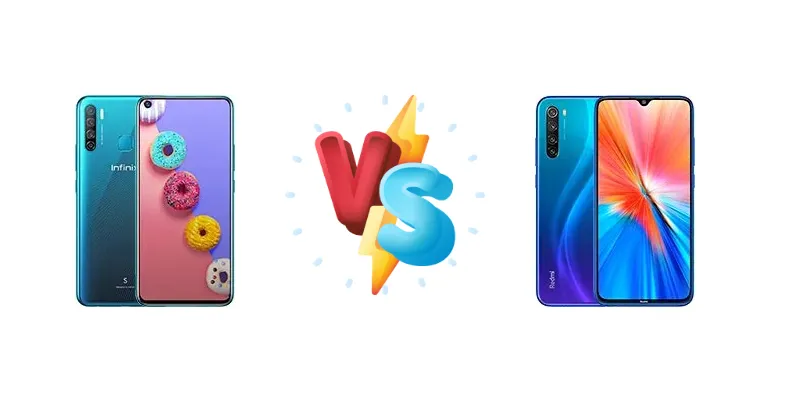
Both the Infinix S5 and the Xiaomi Redmi Note 8 2021 represent compelling options in the ultra-budget smartphone segment. However, while both aim for affordability, they diverge significantly in internal hardware, impacting performance and user experience. This comparison dissects these differences to determine which device delivers the best value.
🏆 Quick Verdict
For the average user, the Xiaomi Redmi Note 8 2021 is the superior choice. Its Helio G85 chipset provides a substantial performance uplift over the Infinix S5’s Helio P22, making it better suited for gaming and demanding applications. While battery life is comparable, the Redmi Note 8 2021’s faster charging is a welcome addition.
| Network |
|---|
| 2G bands | GSM 850 / 900 / 1800 / 1900 | GSM 850 / 900 / 1800 / 1900 |
| 3G bands | HSDPA 850 / 900 / 2100 | HSDPA 850 / 900 / 1700(AWS) / 1900 / 2100 |
| 4G bands | 1, 3, 5, 8, 38, 40, 41 | 1, 2, 3, 4, 5, 7, 8, 20, 28, 38, 40 |
| Speed | HSPA 42.2/5.76 Mbps, LTE Cat4 150/50 Mbps | HSPA, LTE |
| Technology | GSM / HSPA / LTE | GSM / HSPA / LTE |
| Launch |
|---|
| Announced | 2019, October 15. Released 2019, October | 2021, May 25 |
| Status | Discontinued | Available. Released 2021, May 27 |
| Body |
|---|
| Build | Glass front, plastic back, plastic frame | Glass front (Gorilla Glass 5), glass back (Gorilla Glass 5), plastic frame |
| Dimensions | 164 x 76 x 7.9 mm (6.46 x 2.99 x 0.31 in) | 158.3 x 75.3 x 8.4 mm (6.23 x 2.96 x 0.33 in) |
| SIM | Nano-SIM + Nano-SIM | Nano-SIM + Nano-SIM |
| Weight | 178 g (6.28 oz) | 190 g (6.70 oz) |
| Display |
|---|
| Protection | - | Corning Gorilla Glass 5 |
| Resolution | 720 x 1600 pixels, 20:9 ratio (~270 ppi density) | 1080 x 2340 pixels, 19.5:9 ratio (~409 ppi density) |
| Size | 6.6 inches, 102.1 cm2 (~81.9% screen-to-body ratio) | 6.3 inches, 97.4 cm2 (~81.7% screen-to-body ratio) |
| Type | IPS LCD | IPS LCD, 500 nits (typ) |
| Platform |
|---|
| CPU | Octa-core 2.0 GHz Cortex-A53 | Octa-core (2x2.0 GHz Cortex-A75 & 6x1.8 GHz Cortex-A55) |
| Chipset | Mediatek MT6762 Helio P22 (12 nm) | Mediatek MT6769Z Helio G85 (12 nm) |
| GPU | PowerVR GE8320 | Mali-G52 MC2 |
| OS | Android 9.0 (Pie) | Android 11, MIUI 12.5 |
| Memory |
|---|
| Card slot | microSDXC (dedicated slot) | microSDXC (dedicated slot) |
| Internal | 64GB 4GB RAM, 128GB 6GB RAM | 64GB 3GB RAM, 64GB 4GB RAM, 128GB 4GB RAM |
| | eMMC 5.1 | eMMC 5.1 |
| Main Camera |
|---|
| Features | Quad-LED flash, panorama, HDR | LED flash, HDR, panorama |
| Quad | - | 48 MP, f/1.8, 26mm (wide), 1/2.0", 0.8µm, PDAF
8 MP, f/2.2, 120˚ (ultrawide), 1/4.0", 1.12µm
2 MP (macro)
Auxiliary lens |
| Single | - | 13 MP, f/2.0, (wide), 1/3.1", 1.12µm |
| Triple | 16 MP, f/1.8, (wide), PDAF
5 MP, 14mm (ultrawide)
Auxiliary lens | - |
| Video | 1080p@30fps | 1080p@30/120fps; gyro-EIS |
| Selfie camera |
|---|
| Features | - | HDR, panorama |
| Single | 32 MP, f/2.0, 26mm (wide), 1/2.8", 0.8µm | 13 MP, f/2.0, (wide), 1/3.1", 1.12µm |
| Video | 1080p@30fps | 1080p@30fps |
| Sound |
|---|
| 3.5mm jack | Yes | Yes |
| 35mm jack | Yes | Yes |
| Loudspeaker | Yes | Yes |
| Comms |
|---|
| Bluetooth | 5.0, A2DP, LE | 5.2, A2DP, LE |
| Infrared port | - | Yes |
| NFC | No | No |
| Positioning | GPS | GPS, GLONASS, GALILEO, BDS |
| Radio | FM radio | FM radio |
| USB | microUSB 2.0, OTG | USB Type-C 2.0, OTG |
| WLAN | Wi-Fi 802.11 a/b/g/n | Wi-Fi 802.11 a/b/g/n/ac, dual-band, Wi-Fi Direct |
| Features |
|---|
| Sensors | Fingerprint (rear-mounted), accelerometer, gyro, proximity, compass | Fingerprint (rear-mounted), accelerometer, gyro, proximity, compass |
| Battery |
|---|
| Charging | - | 18W wired |
| Type | 4000 mAh, non-removable | Li-Po 4000 mAh |
| Misc |
|---|
| Colors | Quetzal Cyan, Violet | Neptune Blue, Moonlight White, Space Black |
| Models | X652 | M1908C3JGG |
| Price | About 120 EUR | About 160 EUR |
| SAR | - | 0.97 W/kg (head) 0.75 W/kg (body) |
| SAR EU | - | 0.57 W/kg (head) 0.94 W/kg (body) |
| Tests |
|---|
| Battery life | - |
Endurance rating 102h
|
| Camera | - |
Photo / Video |
| Display | - |
Contrast ratio: 1487:1 (nominal) |
| Loudspeaker | - |
-28.6 LUFS (Average)
|
| Performance | - |
AnTuTu: 180195 (v8), 165779 (v9)
GeekBench: 5259 (v4.4), 1314 (v5.1)
GFXBench: 8.7fps (ES 3.1 onscreen) |
Infinix S5
- Potentially lower price point
- Acceptable battery life for basic use
- Functional for essential smartphone tasks
- Significantly weaker performance
- Likely slower charging speeds
- Less capable camera system
Xiaomi Redmi Note 8 2021
- Superior performance with Helio G85
- Faster 18W charging
- Brighter display for better outdoor visibility
- May be slightly more expensive
- Battery life is comparable, not superior
- Still a budget device with inherent limitations
Display Comparison
The Xiaomi Redmi Note 8 2021 boasts a brighter display, reaching a measured 620 nits compared to the Infinix S5’s unspecified brightness. Both share a 1487:1 contrast ratio, suggesting similar color depth and black levels. However, the Redmi Note 8 2021’s higher peak brightness translates to better visibility outdoors under direct sunlight. While both likely utilize IPS LCD panels, the Redmi Note 8 2021’s superior brightness provides a more comfortable viewing experience in various lighting conditions.
Camera Comparison
Both devices offer 'Photo / Video' capabilities, but the context data lacks specifics. Given the market positioning, it’s safe to assume both feature basic camera setups. The Redmi Note 8 2021 likely benefits from the improved image signal processor (ISP) within the Helio G85, potentially leading to better image processing and low-light performance. Without sensor size or aperture information, a definitive camera comparison is impossible, but the Redmi Note 8 2021’s chipset advantage suggests a more capable camera system.
Performance
The core difference lies in the chipsets. The Infinix S5 utilizes the Mediatek Helio P22, featuring eight Cortex-A53 cores clocked at 2.0 GHz. The Redmi Note 8 2021, however, is powered by the Helio G85. This chipset employs a more modern architecture with two Cortex-A75 cores at 2.0 GHz and six Cortex-A55 cores at 1.8 GHz. This architectural shift, combined with the G85’s improved GPU, results in significantly better performance in both CPU-intensive tasks and gaming. The Redmi Note 8 2021 will handle multitasking and graphically demanding games with greater ease, while the S5 may struggle with heavier workloads.
Battery Life
Both the Infinix S5 and the Xiaomi Redmi Note 8 2021 achieve an endurance rating of 102 hours, indicating comparable battery life under similar usage patterns. However, the Redmi Note 8 2021 supports 18W wired charging, a significant advantage over the Infinix S5’s likely slower charging speed. This means the Redmi Note 8 2021 can be topped up much faster, minimizing downtime and offering greater convenience.
Buying Guide
Buy the Infinix S5 if your primary needs are basic smartphone functionality – calls, texts, and light social media – and you prioritize minimizing cost above all else. Buy the Xiaomi Redmi Note 8 2021 if you want a more responsive experience, enjoy mobile gaming occasionally, or value faster charging and a slightly brighter display.
Frequently Asked Questions
❓ Is the Helio G85 in the Redmi Note 8 2021 capable of playing demanding games like PUBG Mobile?
Yes, the Helio G85 is specifically designed for gaming. While it won't deliver flagship-level performance, it can comfortably run PUBG Mobile at medium settings with stable frame rates. The Infinix S5’s Helio P22 would likely struggle with consistent performance in PUBG.
❓ How much faster is the charging on the Redmi Note 8 2021 compared to the Infinix S5?
The Redmi Note 8 2021 supports 18W charging, while the Infinix S5 likely supports a much slower charging speed (typically 10W or less). This translates to a significantly faster 0-100% charge time on the Redmi Note 8 2021, potentially cutting charging time in half.
❓ Will I notice a significant difference in app loading times between the two phones?
Absolutely. The Redmi Note 8 2021’s Helio G85, with its Cortex-A75 cores, offers a substantial improvement in CPU performance. This will result in noticeably faster app loading times, smoother multitasking, and a more responsive overall user experience compared to the Infinix S5.