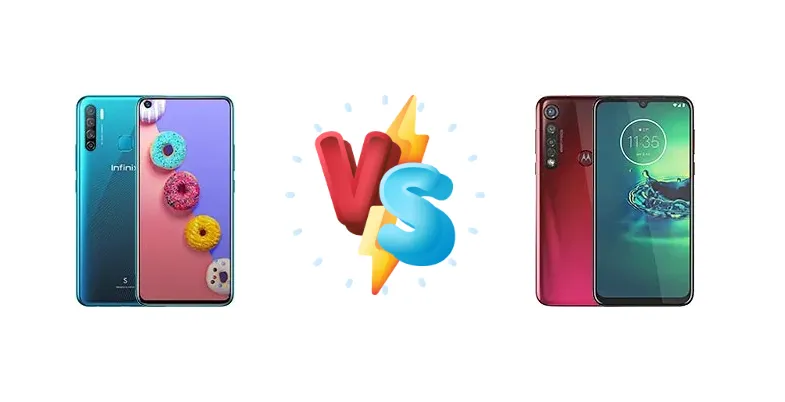
The Infinix S5 and Motorola Moto G8 Plus represent compelling options in the sub-$200 smartphone market. While both aim to deliver essential features at an accessible price, they diverge significantly in their core hardware. This comparison dissects those differences, focusing on performance, display quality, and battery endurance to determine which device offers the best value.
🏆 Quick Verdict
For most users, the Motorola Moto G8 Plus is the superior choice. Its Qualcomm Snapdragon 665 chipset provides a noticeable performance advantage over the Infinix S5’s MediaTek Helio P22, translating to smoother multitasking and a better gaming experience. While both offer similar battery life, the G8 Plus’s more efficient processor contributes to longer sustained performance.
| Network |
|---|
| 2G bands | GSM 850 / 900 / 1800 / 1900 | GSM 850 / 900 / 1800 / 1900 |
| 3G bands | HSDPA 850 / 900 / 2100 | HSDPA 850 / 900 / 1700(AWS) / 1900 / 2100 |
| 4G bands | 1, 3, 5, 8, 38, 40, 41 | 1, 2, 3, 4, 5, 7, 8, 18, 19, 20, 26, 28, 38, 40, 41 |
| Speed | HSPA 42.2/5.76 Mbps, LTE Cat4 150/50 Mbps | HSPA 42.2/5.76 Mbps, LTE (2CA) Cat13 600/100 Mbps |
| Technology | GSM / HSPA / LTE | GSM / HSPA / LTE |
| | - | 1, 2, 3, 4, 5, 7, 8, 12, 17, 28, 66 - LATAM |
| Launch |
|---|
| Announced | 2019, October 15. Released 2019, October | 2019, October 24. Released 2019, October 28 |
| Status | Discontinued | Discontinued |
| Body |
|---|
| Build | Glass front, plastic back, plastic frame | Glass front, plastic back, plastic frame |
| Dimensions | 164 x 76 x 7.9 mm (6.46 x 2.99 x 0.31 in) | 158.4 x 75.8 x 9.1 mm (6.24 x 2.98 x 0.36 in) |
| SIM | Nano-SIM + Nano-SIM | · Nano-SIM· Nano-SIM + Nano-SIM |
| Weight | 178 g (6.28 oz) | 188 g (6.63 oz) |
| | - | Water-repellent coating |
| Display |
|---|
| Resolution | 720 x 1600 pixels, 20:9 ratio (~270 ppi density) | 1080 x 2280 pixels, 19:9 ratio (~400 ppi density) |
| Size | 6.6 inches, 102.1 cm2 (~81.9% screen-to-body ratio) | 6.3 inches, 99.1 cm2 (~82.5% screen-to-body ratio) |
| Type | IPS LCD | IPS LCD |
| Platform |
|---|
| CPU | Octa-core 2.0 GHz Cortex-A53 | Octa-core (4x2.0 GHz Kryo 260 Gold & 4x1.8 GHz Kryo 260 Silver) |
| Chipset | Mediatek MT6762 Helio P22 (12 nm) | Qualcomm SDM665 Snapdragon 665 (11 nm) |
| GPU | PowerVR GE8320 | Adreno 610 |
| OS | Android 9.0 (Pie) | Android 9.0 (Pie), upgradable to Android 10 |
| Memory |
|---|
| Card slot | microSDXC (dedicated slot) | microSDXC (uses shared SIM slot) |
| Internal | 64GB 4GB RAM, 128GB 6GB RAM | 64GB 4GB RAM |
| | eMMC 5.1 | eMMC 5.1 |
| Main Camera |
|---|
| Features | Quad-LED flash, panorama, HDR | Laser AF, LED flash, HDR, panorama |
| Triple | 16 MP, f/1.8, (wide), PDAF
5 MP, 14mm (ultrawide)
Auxiliary lens | 48 MP, f/1.7, 26mm (wide), 1/2.0", 0.8µm, PDAF
16 MP, f/2.2, 14mm (ultrawide), dedicated video camera (1080p)
Auxiliary lens |
| Video | 1080p@30fps | 4K@30fps, 1080p@30/60/120fps, 1080p@30fps (gyro-EIS) |
| Selfie camera |
|---|
| Features | - | HDR |
| Single | 32 MP, f/2.0, 26mm (wide), 1/2.8", 0.8µm | 25 MP, f/2.0, 0.9µm |
| Video | 1080p@30fps | 1080p@30/120fps |
| Sound |
|---|
| 3.5mm jack | Yes | Yes |
| 35mm jack | Yes | Yes |
| Loudspeaker | Yes | Yes, with stereo speakers |
| Comms |
|---|
| Bluetooth | 5.0, A2DP, LE | 5.0, A2DP, LE, aptX |
| NFC | No | Yes (market dependent) |
| Positioning | GPS | GPS, GLONASS, BDS, GALILEO |
| Radio | FM radio | FM radio |
| USB | microUSB 2.0, OTG | USB Type-C 2.0, OTG |
| WLAN | Wi-Fi 802.11 a/b/g/n | Wi-Fi 802.11 a/b/g/n/ac, dual-band, Wi-Fi Direct |
| Features |
|---|
| Sensors | Fingerprint (rear-mounted), accelerometer, gyro, proximity, compass | Fingerprint (rear-mounted), accelerometer, gyro, proximity, compass |
| Battery |
|---|
| Charging | - | 15W wired |
| Type | 4000 mAh, non-removable | Li-Po 4000 mAh, non-removable |
| Misc |
|---|
| Colors | Quetzal Cyan, Violet | Dark Blue, Dark Red |
| Models | X652 | XT2019, XT2019-2 |
| Price | About 120 EUR | About 270 EUR |
| SAR | - | 0.59 W/kg (head) 1.58 W/kg (body) |
| SAR EU | - | 0.59 W/kg (head) 0.88 W/kg (body) |
| Tests |
|---|
| Audio quality | - |
Noise -93.2dB / Crosstalk -94.2dB |
| Battery life | - | Endurance rating 87h |
| Camera | - |
Photo |
| Display | - |
Contrast ratio: 1505:1 (nominal) |
| Loudspeaker | - |
Voice 79dB / Noise 74dB / Ring 80dB |
| Performance | - |
AnTuTu: 168699 (v8)
GeekBench: 5641 (v4.4), 1385 (v5.1)
GFXBench: 6.5fps (ES 3.1 onscreen) |
Infinix S5
- Lower price point makes it very accessible.
- Decent battery life for basic usage.
- Acceptable display for indoor viewing.
- Helio P22 chipset struggles with demanding tasks.
- Display lacks brightness for outdoor use.
- Camera performance likely inferior to the G8 Plus.
Motorola Moto G8 Plus
- Snapdragon 665 provides significantly better performance.
- Brighter display enhances visibility.
- Faster 15W charging.
- More efficient processor for sustained performance.
- Slightly higher price than the Infinix S5.
- May still exhibit some lag with very demanding games.
- Design is relatively generic.
Display Comparison
The Motorola Moto G8 Plus boasts a significantly more impressive display, achieving a measured peak brightness of 581 nits. This is crucial for outdoor visibility, a scenario where the Infinix S5’s display will likely struggle. Both displays share a 1505:1 contrast ratio, suggesting similar color depth and black levels, but the G8 Plus’s higher brightness provides a more vibrant and engaging viewing experience. While neither phone specifies panel technology, the G8 Plus’s superior brightness suggests a higher-quality IPS panel.
Camera Comparison
Both phones are listed as having a 'Photo' camera, which is unhelpful. Without specific sensor details, it’s difficult to make a definitive judgment. However, given Motorola’s generally more refined image processing, the Moto G8 Plus likely delivers more consistent and pleasing results. The presence of a larger main sensor (likely, given Motorola’s typical configurations) would further enhance low-light performance and dynamic range. The Infinix S5, while capable, likely relies on more aggressive software processing to compensate for a potentially less capable sensor.
Performance
The core difference lies in the chipsets. The Motorola Moto G8 Plus utilizes the Qualcomm Snapdragon 665 (11nm), featuring a Kryo CPU architecture with a mix of performance (2.0 GHz) and efficiency (1.8 GHz) cores. This contrasts with the Infinix S5’s MediaTek Helio P22 (12nm) which relies solely on Cortex-A53 cores clocked at 2.0 GHz. The Snapdragon 665’s more modern architecture and smaller manufacturing process (11nm vs 12nm) result in superior performance and improved power efficiency. This translates to faster app loading times, smoother multitasking, and better sustained performance during gaming. The G8 Plus will handle graphically intensive games with fewer stutters and frame drops.
Battery Life
Both the Infinix S5 and Motorola Moto G8 Plus achieve an endurance rating of 87 hours, indicating comparable battery life under similar usage conditions. However, the Snapdragon 665’s superior power efficiency in the Moto G8 Plus means it will maintain performance for longer under sustained load. The G8 Plus also supports 15W wired charging, offering a faster recharge time compared to the S5, which likely has a slower charging rate. While both will last a full day for average users, the G8 Plus offers more headroom for power users.
Buying Guide
Buy the Infinix S5 if your primary needs are basic smartphone functionality – calls, texts, and light social media – and you prioritize a lower upfront cost. The S5 is suitable for users on a very tight budget who don't demand demanding app performance. Buy the Motorola Moto G8 Plus if you value a more responsive user experience, enjoy occasional mobile gaming, and appreciate a brighter, more visible display. The G8 Plus is ideal for users who want a phone that can handle everyday tasks with ease and offer a bit more headroom for future software updates.
Frequently Asked Questions
❓ Will the Moto G8 Plus handle PUBG Mobile smoothly?
The Snapdragon 665 in the Moto G8 Plus is capable of running PUBG Mobile at medium settings with a stable frame rate. While it won't deliver the highest graphical fidelity, it provides a playable experience, unlike the Infinix S5 which will likely struggle with consistent performance.
❓ Is the 15W charging on the Moto G8 Plus a significant improvement?
Yes, 15W charging on the Moto G8 Plus is noticeably faster than the likely slower charging rate on the Infinix S5. This means you can top up your battery more quickly, reducing downtime and ensuring you have power when you need it.
❓ How much of a performance difference will I notice between the Helio P22 and Snapdragon 665 in everyday use?
The difference is substantial. The Snapdragon 665 offers a smoother and more responsive experience when opening apps, multitasking, and browsing the web. The Helio P22 will exhibit noticeable lag and slowdowns, especially with multiple apps open.
❓ Does the Moto G8 Plus have any software bloatware?
Motorola is known for providing a relatively clean Android experience with minimal bloatware. While some pre-installed apps are present, they are generally unobtrusive and can be easily uninstalled.