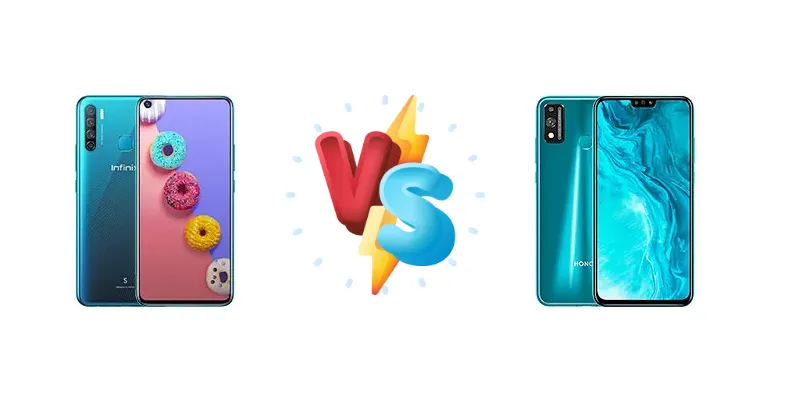
The sub-$150 smartphone market is fiercely competitive. Both the Infinix S5 and Honor 9X Lite aim to deliver a solid experience without breaking the bank. However, they take different approaches to achieving this, primarily through their chipset choices. This comparison dives deep into the specifications and real-world implications of each device to determine which offers the best value.
🏆 Quick Verdict
For most users, the Honor 9X Lite is the superior choice. Its Kirin 710F chipset provides a noticeable performance uplift over the Infinix S5’s Helio P22, translating to smoother multitasking and a more responsive user experience. While the S5 may offer slightly better value in some regions, the 9X Lite’s processing power justifies the potential price difference.
| Network |
|---|
| 2G bands | GSM 850 / 900 / 1800 / 1900 | GSM 850 / 900 / 1800 / 1900 |
| 3G bands | HSDPA 850 / 900 / 2100 | HSDPA 850 / 900 / 1900 / 2100 |
| 4G bands | 1, 3, 5, 8, 38, 40, 41 | 1, 3, 7, 8, 20 |
| Speed | HSPA 42.2/5.76 Mbps, LTE Cat4 150/50 Mbps | HSPA 42.2/5.76 Mbps, LTE (2CA) Cat6 300/50 Mbps |
| Technology | GSM / HSPA / LTE | GSM / HSPA / LTE |
| Launch |
|---|
| Announced | 2019, October 15. Released 2019, October | 2020, April 17. Released 2020, May 14 |
| Status | Discontinued | Discontinued |
| Body |
|---|
| Build | Glass front, plastic back, plastic frame | - |
| Dimensions | 164 x 76 x 7.9 mm (6.46 x 2.99 x 0.31 in) | 160.4 x 76.6 x 7.8 mm (6.31 x 3.02 x 0.31 in) |
| SIM | Nano-SIM + Nano-SIM | Nano-SIM + Nano-SIM |
| Weight | 178 g (6.28 oz) | 188 g (6.63 oz) |
| Display |
|---|
| Resolution | 720 x 1600 pixels, 20:9 ratio (~270 ppi density) | 1080 x 2340 pixels, 19.5:9 ratio (~397 ppi density) |
| Size | 6.6 inches, 102.1 cm2 (~81.9% screen-to-body ratio) | 6.5 inches, 103.2 cm2 (~84.0% screen-to-body ratio) |
| Type | IPS LCD | IPS LCD |
| Platform |
|---|
| CPU | Octa-core 2.0 GHz Cortex-A53 | Octa-core (4x2.2 GHz Cortex-A73 & 4x1.7 GHz Cortex-A53) |
| Chipset | Mediatek MT6762 Helio P22 (12 nm) | Kirin 710F (12 nm) |
| GPU | PowerVR GE8320 | Mali-G51 MP4 |
| OS | Android 9.0 (Pie) | Android 9.0 (Pie), EMUI 9.1, Google Play Services |
| Memory |
|---|
| Card slot | microSDXC (dedicated slot) | microSDXC (dedicated slot) |
| Internal | 64GB 4GB RAM, 128GB 6GB RAM | 128GB 4GB RAM |
| | eMMC 5.1 | - |
| Main Camera |
|---|
| Dual | - | 48 MP, f/1.8, (wide), 1/2.0", 0.8µm, PDAF
Auxiliary lens |
| Features | Quad-LED flash, panorama, HDR | LED flash, HDR, panorama |
| Triple | 16 MP, f/1.8, (wide), PDAF
5 MP, 14mm (ultrawide)
Auxiliary lens | - |
| Video | 1080p@30fps | 1080p@30fps |
| Selfie camera |
|---|
| Single | 32 MP, f/2.0, 26mm (wide), 1/2.8", 0.8µm | 8 MP, f/2.0, (wide) |
| Video | 1080p@30fps | 1080p@30fps |
| Sound |
|---|
| 3.5mm jack | Yes | Yes |
| 35mm jack | Yes | Yes |
| Loudspeaker | Yes | Yes |
| Comms |
|---|
| Bluetooth | 5.0, A2DP, LE | 4.2, A2DP, LE |
| NFC | No | Yes (market/region dependent) |
| Positioning | GPS | GPS, GLONASS, BDS |
| Radio | FM radio | FM radio |
| USB | microUSB 2.0, OTG | microUSB 2.0 |
| WLAN | Wi-Fi 802.11 a/b/g/n | Wi-Fi 802.11 a/b/g/n/ac, dual-band, Wi-Fi Direct |
| Features |
|---|
| Sensors | Fingerprint (rear-mounted), accelerometer, gyro, proximity, compass | Fingerprint (rear-mounted), accelerometer, proximity, compass |
| Battery |
|---|
| Charging | - | 10W wired |
| Type | 4000 mAh, non-removable | Li-Po 3750 mAh |
| Misc |
|---|
| Colors | Quetzal Cyan, Violet | Emerald Green, Midnight Black |
| Models | X652 | JSN-L21, JSN-L22, JSN-L23 |
| Price | About 120 EUR | About 220 EUR |
Infinix S5
- Potentially better battery life due to efficient chipset.
- May be more affordable in certain markets.
- Simple and straightforward user experience.
- Significantly slower performance compared to the Honor 9X Lite.
- Less capable chipset for multitasking and gaming.
- Likely inferior camera image processing.
Honor 9X Lite
- Faster and more responsive performance with the Kirin 710F.
- Better multitasking capabilities.
- Faster charging (10W).
- Potentially shorter battery life compared to the Infinix S5.
- May be slightly more expensive.
- Software experience may vary depending on region.
Display Comparison
Neither device boasts a standout display. Both utilize 12nm chipsets, suggesting a focus on efficiency over pushing display boundaries. Specific display specs (resolution, panel type, brightness) are not provided, but given the price point, we can assume both employ LCD panels. The Honor 9X Lite likely benefits from slightly better image processing capabilities due to its more powerful chipset, potentially resulting in more accurate color reproduction. Bezels are likely comparable, typical of this price segment.
Camera Comparison
Without detailed camera specifications, a direct comparison is difficult. However, it’s reasonable to assume both phones feature a primary camera and potentially depth/macro sensors. The Honor 9X Lite’s image signal processor (ISP), integrated within the Kirin 710F, is likely more advanced than the one in the Helio P22, leading to better image processing, noise reduction, and dynamic range. The S5 may rely more heavily on software processing to compensate for a potentially less capable sensor. The presence of a 10W charging capability on the 9X Lite suggests a slightly more refined overall user experience, potentially extending to camera software features.
Performance
The core difference lies in the chipsets. The Honor 9X Lite’s Kirin 710F is a clear upgrade over the Infinix S5’s Mediatek Helio P22. The Kirin 710F features a combination of four high-performance Cortex-A73 cores clocked at 2.2 GHz and four efficiency-focused Cortex-A53 cores at 1.7 GHz. This contrasts with the S5’s eight Cortex-A53 cores clocked at 2.0 GHz. The A73 cores in the 9X Lite provide a substantial boost in single-core performance, crucial for app launch speeds and general responsiveness. While both are 12nm, the Kirin 710F’s architecture is more modern and efficient. This translates to better multitasking and a smoother experience with demanding applications.
Battery Life
Battery capacity isn’t specified for either device. However, the Helio P22 in the Infinix S5 is known for its power efficiency. This, combined with potentially less demanding display and camera hardware, could result in slightly longer battery life compared to the Honor 9X Lite. However, the 9X Lite’s 10W wired charging offers a faster replenishment rate, reducing downtime. The trade-off is between potentially longer runtimes on the S5 and quicker charging on the 9X Lite.
Buying Guide
Buy the Infinix S5 if your primary needs are basic smartphone functionality – calls, texts, and light social media – and you prioritize maximizing battery life over performance. It’s a good option for first-time smartphone users or those on a very tight budget. Buy the Honor 9X Lite if you want a phone that can handle more demanding tasks like gaming, video streaming, and running multiple apps simultaneously. The Kirin 710F offers a significantly better experience for users who want a more responsive and versatile device.
Frequently Asked Questions
❓ Will the Honor 9X Lite struggle with popular games like PUBG Mobile?
While the Kirin 710F isn't a gaming powerhouse, it's capable of running PUBG Mobile at medium settings with reasonable frame rates. Expect some occasional stuttering during intense firefights, but it's a playable experience. The Infinix S5’s Helio P22 will likely struggle to maintain stable frame rates even at the lowest settings.
❓ Is the 10W charging on the Honor 9X Lite slow compared to modern fast charging standards?
Yes, 10W is relatively slow by today's standards. However, it's still faster than what the Infinix S5 likely offers (charging speed not specified). A full charge will take around 2-3 hours. It's a trade-off for the lower price point.
❓ How does the software experience differ between the Infinix S5 and Honor 9X Lite?
The Infinix S5 typically runs on XOS, while the Honor 9X Lite runs on EMUI (based on Android). EMUI is generally considered more polished and feature-rich, but also includes more pre-installed apps. XOS is lighter but may lack some of the refinements found in EMUI.