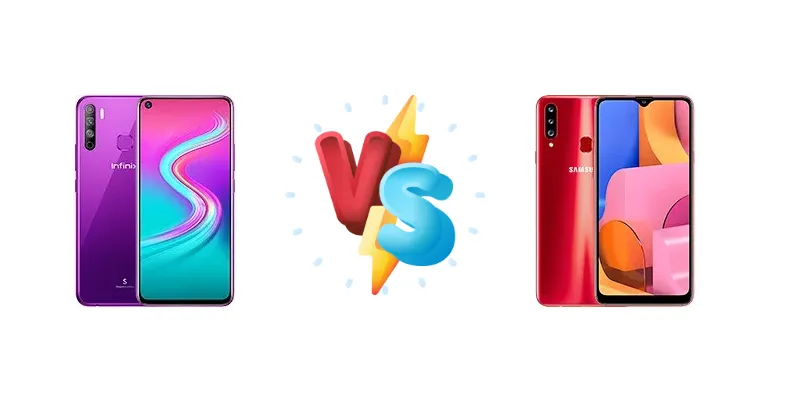
The Infinix S5 Lite and Samsung Galaxy A20s represent compelling options in the ultra-budget smartphone segment. Both aim to deliver essential smartphone functionality at a low price point, but they achieve this with different approaches to chipset design and feature sets. This comparison dives deep into the core differences to help you determine which device best suits your needs.
🏆 Quick Verdict
For the average user prioritizing sustained performance and faster charging, the Samsung Galaxy A20s is the better choice. While the Infinix S5 Lite boasts a slightly newer chipset architecture, the Snapdragon 450’s 14nm process and 15W charging provide a more refined and efficient experience.
| Network |
|---|
| 2G bands | GSM 850 / 900 / 1800 / 1900 | GSM 850 / 900 / 1800 / 1900 |
| 3G bands | HSDPA 850 / 900 / 2100 | HSDPA 850 / 900 / 1900 / 2100 - SM-A207F/DS |
| 4G bands | 1, 3, 5, 8, 38, 40, 41 | 1, 2, 3, 5, 7, 8, 20, 28, 34, 38, 39, 40, 41 - SM-A207F/DS |
| Speed | HSPA 42.2/11.5 Mbps, LTE Cat4 150/50 Mbps | HSPA, LTE |
| Technology | GSM / HSPA / LTE | GSM / HSPA / LTE |
| | 1, 2, 3, 4, 5, 7, 8, 20, 28, 38, 40, 41 | 1, 2, 3, 4, 5, 7, 8, 12, 13, 17, 20, 28, 38, 40, 41, 66 - SM-A207M/DS |
| Launch |
|---|
| Announced | 2019, November. Released 2019, November | 2019, September 24. Released 2019, October 05 |
| Status | Discontinued | Discontinued |
| Body |
|---|
| Build | Glass front, plastic back, plastic frame | Glass front, plastic back, plastic frame |
| Dimensions | 164 x 76 x 7.9 mm (6.46 x 2.99 x 0.31 in) | 163.3 x 77.5 x 8 mm (6.43 x 3.05 x 0.31 in) |
| SIM | Nano-SIM + Nano-SIM | · Nano-SIM· Nano-SIM + Nano-SIM |
| Weight | 178 g (6.28 oz) | 183 g (6.46 oz) |
| Display |
|---|
| Resolution | 720 x 1600 pixels, 20:9 ratio (~266 ppi density) | 720 x 1560 pixels, 19.5:9 ratio (~264 ppi density) |
| Size | 6.6 inches, 105.2 cm2 (~84.4% screen-to-body ratio) | 6.5 inches, 103.7 cm2 (~81.9% screen-to-body ratio) |
| Type | IPS LCD, 480 nits (typ) | IPS LCD |
| Platform |
|---|
| CPU | Octa-core 2.0 GHz Cortex-A53 | Octa-core 1.8 GHz Cortex-A53 |
| Chipset | Mediatek MT6762 Helio P22 (12 nm) | Qualcomm SDM450 Snapdragon 450 (14 nm) |
| GPU | PowerVR GE8320 | Adreno 506 |
| OS | Android 9.0 (Pie), XOS 5.5 | Android 9.0 (Pie), upgradable to Android 11, One UI Core 3.1 |
| Memory |
|---|
| Card slot | microSDXC (dedicated slot) | microSDXC (dedicated slot) |
| Internal | 32GB 3GB RAM, 64GB 4GB RAM | 32GB 2GB RAM, 32GB 3GB RAM, 64GB 4GB RAM |
| | eMMC 5.1 | eMMC 5.1 |
| Main Camera |
|---|
| Features | Quad-LED flash, panorama, HDR | LED flash, panorama, HDR |
| Triple | 16 MP, f/1.8, PDAF
2 MP
AI Lens (low light sensor) | 13 MP, f/1.8, 27mm (wide), PDAF
8 MP, f/2.2, 13mm (ultrawide), 1/4.0", 1.12µm
Auxiliary lens |
| Video | 1080p@30fps | 1080p@30fps |
| Selfie camera |
|---|
| Single | 16 MP, f/2.0 | 8 MP, f/2.0 |
| Video | 1080p@30fps | 1080p@30fps |
| Sound |
|---|
| 3.5mm jack | Yes | Yes |
| 35mm jack | Yes | Yes |
| Loudspeaker | Yes | Yes |
| Comms |
|---|
| Bluetooth | 5.0, A2DP, LE | 4.2, A2DP, LE |
| NFC | No | No |
| Positioning | GPS | GPS, GLONASS, GALILEO, BDS |
| Radio | FM radio | FM radio |
| USB | microUSB 2.0, OTG | USB Type-C 2.0 |
| WLAN | Wi-Fi 802.11 a/b/g/n | Wi-Fi 802.11 b/g/n, Wi-Fi Direct |
| Features |
|---|
| Sensors | Fingerprint (rear-mounted), accelerometer, proximity, compass | Fingerprint (rear-mounted), accelerometer, gyro, proximity, compass |
| Battery |
|---|
| Charging | - | 15W wired |
| Type | 4000 mAh | Li-Po 4000 mAh, non-removable |
| Misc |
|---|
| Colors | Midnight black, Quetzal cyan, Violet | Black, Blue, Red, Green |
| Models | X652B, X652C | SM-A207F, SM-A207M, SM-A2070 |
| Price | About 100 EUR | About 250 EUR |
| SAR | - | 0.69 W/kg (head) 1.43 W/kg (body) |
| SAR EU | - | 0.35 W/kg (head) 0.83 W/kg (body) |
Infinix S5 lite
- Potentially more efficient 12nm chipset
- Higher CPU clock speed (2.0 GHz)
- Competitive price point
- Likely slower charging speeds
- Less established brand reputation
- Potential for more thermal throttling
Samsung Galaxy A20s
- 15W fast charging support
- Qualcomm chipset optimization for smoother performance
- Established brand reputation and potential for better software support
- Slightly lower CPU clock speed (1.8 GHz)
- 14nm process is less efficient than 12nm (theoretically)
- May be slightly more expensive
Display Comparison
Neither device is known for display prowess. Specifications are unavailable for both, so we must infer. Given the price bracket, both likely utilize IPS LCD panels with 720p+ resolutions. The A20s, being a Samsung product, *may* benefit from slightly better color calibration, but this is speculative. The absence of high refresh rates or advanced panel technologies like LTPO is expected at this price point. Bezels are likely comparable, prioritizing cost reduction over premium aesthetics.
Camera Comparison
Camera performance is likely to be similar, with both devices targeting basic photography needs. Without sensor size or aperture data, a direct comparison is difficult. However, given Samsung’s image processing expertise, the A20s is likely to produce more consistently pleasing images, particularly in challenging lighting conditions. The prevalence of 2MP macro/depth sensors on both devices suggests these are largely marketing features with limited practical benefit. Focusing on the main sensor’s quality is crucial, and without specific details, it’s difficult to declare a clear winner.
Performance
The core difference lies in the chipsets. The Infinix S5 Lite utilizes the Mediatek Helio P22 (12nm), while the Samsung Galaxy A20s features the Qualcomm Snapdragon 450 (14nm). While both are octa-core Cortex-A53 designs, the 12nm process of the Helio P22 *should* theoretically offer better power efficiency. However, the Snapdragon 450’s architecture and Qualcomm’s optimization often translate to smoother performance in real-world usage, particularly in sustained tasks. The A20s’s 1.8 GHz clock speed is slightly lower, but the more mature chipset design compensates. The A20s is likely to exhibit less thermal throttling under load.
Battery Life
Battery capacity is not specified for either device, but both likely fall in the 3000-4000 mAh range. The key differentiator is charging speed. The Samsung Galaxy A20s supports 15W wired charging, a significant advantage over the likely slower charging speeds of the Infinix S5 Lite. This translates to faster top-ups and less time tethered to a charger. While a larger battery capacity on the S5 Lite could offset this, the efficiency of the Snapdragon 450 may result in comparable real-world battery life despite a potentially smaller capacity.
Buying Guide
Buy the Infinix S5 Lite if you prioritize a potentially smoother experience with everyday tasks due to its octa-core CPU clocked at 2.0 GHz, and are comfortable with slower charging speeds. Buy the Samsung Galaxy A20s if you value a more established brand reputation, a more efficient chipset with 15W fast charging, and potentially better long-term software support, even if the CPU is clocked slightly lower.
Frequently Asked Questions
❓ Will the Snapdragon 450 in the Galaxy A20s handle popular apps like WhatsApp and Facebook smoothly?
Yes, the Snapdragon 450 is more than capable of handling everyday apps like WhatsApp, Facebook, and web browsing without significant lag. Qualcomm’s optimization ensures a fluid experience even with multiple apps open.
❓ Is the difference in CPU clock speed (2.0 GHz vs 1.8 GHz) noticeable in real-world use?
While the Infinix S5 Lite has a slightly higher clock speed, the Snapdragon 450’s more efficient architecture and thermal management often result in a smoother overall experience. The difference in clock speed is unlikely to be noticeable during typical usage scenarios.
❓ How long will it take to fully charge the Samsung Galaxy A20s with the 15W charger?
Assuming a 4000mAh battery (a common capacity for this segment), the Samsung Galaxy A20s should fully charge from 0% to 100% in approximately 2.5 to 3 hours with the included 15W charger. This is significantly faster than the likely charging time of the Infinix S5 Lite.
❓ Does either phone support USB-C charging?
Both phones likely use Micro-USB for charging, a common feature in this price range. USB-C is less common in ultra-budget smartphones.