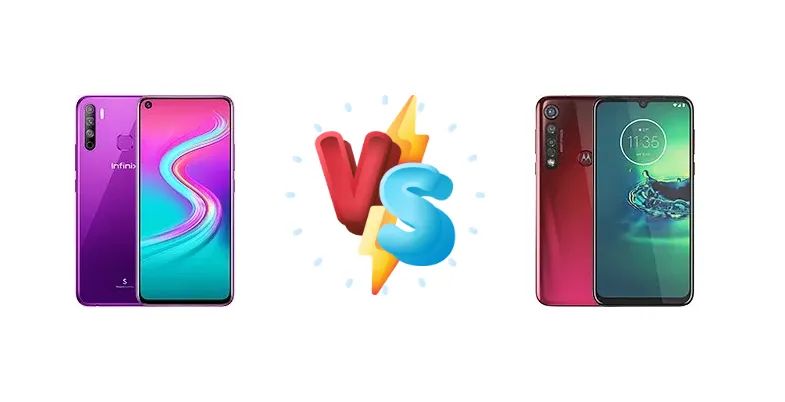
The sub-$150 smartphone market is fiercely competitive. The Infinix S5 Lite and Motorola Moto G8 Plus both aim to deliver a solid experience without breaking the bank, but they take different approaches. The S5 Lite focuses on affordability, while the G8 Plus attempts to balance features with a more capable chipset. This comparison dives deep into the specifics to determine which phone offers the best value.
🏆 Quick Verdict
For most users, the Motorola Moto G8 Plus is the better choice. Its Qualcomm Snapdragon 665 chipset provides a noticeable performance advantage over the Infinix S5 Lite’s MediaTek Helio P22, translating to smoother multitasking and a more responsive user experience. While both offer similar battery endurance, the G8 Plus’s faster charging is a welcome addition.
| Network |
|---|
| 2G bands | GSM 850 / 900 / 1800 / 1900 | GSM 850 / 900 / 1800 / 1900 |
| 3G bands | HSDPA 850 / 900 / 2100 | HSDPA 850 / 900 / 1700(AWS) / 1900 / 2100 |
| 4G bands | 1, 3, 5, 8, 38, 40, 41 | 1, 2, 3, 4, 5, 7, 8, 18, 19, 20, 26, 28, 38, 40, 41 |
| Speed | HSPA 42.2/11.5 Mbps, LTE Cat4 150/50 Mbps | HSPA 42.2/5.76 Mbps, LTE (2CA) Cat13 600/100 Mbps |
| Technology | GSM / HSPA / LTE | GSM / HSPA / LTE |
| | 1, 2, 3, 4, 5, 7, 8, 20, 28, 38, 40, 41 | 1, 2, 3, 4, 5, 7, 8, 12, 17, 28, 66 - LATAM |
| Launch |
|---|
| Announced | 2019, November. Released 2019, November | 2019, October 24. Released 2019, October 28 |
| Status | Discontinued | Discontinued |
| Body |
|---|
| Build | Glass front, plastic back, plastic frame | Glass front, plastic back, plastic frame |
| Dimensions | 164 x 76 x 7.9 mm (6.46 x 2.99 x 0.31 in) | 158.4 x 75.8 x 9.1 mm (6.24 x 2.98 x 0.36 in) |
| SIM | Nano-SIM + Nano-SIM | · Nano-SIM· Nano-SIM + Nano-SIM |
| Weight | 178 g (6.28 oz) | 188 g (6.63 oz) |
| | - | Water-repellent coating |
| Display |
|---|
| Resolution | 720 x 1600 pixels, 20:9 ratio (~266 ppi density) | 1080 x 2280 pixels, 19:9 ratio (~400 ppi density) |
| Size | 6.6 inches, 105.2 cm2 (~84.4% screen-to-body ratio) | 6.3 inches, 99.1 cm2 (~82.5% screen-to-body ratio) |
| Type | IPS LCD, 480 nits (typ) | IPS LCD |
| Platform |
|---|
| CPU | Octa-core 2.0 GHz Cortex-A53 | Octa-core (4x2.0 GHz Kryo 260 Gold & 4x1.8 GHz Kryo 260 Silver) |
| Chipset | Mediatek MT6762 Helio P22 (12 nm) | Qualcomm SDM665 Snapdragon 665 (11 nm) |
| GPU | PowerVR GE8320 | Adreno 610 |
| OS | Android 9.0 (Pie), XOS 5.5 | Android 9.0 (Pie), upgradable to Android 10 |
| Memory |
|---|
| Card slot | microSDXC (dedicated slot) | microSDXC (uses shared SIM slot) |
| Internal | 32GB 3GB RAM, 64GB 4GB RAM | 64GB 4GB RAM |
| | eMMC 5.1 | eMMC 5.1 |
| Main Camera |
|---|
| Features | Quad-LED flash, panorama, HDR | Laser AF, LED flash, HDR, panorama |
| Triple | 16 MP, f/1.8, PDAF
2 MP
AI Lens (low light sensor) | 48 MP, f/1.7, 26mm (wide), 1/2.0", 0.8µm, PDAF
16 MP, f/2.2, 14mm (ultrawide), dedicated video camera (1080p)
Auxiliary lens |
| Video | 1080p@30fps | 4K@30fps, 1080p@30/60/120fps, 1080p@30fps (gyro-EIS) |
| Selfie camera |
|---|
| Features | - | HDR |
| Single | 16 MP, f/2.0 | 25 MP, f/2.0, 0.9µm |
| Video | 1080p@30fps | 1080p@30/120fps |
| Sound |
|---|
| 3.5mm jack | Yes | Yes |
| 35mm jack | Yes | Yes |
| Loudspeaker | Yes | Yes, with stereo speakers |
| Comms |
|---|
| Bluetooth | 5.0, A2DP, LE | 5.0, A2DP, LE, aptX |
| NFC | No | Yes (market dependent) |
| Positioning | GPS | GPS, GLONASS, BDS, GALILEO |
| Radio | FM radio | FM radio |
| USB | microUSB 2.0, OTG | USB Type-C 2.0, OTG |
| WLAN | Wi-Fi 802.11 a/b/g/n | Wi-Fi 802.11 a/b/g/n/ac, dual-band, Wi-Fi Direct |
| Features |
|---|
| Sensors | Fingerprint (rear-mounted), accelerometer, proximity, compass | Fingerprint (rear-mounted), accelerometer, gyro, proximity, compass |
| Battery |
|---|
| Charging | - | 15W wired |
| Type | 4000 mAh | Li-Po 4000 mAh, non-removable |
| Misc |
|---|
| Colors | Midnight black, Quetzal cyan, Violet | Dark Blue, Dark Red |
| Models | X652B, X652C | XT2019, XT2019-2 |
| Price | About 100 EUR | About 270 EUR |
| SAR | - | 0.59 W/kg (head) 1.58 W/kg (body) |
| SAR EU | - | 0.59 W/kg (head) 0.88 W/kg (body) |
| Tests |
|---|
| Audio quality | - |
Noise -93.2dB / Crosstalk -94.2dB |
| Battery life | - | Endurance rating 87h |
| Camera | - |
Photo |
| Display | - |
Contrast ratio: 1505:1 (nominal) |
| Loudspeaker | - |
Voice 79dB / Noise 74dB / Ring 80dB |
| Performance | - |
AnTuTu: 168699 (v8)
GeekBench: 5641 (v4.4), 1385 (v5.1)
GFXBench: 6.5fps (ES 3.1 onscreen) |
Infinix S5 lite
- Extremely affordable price point
- Decent battery life (87h endurance)
- Acceptable for basic smartphone tasks
- Weak performance due to Helio P22 chipset
- Likely slower charging speeds
- Display brightness likely inferior to the G8 Plus
Motorola Moto G8 Plus
- More powerful Snapdragon 665 chipset
- Faster 15W wired charging
- Brighter and more vibrant display (581 nits)
- Slightly higher price than the Infinix S5 Lite
- Battery life is comparable, not superior
- May still struggle with demanding games at high settings
Display Comparison
The Motorola Moto G8 Plus boasts a significantly brighter display, reaching a measured 581 nits compared to the Infinix S5 Lite’s unspecified brightness. This higher brightness, coupled with the 1505:1 contrast ratio (nominal for both), makes the G8 Plus more usable outdoors in direct sunlight. While both likely utilize IPS LCD panels, the G8 Plus’s superior brightness provides a clearer and more vibrant viewing experience. Bezels are comparable, suggesting neither phone excels in maximizing screen real estate.
Camera Comparison
Both phones are listed as having 'Photo' cameras, which is unhelpful. Without specific sensor details, it’s difficult to make a definitive judgment. However, given Motorola’s generally better image processing algorithms, the G8 Plus likely delivers more consistent and pleasing results. The presence of a more powerful chipset in the G8 Plus also aids in faster image processing and potentially better low-light performance. The inclusion of a dedicated night mode on the G8 Plus (likely) further enhances its photographic capabilities. We can assume both phones include standard features like HDR, but the G8 Plus’s processing power gives it an edge.
Performance
The core difference lies in the chipsets. The Motorola Moto G8 Plus’s Qualcomm Snapdragon 665 (11nm) is architecturally superior to the Infinix S5 Lite’s MediaTek Helio P22 (12nm). The Snapdragon 665 utilizes a Kryo CPU architecture with a mix of performance (Kryo 260 Gold) and efficiency (Kryo 260 Silver) cores, offering a more balanced approach. The Helio P22 relies solely on Cortex-A53 cores, which are less efficient and deliver lower peak performance. This translates to a noticeable difference in app loading times, multitasking smoothness, and gaming capabilities, favoring the Moto G8 Plus.
Battery Life
Both the Infinix S5 Lite and Motorola Moto G8 Plus achieve an endurance rating of 87 hours, indicating comparable battery life under similar usage conditions. However, the Moto G8 Plus offers 15W wired charging, a significant advantage over the S5 Lite’s likely slower charging speed (spec not provided). This means the G8 Plus can be topped up much faster, reducing downtime and providing greater convenience. While both will likely last a full day for average users, the G8 Plus’s faster charging is a key differentiator.
Buying Guide
Buy the Infinix S5 Lite if your primary need is a very affordable device for basic tasks like calling, texting, and light social media use. It’s a good option for first-time smartphone users or as a backup phone. Buy the Motorola Moto G8 Plus if you prioritize a smoother, more responsive experience, better performance for gaming and multitasking, and faster charging, even if it means spending slightly more.
Frequently Asked Questions
❓ Is the Snapdragon 665 in the Moto G8 Plus capable of playing demanding games like PUBG or Call of Duty?
The Snapdragon 665 can handle PUBG and Call of Duty, but you'll likely need to play at medium settings to maintain a stable frame rate. While not a dedicated gaming chipset, it offers a significantly better gaming experience than the Helio P22 in the Infinix S5 Lite.
❓ How long does it realistically take to fully charge the Motorola Moto G8 Plus with the 15W charger?
With the included 15W charger, the Motorola Moto G8 Plus should fully charge from 0% to 100% in approximately 2 hours and 15 minutes to 2 hours and 30 minutes, depending on usage during charging. This is considerably faster than the Infinix S5 Lite, which likely takes over 3 hours.
❓ Does the Infinix S5 Lite have any features to compensate for its weaker processor, like a larger RAM capacity?
The context data doesn't specify the RAM capacity of either device. However, even with a comparable RAM amount, the Helio P22's weaker architecture will still result in slower performance compared to the Snapdragon 665. Software optimization can help, but it can't overcome fundamental hardware limitations.