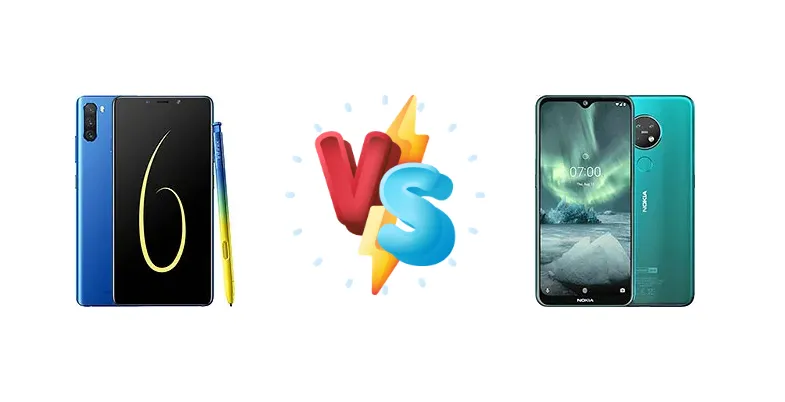
The Infinix Note 6 and Nokia 7.2 represent compelling options in the sub-$200 smartphone market. While both aim to deliver a solid Android experience, they take different approaches to achieving this. The Note 6 prioritizes a larger screen and potentially lower cost, while the Nokia 7.2 leans on Qualcomm’s Snapdragon platform and a focus on imaging. This comparison dissects their key differences to help you choose the right device.
🏆 Quick Verdict
For the average user prioritizing consistent performance and a slightly better display, the Nokia 7.2 emerges as the stronger choice. Its Snapdragon 660 chipset offers a noticeable advantage in multitasking and app responsiveness, offsetting the identical battery endurance ratings. However, the Infinix Note 6 remains a viable option for those on a tighter budget.
| Network |
|---|
| 2G bands | GSM 850 / 900 / 1800 / 1900 | GSM 850 / 900 / 1800 / 1900 |
| 3G bands | HSDPA 850 / 900 / 2100 | HSDPA 850 / 900 / 2100 - ROW |
| 4G bands | 1, 3, 5, 8, 40, 41 | 1, 3, 5, 7, 8, 20, 28, 38, 40, 41 - ROW |
| Speed | HSPA 42.2/5.76 Mbps, LTE Cat4 150/50 Mbps | HSPA 42.2/5.76 Mbps, LTE (2CA) Cat6 300/50 Mbps or LTE Cat4 150/50 Mbps |
| Technology | GSM / HSPA / LTE | GSM / HSPA / LTE |
| | - | 1, 3, 5, 8, 40, 41 - IN |
| Launch |
|---|
| Announced | 2019, June. Released 2019, June | 2019, September 05. Released 2019, September 23 |
| Status | Discontinued | Discontinued |
| Body |
|---|
| Build | - | Glass front (Gorilla Glass 3), glass back (Gorilla Glass 3), plastic frame |
| Dimensions | 154.2 x 74.5 x 7.7 mm (6.07 x 2.93 x 0.30 in) | 159.9 x 75.2 x 8.3 mm (6.30 x 2.96 x 0.33 in) |
| SIM | Nano-SIM + Nano-SIM | · Nano-SIM· Nano-SIM + Nano-SIM |
| Weight | 173 g (6.10 oz) | 180 g (6.35 oz) |
| | Stylus | - |
| Display |
|---|
| Protection | - | Corning Gorilla Glass 3 |
| Resolution | 1080 x 2160 pixels, 18:9 ratio (~402 ppi density) | 1080 x 2280 pixels, 19:9 ratio (~400 ppi density) |
| Size | 6.01 inches, 93.2 cm2 (~81.1% screen-to-body ratio) | 6.3 inches, 99.1 cm2 (~82.4% screen-to-body ratio) |
| Type | AMOLED | IPS LCD, HDR10 |
| Platform |
|---|
| CPU | Octa-core (4x2.3 GHz Cortex-A53 & 4x1.8 GHz Cortex-A53) | Octa-core (4x2.2 GHz Kryo 260 Gold & 4x1.8 GHz Kryo 260 Silver) |
| Chipset | Mediatek MT6765 Helio P35 (12 nm) | Qualcomm SDM660 Snapdragon 660 (14 nm) |
| GPU | PowerVR GE8320 | Adreno 512 |
| OS | Android 9.0 (Pie) | Android 9.0 (Pie), upgradable to Android 11, Android One |
| Memory |
|---|
| Card slot | microSDXC (dedicated slot) | microSDXC (dedicated slot) |
| Internal | 64GB 4GB RAM | 64GB 4GB RAM, 64GB 6GB RAM, 128GB 4GB RAM, 128GB 6GB RAM |
| | eMMC 5.1 | eMMC 5.1 |
| Main Camera |
|---|
| Features | Dual-LED flash, panorama, HDR | Zeiss optics, LED flash, panorama, HDR |
| Triple | 16 MP (wide), PDAF
8 MP (ultrawide)
Auxiliary lens | 48 MP, f/1.8, (wide), 1/2.0", 0.8µm, PDAF
8 MP, f/2.2, 13mm (ultrawide), 1/4.0", 1.12µm
Auxiliary lens |
| Video | 1080p@30fps | 4K@30fps, 1080p@30fps (gyro-EIS) |
| Selfie camera |
|---|
| Features | LED flash | Zeiss optics, HDR |
| Single | 16 MP, f/2.0, 26mm (wide), 1/3.06", 1.0µm | 20 MP, f/2.0, (wide), 1/3", 0.9µm |
| Video | 1080p@30fps | 1080p@30fps |
| Sound |
|---|
| 3.5mm jack | Yes | Yes |
| 35mm jack | Yes | Yes |
| Loudspeaker | Yes | Yes |
| Comms |
|---|
| Bluetooth | 5.0, A2DP, LE | 5.0, A2DP, EDR, LE, aptX |
| NFC | No | Yes (excl. India) |
| Positioning | GPS | GPS, GLONASS, GALILEO, BDS |
| Radio | FM radio | FM radio |
| USB | microUSB 2.0, OTG | USB Type-C 2.0, OTG |
| WLAN | Wi-Fi 802.11 a/b/g/n/ac, dual-band | Wi-Fi 802.11 b/g/n/ac, dual-band, Wi-Fi Direct |
| Features |
|---|
| Sensors | Fingerprint (rear-mounted), accelerometer, gyro, proximity, compass | Fingerprint (rear-mounted), accelerometer, gyro, proximity, compass |
| Battery |
|---|
| Charging | - | 10W wired |
| Type | 4000 mAh, non-removable | Li-Po 3500 mAh, non-removable |
| Misc |
|---|
| Colors | Midnight Black, Mocha Brown, Aqua Blue | Cyan Green, Charcoal, Ice |
| Models | X610 | TA-1193, TA-1178, TA-1196, TA-1181 |
| Price | About 180 EUR | About 240 EUR |
| SAR | - | 1.15 W/kg (head) 0.90 W/kg (body) |
| SAR EU | - | 0.99 W/kg (head) 1.44 W/kg (body) |
| Tests |
|---|
| Audio quality | - |
Noise -93.0dB / Crosstalk -93.4dB |
| Battery life | - |
Endurance rating 69h
|
| Camera | - |
Photo / Video |
| Display | - |
Contrast ratio: 1342:1 (nominal) |
| Loudspeaker | - |
-29.6 LUFS (Average)
|
| Performance | - |
AnTuTu: 139495 (v7), 164484 (v8)
GeekBench: 5440 (v4.4), 1398 (v5.1)
GFXBench: 8.1fps (ES 3.1 onscreen) |
Infinix Note 6
- Potentially lower price point
- Large display for media consumption
- Comparable battery endurance
- Inferior chipset performance
- Likely lower camera quality
- Unspecified charging speed
Nokia 7.2
- Superior chipset performance (Snapdragon 660)
- Better display brightness and clarity
- Likely improved camera quality
- Slower 10W charging
- Potentially higher price
- Identical battery endurance to Note 6
Display Comparison
The Nokia 7.2 boasts a superior display experience, achieving a measured peak brightness of 585 nits and a 1342:1 contrast ratio. While the Infinix Note 6’s display specifications are not provided, the Nokia’s higher brightness translates to better visibility outdoors. The identical contrast ratio suggests similar black levels, but the Nokia’s overall clarity will be superior. The Nokia 7.2’s display is likely to offer a more vibrant and engaging viewing experience, particularly for video content.
Camera Comparison
Both devices are listed as having Photo/Video capabilities, but detailed camera specifications are absent for both. However, given Nokia’s historical emphasis on imaging, and the Snapdragon 660’s image signal processor (ISP), the Nokia 7.2 is likely to deliver superior image quality, particularly in challenging lighting conditions. The Snapdragon 660’s ISP offers better noise reduction and dynamic range. Without specific sensor details, it’s difficult to make a definitive statement, but the Nokia 7.2 has a clear advantage based on its chipset.
Performance
The core difference lies in the chipsets: the Infinix Note 6 utilizes the Mediatek MT6765 Helio P35 (12nm), while the Nokia 7.2 features the Qualcomm Snapdragon 660 (14nm). Despite the larger node size, the Snapdragon 660’s Kryo 260 cores (4x2.2 GHz Gold & 4x1.8 GHz Silver) offer a significant performance advantage over the Helio P35’s Cortex-A53 configuration (4x2.3 GHz & 4x1.8 GHz). The Snapdragon 660’s architecture is more efficient at handling demanding tasks and multitasking. While both are octa-core, the Qualcomm chip’s design provides a smoother, more responsive user experience. The Nokia 7.2 will handle graphically intensive games and applications with greater ease.
Battery Life
Both the Infinix Note 6 and Nokia 7.2 share an endurance rating of 69 hours, suggesting comparable battery life under similar usage scenarios. However, the Nokia 7.2 is limited to 10W wired charging, while the Infinix Note 6’s charging speed is unspecified. This means the Nokia 7.2 will take longer to fully recharge. While both offer similar longevity, the lack of fast charging on the Nokia 7.2 is a potential drawback for users who frequently need to top up their battery.
Buying Guide
Buy the Infinix Note 6 if you need a large-screen device for media consumption and basic tasks, and your budget is extremely limited. It’s a good fit for users who primarily use social media, messaging apps, and streaming services. Buy the Nokia 7.2 if you prefer a smoother, more responsive user experience, better camera performance, and a more refined software experience, even if it means spending a bit more.
Frequently Asked Questions
❓ Is the Snapdragon 660 in the Nokia 7.2 still capable of handling modern apps and games?
Yes, the Snapdragon 660 remains a capable chipset for everyday tasks and many popular games. While it won't deliver flagship-level performance, it provides a smooth and responsive experience for most users. It’s significantly more powerful than the Helio P35 in the Infinix Note 6, allowing for better multitasking and more consistent frame rates in games.
❓ How does the 10W charging on the Nokia 7.2 affect its usability compared to a potentially faster-charging Infinix Note 6?
The Nokia 7.2’s 10W charging is relatively slow by today’s standards. It will take considerably longer to fully charge the device compared to phones with 18W or higher charging capabilities. This means you’ll need to plan ahead and charge the phone overnight or during extended periods of inactivity. If quick top-ups are important to you, the Infinix Note 6 might be preferable if it supports faster charging.
❓ Given the similar battery endurance ratings, does the Nokia 7.2’s more efficient chipset translate to longer real-world usage?
While both phones have a 69-hour endurance rating, the Snapdragon 660’s more efficient architecture means it will likely consume less power during typical usage. This could translate to slightly longer screen-on time and overall battery life, especially when running demanding applications or multitasking. The efficiency gain isn't massive, but it's a subtle advantage for the Nokia 7.2.