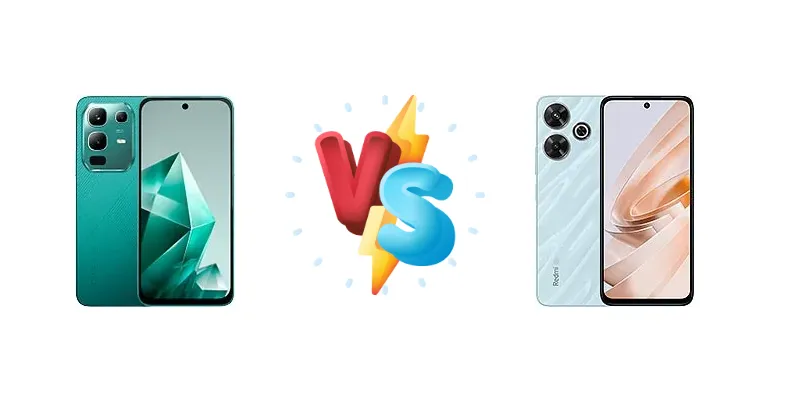
The Infinix Note 50x and Xiaomi Redmi Note 13R represent compelling options in the increasingly competitive sub-$200 smartphone market. Both leverage 4nm chipsets for efficiency, but diverge significantly in their processing power and charging capabilities. This comparison dissects these differences to determine which device delivers the best experience for your needs.
🏆 Quick Verdict
For users prioritizing raw performance and faster charging, the Infinix Note 50x emerges as the winner. Its Dimensity 7300 Ultimate offers a substantial CPU and GPU advantage. However, the Redmi Note 13R provides a more balanced package with respectable performance and a lower price point, making it ideal for everyday tasks.
| Network |
|---|
| 2G bands | GSM 850 / 900 / 1800 / 1900 | GSM 850 / 900 / 1800 / 1900 |
| 3G bands | HSDPA 850 / 900 / 1700(AWS) / 1900 / 2100 | HSDPA 850 / 900 / 2100 |
| 4G bands | 1, 2, 3, 4, 5, 7, 8, 12, 17, 20, 28, 38, 40, 41, 42, 66 | 1, 3, 5, 8, 34, 38, 39, 40, 41 |
| 5G bands | 1, 3, 5, 7, 8, 12, 20, 28, 38, 40, 41, 66, 71, 77, 78 SA/NSA | 1, 5, 8, 28, 41, 78 SA/NSA |
| Speed | HSPA, LTE, 5G | HSPA, LTE, 5G |
| Technology | GSM / HSPA / LTE / 5G | GSM / CDMA / HSPA / EVDO / LTE / 5G |
| Launch |
|---|
| Announced | 2025, March 27 | 2024, May 17 |
| Status | Available. Released 2025, April | Available. Released 2024, May 17 |
| Body |
|---|
| Build | - | Glass front, plastic frame, glass back |
| Dimensions | 165.4 x 76.4 x 8.0 mm or 8.2 mm | 168.6 x 76.3 x 8.2 mm (6.64 x 3.00 x 0.32 in) |
| SIM | Nano-SIM + Nano-SIM | Nano-SIM + Nano-SIM |
| Weight | 195.4 g or 198.9 g (6.88 oz) | 205 g (7.23 oz) |
| Display |
|---|
| Resolution | 720 x 1600 pixels, 20:9 ratio (~263 ppi density) | 1080 x 2460 pixels (~396 ppi density) |
| Size | 6.67 inches, 107.4 cm2 (~85.0% screen-to-body ratio) | 6.79 inches, 109.5 cm2 (~85.1% screen-to-body ratio) |
| Type | IPS LCD, 120Hz, 560 nits (typ) | IPS LCD, 120Hz, 550 nits |
| Platform |
|---|
| CPU | Octa-core (4x2.5 GHz Cortex-A78 & 4x2.0 GHz Cortex-A55) | Octa-core (2x2.3 GHz Cortex-A78 & 6x1.95 GHz Cortex-A55) |
| Chipset | Mediatek Dimensity 7300 Ultimate (4 nm) | Qualcomm SM4450 Snapdragon 4+ Gen 2 (4 nm) |
| GPU | Mali-G615 MC2 | Adreno 613 |
| OS | Android 15, up to 2 major Android upgrades, XOS 15 | Android 14, HyperOS |
| Memory |
|---|
| Card slot | microSDXC (uses shared SIM slot) | No |
| Internal | 128GB 6GB RAM, 128GB 8GB RAM, 256GB 8GB RAM | 128GB 6GB RAM, 128GB 8GB RAM, 256GB 8GB RAM, 256GB 12GB RAM, 512GB 12GB RAM |
| Main Camera |
|---|
| Dual | - | 50 MP, f/1.8, (wide), 1/2.76", 0.64µm, PDAF
2 MP (macro) |
| Features | Dual-LED flash, HDR, panorama | LED flash, HDR |
| Single | 50 MP, f/1.6, (wide), PDAF | - |
| Video | 4K@30fps, 1080p@30/120/240fps | 1080p@30fps |
| Selfie camera |
|---|
| Single | 8 MP, f/2.0, (wide) | 8 MP, (wide), 1/4.0", 1.12µm |
| Video | 1440p@30fps, 1080p@30fps | 1080p@30fps |
| Sound |
|---|
| 35mm jack | No | Yes |
| Loudspeaker | Yes, with stereo speakers | Yes |
| Comms |
|---|
| Bluetooth | 5.4, A2DP, LE | 5.3, A2DP, LE |
| Infrared port | Yes | Yes |
| NFC | No | Yes |
| Positioning | GPS | GPS, GLONASS, GALILEO, BDS |
| Radio | FM radio | No |
| USB | USB Type-C 2.0, OTG | USB Type-C |
| WLAN | Wi-Fi 802.11 a/b/g/n/ac/6, dual-band | Wi-Fi 802.11 a/b/g/n/ac, dual-band |
| Features |
|---|
| Sensors | Fingerprint (side-mounted), accelerometer, gyro, proximity, compass | Fingerprint (side-mounted), accelerometer, compass |
| Battery |
|---|
| Charging | 45W wired
10W reverse wired
Bypass Charging | 33W wired |
| Type | 5500 mAh | 5030 mAh |
| Misc |
|---|
| Colors | Titanium Gray, Enchanted Purple, Sea Breeze Green, Sunset Spice Pink | Black, Blue, Silver |
| Models | X6857B | 2406ERN9CC |
| Price | About 130 EUR | About 180 EUR |
Infinix Note 50x
- Significantly faster processor with the Dimensity 7300 Ultimate
- 45W fast charging for quicker top-ups
- 10W reverse wired charging for added versatility
- Potentially higher price point
- May generate more heat under sustained load
Xiaomi Redmi Note 13R
- More affordable price
- Efficient Snapdragon 4+ Gen 2 chipset for all-day battery life
- Balanced performance for everyday tasks
- Slower charging speed (33W)
- Less powerful processor for demanding applications
Display Comparison
Neither device's display specifications are provided, so we must infer. Given the price bracket, both likely feature 6.6-6.8 inch LCD panels with FHD+ resolution. The absence of LTPO suggests standard 60Hz or 90Hz refresh rates. The key differentiator will likely be peak brightness and color accuracy, areas where Xiaomi typically performs well. Without specific data, it's difficult to declare a clear winner, but Xiaomi's history suggests a potentially more refined display experience.
Camera Comparison
Without sensor details, a direct comparison is limited. However, the chipset's ISP capabilities play a role. The Dimensity 7300 Ultimate generally offers more advanced image processing features. It's reasonable to assume the Infinix Note 50x will deliver slightly better image quality, particularly in low-light conditions. The absence of OIS on either device suggests reliance on software stabilization. The Redmi Note 13R likely focuses on a balanced camera experience, while the Infinix may prioritize computational photography.
Performance
The core difference lies in the chipsets. The Infinix Note 50x’s Mediatek Dimensity 7300 Ultimate (4nm) boasts an octa-core configuration with 4x2.5 GHz Cortex-A78 cores and 4x2.0 GHz Cortex-A55 cores. This is a significant step up from the Xiaomi Redmi Note 13R’s Qualcomm SM4450 Snapdragon 4+ Gen 2 (4nm), which features 2x2.3 GHz Cortex-A78 cores and 6x1.95 GHz Cortex-A55 cores. The Dimensity 7300 Ultimate’s higher clock speeds and more powerful core configuration translate to noticeably faster application loading, smoother multitasking, and superior gaming performance. While both are 4nm, the architectural differences favor the Dimensity chip for demanding workloads. The Redmi Note 13R will be sufficient for everyday tasks, but the Infinix will handle more intensive applications with greater ease.
Battery Life
Battery capacity isn't specified, but the charging speeds are a key differentiator. The Infinix Note 50x’s 45W wired charging is significantly faster than the Redmi Note 13R’s 33W wired charging. This translates to a quicker 0-100% charge time, reducing downtime. The Infinix also includes 10W reverse wired charging, a feature absent on the Redmi Note 13R, allowing it to top up other devices. Even with a slightly smaller battery, the Infinix’s faster charging could provide a more convenient user experience.
Buying Guide
Buy the Infinix Note 50x if you need a phone capable of handling demanding games and applications, and value the convenience of 45W fast charging and reverse wireless charging. Buy the Xiaomi Redmi Note 13R if you prioritize a streamlined user experience, efficient power consumption for all-day use, and a more budget-friendly price without sacrificing essential smartphone functionality.
Frequently Asked Questions
❓ Will the Dimensity 7300 Ultimate in the Infinix Note 50x overheat during prolonged gaming sessions?
While the Dimensity 7300 Ultimate is a powerful chip, the 4nm process helps mitigate heat generation. However, sustained gaming will inevitably lead to some thermal throttling. The Infinix Note 50x's thermal management system will be crucial; reviews will need to assess its effectiveness in preventing significant performance drops during extended gameplay.
❓ Is the 33W charging on the Redmi Note 13R slow compared to other phones in this price range?
33W charging is becoming increasingly common in this segment. While not the fastest available, it's still a respectable charging speed and should fully charge the device within approximately 1.5-2 hours. The Redmi Note 13R prioritizes efficiency and balanced performance over ultra-fast charging.
❓ Does the Snapdragon 4+ Gen 2 in the Redmi Note 13R support any form of fast charging protocols like Quick Charge?
The Snapdragon 4+ Gen 2 supports Quick Charge 3.0. However, the Redmi Note 13R's 33W charger may not fully utilize the Quick Charge potential. It's best to use the included charger for optimal charging speeds and compatibility.