
Infinix Note 50x vs Motorola Moto G54: A Deep Dive into Mid-Range Power
| Phones Images | |||||
|---|---|---|---|---|---|
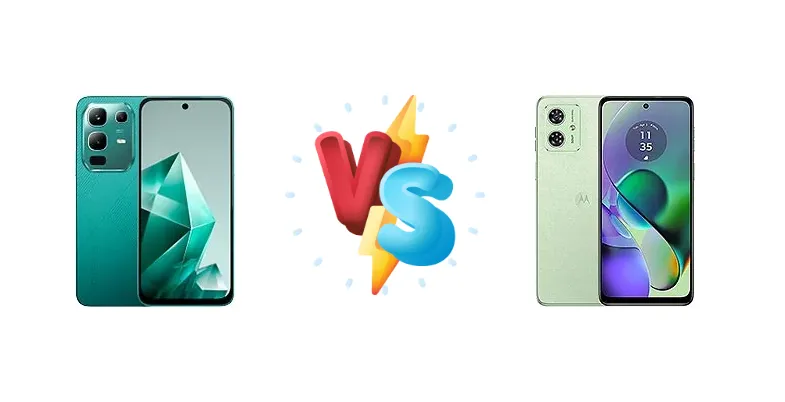
|
🏆 Quick Verdict
For users prioritizing raw performance and faster charging, the Infinix Note 50x emerges as the winner. Its Dimensity 7300 Ultimate, built on a 4nm process, offers a noticeable advantage over the Moto G54’s Dimensity 7020. However, the Moto G54 provides a more refined software experience and potentially better battery optimization.
| PHONES | ||
|---|---|---|
| Phone Names | Infinix Note 50x | Motorola Moto G54 |
| Network | ||
|---|---|---|
| 2G bands | GSM 850 / 900 / 1800 / 1900 | GSM 850 / 900 / 1800 / 1900 |
| 3G bands | HSDPA 850 / 900 / 1700(AWS) / 1900 / 2100 | HSDPA 850 / 900 / 1900 / 2100 |
| 4G bands | 1, 2, 3, 4, 5, 7, 8, 12, 17, 20, 28, 38, 40, 41, 42, 66 | 1, 2, 3, 5, 7, 8, 20, 26, 28, 32, 38, 40, 41, 42 |
| 5G bands | 1, 3, 5, 7, 8, 12, 20, 28, 38, 40, 41, 66, 71, 77, 78 SA/NSA | 1, 3, 5, 7, 8, 20, 26, 28, 38, 40, 41, 77, 78 SA/NSA |
| Speed | HSPA, LTE, 5G | HSPA, LTE, 5G |
| Technology | GSM / HSPA / LTE / 5G | GSM / HSPA / LTE / 5G |
| Launch | ||
|---|---|---|
| Announced | 2025, March 27 | 2023, September 05 |
| Status | Available. Released 2025, April | Available. Released 2023, September 05 |
| Body | ||
|---|---|---|
| Build | - | Glass front, plastic back or silicone polymer back (eco leather), plastic frame |
| Dimensions | 165.4 x 76.4 x 8.0 mm or 8.2 mm | 161.6 x 73.8 x 8 mm (6.36 x 2.91 x 0.31 in) |
| SIM | Nano-SIM + Nano-SIM | · Nano-SIM + eSIM· Nano-SIM + Nano-SIM |
| Weight | 195.4 g or 198.9 g (6.88 oz) | 177 g (6.24 oz) |
| Display | ||
|---|---|---|
| Resolution | 720 x 1600 pixels, 20:9 ratio (~263 ppi density) | 1080 x 2400 pixels, 20:9 ratio (~405 ppi density) |
| Size | 6.67 inches, 107.4 cm2 (~85.0% screen-to-body ratio) | 6.5 inches, 102.0 cm2 (~85.5% screen-to-body ratio) |
| Type | IPS LCD, 120Hz, 560 nits (typ) | IPS LCD, 120Hz |
| Platform | ||
|---|---|---|
| CPU | Octa-core (4x2.5 GHz Cortex-A78 & 4x2.0 GHz Cortex-A55) | Octa-core (2x2.2 GHz Cortex-A78 & 6x2.0 GHz Cortex-A55) |
| Chipset | Mediatek Dimensity 7300 Ultimate (4 nm) | Mediatek Dimensity 7020 (6 nm) |
| GPU | Mali-G615 MC2 | IMG BXM-8-256 |
| OS | Android 15, up to 2 major Android upgrades, XOS 15 | Android 13, upgradable to Android 15 |
| Memory | ||
|---|---|---|
| Card slot | microSDXC (uses shared SIM slot) | microSDXC (dedicated slot) - InternationalmicroSDXC (uses shared SIM slot) - China |
| Internal | 128GB 6GB RAM, 128GB 8GB RAM, 256GB 8GB RAM | 128GB 4GB RAM, 128GB 8GB RAM, 256GB 4GB RAM, 256GB 8GB RAM, 256GB 12GB RAM |
| Main Camera | ||
|---|---|---|
| Dual | - | 50 MP, f/1.8 (wide), 0.61µm, PDAF, OIS 2 MP (macro) |
| Features | Dual-LED flash, HDR, panorama | Dual-LED dual-tone flash, HDR, panorama |
| Single | 50 MP, f/1.6, (wide), PDAF | - |
| Video | 4K@30fps, 1080p@30/120/240fps | 1080p@30/60fps |
| Selfie camera | ||
|---|---|---|
| Features | - | HDR |
| Single | 8 MP, f/2.0, (wide) | 16 MP, f/2.4, (wide), 1.0µm |
| Video | 1440p@30fps, 1080p@30fps | 1080p@30fps |
| Sound | ||
|---|---|---|
| 35mm jack | No | Yes |
| Loudspeaker | Yes, with stereo speakers | Yes, with stereo speakers |
| Comms | ||
|---|---|---|
| Bluetooth | 5.4, A2DP, LE | 5.3, A2DP, LE |
| Infrared port | Yes | - |
| NFC | No | Yes |
| Positioning | GPS | GPS, GLONASS, GALILEO, BDS, QZSS |
| Radio | FM radio | FM radio (market/region dependent) |
| USB | USB Type-C 2.0, OTG | USB Type-C 2.0, OTG |
| WLAN | Wi-Fi 802.11 a/b/g/n/ac/6, dual-band | Wi-Fi 802.11 a/b/g/n/ac, dual-band |
| Features | ||
|---|---|---|
| Sensors | Fingerprint (side-mounted), accelerometer, gyro, proximity, compass | Fingerprint (side-mounted), accelerometer, gyro, proximity, compass |
| Battery | ||
|---|---|---|
| Charging | 45W wired 10W reverse wired Bypass Charging | 15W wired Reverse wired |
| Type | 5500 mAh | Li-Po 5000 mAh |
| Misc | ||
|---|---|---|
| Colors | Titanium Gray, Enchanted Purple, Sea Breeze Green, Sunset Spice Pink | Midnight blue, Indigo blue, Glacier blue, Mint green |
| Models | X6857B | XT2343-1, XT2343-2 |
| Price | About 130 EUR | € 147.00 / $ 189.99 / £ 161.57 |
Infinix Note 50x
- Significantly faster charging (45W)
- More powerful chipset (Dimensity 7300 Ultimate)
- Superior CPU performance for gaming and multitasking
- Potentially less optimized software
- May run hotter under sustained load (though 4nm helps)
Motorola Moto G54
- Cleaner Android experience
- Potentially better battery optimization
- More understated design
- Slower charging (15W)
- Less powerful chipset (Dimensity 7020)
- Lower CPU performance
Display Comparison
Neither device boasts a standout display. While specific panel details (like peak brightness or color gamut coverage) are absent, the core difference lies elsewhere. The focus here is on the processing power driving the UI, as both likely utilize similar LCD or AMOLED panels common in this price bracket. Bezels are expected to be comparable, and color accuracy will likely depend on software calibration.
Camera Comparison
Without detailed camera specs, a direct comparison is difficult. However, the chipset’s ISP (Image Signal Processor) plays a crucial role. The Dimensity 7300 Ultimate’s ISP is likely more advanced, enabling better image processing, noise reduction, and dynamic range. The absence of OIS on either device suggests reliance on software stabilization. The usefulness of any 2MP macro lens on either phone is questionable; focusing on the main sensor’s quality and the chipset’s image processing capabilities is more relevant.
Performance
The core battleground is the chipset. The Infinix Note 50x’s Dimensity 7300 Ultimate (4nm) is a significant step up from the Motorola Moto G54’s Dimensity 7020 (6nm). The 4nm process inherently offers better power efficiency and thermal performance, translating to sustained performance under load. The CPU configuration also favors the Infinix: a 4x2.5 GHz Cortex-A78 setup versus the Moto G54’s 2x2.2 GHz Cortex-A78. This means the Note 50x will exhibit faster single-core and multi-core performance, particularly noticeable in demanding games and multitasking. While both use LPDDR4X RAM (assumed based on market segment), the superior chipset will be the limiting factor, not RAM speed.
Battery Life
The Infinix Note 50x’s 45W wired charging is a clear advantage over the Moto G54’s 15W charging. This translates to significantly faster 0-100% charging times, a crucial benefit for users who need to quickly top up their battery. While battery capacity isn’t specified, the more efficient 4nm Dimensity 7300 Ultimate in the Note 50x should offset any potential capacity difference, offering comparable or even better real-world battery life despite the faster charging.
Buying Guide
Buy the Infinix Note 50x if you need maximum processing power for gaming or demanding applications and value the convenience of 45W fast charging. This phone is ideal for users who frequently push their devices to the limit. Buy the Motorola Moto G54 if you prefer a cleaner Android experience, prioritize battery life over peak performance, and appreciate a more understated design. It’s a solid all-rounder for everyday tasks and moderate gaming.