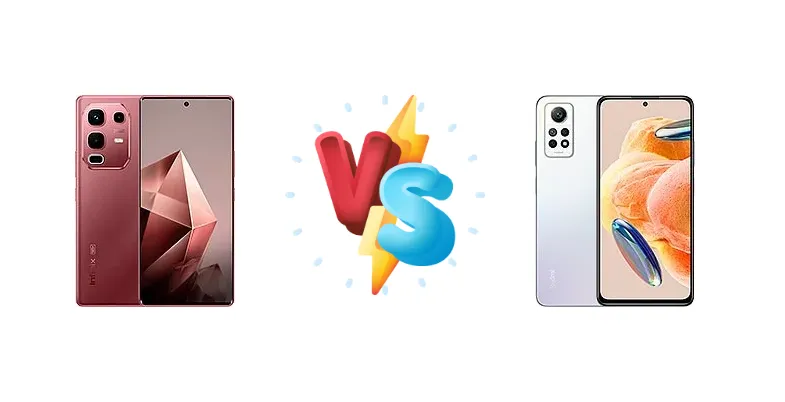
The Infinix Note 50s and Xiaomi Redmi Note 12 Pro 4G represent compelling options in the increasingly competitive mid-range smartphone market. The Note 50s arrives with the newer, more efficient Mediatek Dimensity 7300 Ultimate, while the Redmi Note 12 Pro 4G leverages the established Qualcomm Snapdragon 732G. This comparison dissects their key differences to help you determine which device best suits your needs.
🏆 Quick Verdict
For users prioritizing raw performance and future-proofing, the Infinix Note 50s emerges as the winner. Its Dimensity 7300 Ultimate chipset, built on a 4nm process, delivers a noticeable performance advantage over the Redmi Note 12 Pro 4G’s Snapdragon 732G. However, the Redmi Note 12 Pro 4G’s 67W charging offers a quicker top-up, making it a strong contender for those valuing convenience.
| Network |
|---|
| 2G bands | GSM 850 / 900 / 1800 / 1900 | GSM 850 / 900 / 1800 / 1900 |
| 3G bands | HSDPA 850 / 900 / 2100 | HSDPA 850 / 900 / 1700(AWS) / 1900 / 2100 |
| 4G bands | 1, 3, 5, 8, 28, 38, 40, 41 | 1, 2, 3, 4, 5, 7, 8, 20, 28, 38, 40, 41, 66 |
| 5G bands | 1, 3, 5, 8, 28, 38, 40, 41, 77, 78 SA/NSA | - |
| Speed | HSPA, LTE, 5G | HSPA, LTE |
| Technology | GSM / HSPA / LTE / 5G | GSM / HSPA / LTE |
| Launch |
|---|
| Announced | 2025, April 18 | 2023, March 03 |
| Status | Available. Released 2025, April 24 | Available. Released 2023, April 11 |
| Body |
|---|
| Dimensions | 164.3 x 74.5 x 7.6 mm (6.47 x 2.93 x 0.30 in) | 164.2 x 76.1 x 8.1 mm (6.46 x 3.00 x 0.32 in) |
| SIM | Nano-SIM + Nano-SIM | Nano-SIM + Nano-SIM |
| Weight | 180 g (6.35 oz) | 201.8 g (7.13 oz) |
| Display |
|---|
| Protection | Corning Gorilla Glass 5 | - |
| Resolution | 1080 x 2436 pixels (~393 ppi density) | 1080 x 2400 pixels, 20:9 ratio (~395 ppi density) |
| Size | 6.78 inches, 109.9 cm2 (~89.8% screen-to-body ratio) | 6.67 inches, 107.4 cm2 (~86.0% screen-to-body ratio) |
| Type | AMOLED, 1B colors, 144Hz, 2304Hz PWM, 1300 nits (peak) | AMOLED, 120Hz, Dolby Vision, 700 nits (HBM), 1100 nits (peak) |
| Platform |
|---|
| CPU | Octa-core (4x2.5 GHz Cortex-A78 & 4x2.0 GHz Cortex-A55) | Octa-core (2x2.2 GHz Kryo 470 Gold & 6x1.8 GHz Kryo 470 Silver) |
| Chipset | Mediatek Dimensity 7300 Ultimate (4 nm) | Qualcomm SM7150 Snapdragon 732G (8 nm) |
| GPU | Mali-G615 MC2 | Adreno 618 |
| OS | Android 15, up to 2 major Android upgrades, XOS 15 | Android 11, MIUI 13 |
| Memory |
|---|
| Card slot | No | microSDXC (uses shared SIM slot) |
| Internal | 128GB 6GB RAM, 128GB 8GB RAM, 256GB 8GB RAM | 128GB 6GB RAM, 128GB 8GB RAM, 256GB 8GB RAM |
| | - | UFS 2.2 |
| Main Camera |
|---|
| Dual | 64 MP, f/1.8, (wide), 1/1.73", 0.8µm, PDAF
2 MP | - |
| Features | Dual-LED flash, HDR, panorama | LED flash, HDR, panorama |
| Quad | - | 108 MP, f/1.9, (wide), 1/1.52", 0.7µm, PDAF
8 MP, 120˚, (ultrawide)
2 MP (macro)
Auxiliary lens |
| Video | 4K@30fps, 1080p@30fps | 4K@30fps, 1080p@30/60fps |
| Selfie camera |
|---|
| Single | 13 MP, f/2.2, (wide) | 16 MP, f/2.4, (wide) |
| Video | 4K@30fps, 1080p@30fps | 1080p@30fps |
| Sound |
|---|
| 3.5mm jack | - | Yes |
| 35mm jack | No | Yes |
| Loudspeaker | Yes, with stereo speakers | Yes, with stereo speakers |
| Comms |
|---|
| Bluetooth | 5.4, A2DP, LE | 5.0, A2DP, LE |
| Infrared port | Yes | Yes |
| NFC | No | Yes (market/region dependent) |
| Positioning | GPS | GPS, GLONASS, GALILEO, BDS |
| Radio | Unspecified | Unspecified |
| USB | USB Type-C 2.0, OTG | USB Type-C 2.0, OTG |
| WLAN | Wi-Fi 802.11 a/b/g/n/ac/6, dual-band | Wi-Fi 802.11 a/b/g/n/ac, dual-band |
| Features |
|---|
| Sensors | Fingerprint (under display, optical), accelerometer, gyro, proximity, compass | Fingerprint (side-mounted), accelerometer, gyro, compass |
| Battery |
|---|
| Charging | 45W wired, 100% in 60 min
10W reverse wired
Bypass Charging | 67W wired |
| Type | 5500 mAh | Li-Po 5000 mAh |
| Misc |
|---|
| Colors | Marine Blue, Titanium Grey, Ruby Red | Star Blue, Graphite Gray, Polar White, Ice blue |
| Models | X6870 | 2209116AG, 2209116AG |
| Price | $ 552.51 / ₹ 15,999 | About 150 EUR |
Infinix Note 50s
- Superior processing power with the Dimensity 7300 Ultimate
- More efficient 4nm manufacturing process
- Reverse wired charging capability
- Slower charging speed (45W vs 67W)
- Potential software optimization concerns (Infinix's track record)
Xiaomi Redmi Note 12 Pro 4G
- Faster 67W wired charging
- Proven Snapdragon 732G chipset with reliable performance
- Established Xiaomi software ecosystem
- Less powerful chipset compared to the Dimensity 7300 Ultimate
- Less efficient 8nm manufacturing process
Display Comparison
While both phones likely feature similar LCD or AMOLED panels (data not provided), the core difference lies in the processing power driving them. The chipset impacts UI responsiveness and gaming frame rates. The absence of display specs necessitates focusing on the processing power to deliver a smooth visual experience. The Dimensity 7300 Ultimate’s superior GPU will translate to higher, more stable frame rates in graphically intensive games.
Camera Comparison
Without detailed camera specifications, a direct comparison is limited. However, the chipset’s image signal processor (ISP) plays a crucial role in image quality. The Dimensity 7300 Ultimate’s ISP is likely more advanced, offering better noise reduction, dynamic range, and overall image processing capabilities. While both phones likely feature a standard set of lenses, the Note 50s’ superior processing power will likely result in more detailed and vibrant photos, particularly in challenging lighting conditions. We can assume both phones will have a primary camera, ultrawide, and potentially a macro lens, but the quality will be dictated by the ISP.
Performance
The Infinix Note 50s’ Mediatek Dimensity 7300 Ultimate, fabricated on a 4nm process, represents a significant leap forward in efficiency compared to the Xiaomi Redmi Note 12 Pro 4G’s 8nm Qualcomm Snapdragon 732G. The Dimensity 7300 Ultimate’s octa-core configuration, featuring four high-performance Cortex-A78 cores clocked at 2.5 GHz, provides a substantial advantage in multi-threaded tasks and demanding applications. The Snapdragon 732G, with its Kryo 470 Gold cores peaking at 2.2 GHz, is a capable performer but will struggle to match the Note 50s in sustained workloads. This translates to smoother multitasking, faster app loading times, and a more responsive user experience on the Infinix.
Battery Life
The Xiaomi Redmi Note 12 Pro 4G boasts 67W wired charging, allowing for a significantly faster 0-100% charge compared to the Infinix Note 50s’ 45W charging (60 minutes to 100%). While the Note 50s includes 10W reverse wired charging, a useful feature for topping up accessories, the Redmi Note 12 Pro 4G prioritizes speed. The actual battery capacity of both devices is unknown, but the faster charging of the Redmi Note 12 Pro 4G will be a key advantage for users who frequently need to quickly replenish their battery.
Buying Guide
Buy the Infinix Note 50s if you need a phone capable of handling demanding games and applications with greater efficiency, and appreciate the benefits of a more modern chipset. Buy the Xiaomi Redmi Note 12 Pro 4G if you prioritize faster charging speeds and prefer a proven, reliable chipset with a well-established software ecosystem, even if it means sacrificing some raw processing power.
Frequently Asked Questions
❓ Will the Dimensity 7300 Ultimate in the Infinix Note 50s overheat during prolonged gaming sessions?
The 4nm process of the Dimensity 7300 Ultimate is designed for improved thermal efficiency. While some heat generation is inevitable during gaming, it's less likely to throttle performance compared to the 8nm Snapdragon 732G in the Redmi Note 12 Pro 4G, especially during extended gameplay. However, sustained performance will also depend on the phone's cooling system, which is currently unknown.
❓ Does the 67W charging on the Redmi Note 12 Pro 4G support Power Delivery (PD) or Quick Charge (QC) standards?
Xiaomi typically implements its own proprietary charging standards, although the Redmi Note 12 Pro 4G may support some level of Quick Charge compatibility. It's unlikely to fully support Power Delivery. Using a non-compatible charger may result in slower charging speeds. It's best to use the included charger for optimal performance.
❓ How does the software experience differ between Infinix and Xiaomi?
Xiaomi's MIUI is a well-established Android skin with a large user base and frequent updates. Infinix's XOS, while improving, has historically been criticized for bloatware and less consistent updates. Users prioritizing a polished and regularly updated software experience may prefer the Redmi Note 12 Pro 4G.