
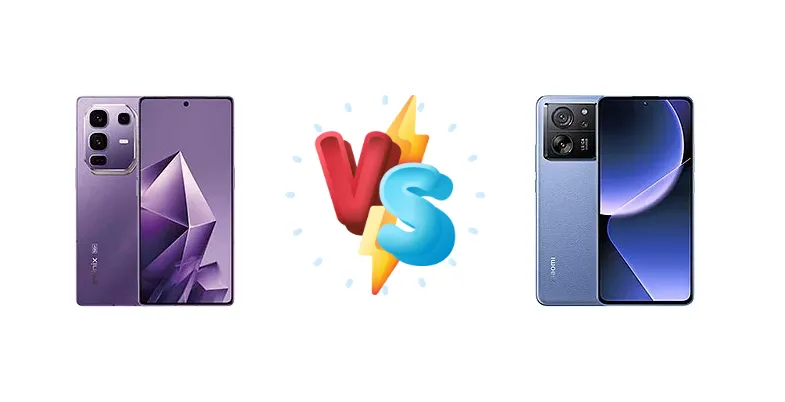
Infinix Note 50 Pro+ vs Xiaomi 13T Pro: A Deep Dive into Mid-Range Power
| Phones Images | |||||
|---|---|---|---|---|---|
|
🏆 Quick Verdict
For the average user prioritizing all-around performance and faster charging, the Xiaomi 13T Pro emerges as the winner. Its Dimensity 9200+ chipset provides a noticeable performance edge, and the 120W charging significantly reduces downtime. However, the Infinix Note 50 Pro+ offers a compelling alternative with its innovative MagCharge and competitive price.
| PHONES | ||
|---|---|---|
| Phone Names | Infinix Note 50 Pro+ | Xiaomi 13T Pro |
| Network | ||
|---|---|---|
| 2G bands | GSM 850 / 900 / 1800 / 1900 | GSM 850 / 900 / 1800 / 1900 |
| 3G bands | HSDPA 850 / 900 / 1700(AWS) / 1900 / 2100 | HSDPA 800 / 850 / 900 / 1700(AWS) / 1900 / 2100 |
| 4G bands | 1, 2, 3, 4, 5, 7, 8, 12, 17, 20, 28, 38, 40, 41, 42, 66 | 1, 2, 3, 4, 5, 7, 8, 12, 13, 17, 18, 19, 20, 25, 26, 28, 32, 38, 39, 40, 41, 42, 48, 66 |
| 5G bands | 1, 3, 5, 7, 8, 12, 20, 28, 38, 40, 41, 66, 71, 77, 78 SA/NSA/Sub6 | 1, 3, 5, 7, 8, 20, 28, 38, 40, 41, 66, 75, 77, 78 SA/NSA |
| Speed | HSPA, LTE, 5G | HSPA, LTE, 5G |
| Technology | GSM / HSPA / LTE / 5G | GSM / HSPA / LTE / 5G |
| Launch | ||
|---|---|---|
| Announced | 2025, March 20 | 2023, September 26 |
| Status | Available. Released 2025, April | Available. Released 2023, September 26 |
| Body | ||
|---|---|---|
| Build | Glass front, aluminum frame, glass back | Glass front (Gorilla Glass 5), glass back or silicone polymer back, plastic frame |
| Dimensions | 163.4 x 74.5 x 8 mm (6.43 x 2.93 x 0.31 in) | 162.2 x 75.7 x 8.5 mm (6.39 x 2.98 x 0.33 in) |
| SIM | Nano-SIM + Nano-SIM | · Nano-SIM + eSIM· Nano-SIM + Nano-SIM |
| Weight | 209 g (7.37 oz) | 200 g or 206 g (7.05 oz) |
| Display | ||
|---|---|---|
| Protection | - | Corning Gorilla Glass 5 |
| Resolution | 1080 x 2436 pixels (~393 ppi density) | 1220 x 2712 pixels, 20:9 ratio (~446 ppi density) |
| Size | 6.78 inches, 109.9 cm2 (~90.3% screen-to-body ratio) | 6.67 inches, 107.4 cm2 (~87.5% screen-to-body ratio) |
| Type | AMOLED, 1B colors, 144Hz, 2304Hz PWM, 1300 nits (peak) | AMOLED, 68B colors, 144Hz, Dolby Vision, HDR10+, 1200 nits (HBM), 2600 nits (peak) |
| Platform | ||
|---|---|---|
| CPU | Octa-core (1x3.35 GHz Cortex-A715 & 3x3.20 GHz Cortex-A715 & 4x2.20 GHz Cortex-A510) | Octa-core (1x3.35 GHz Cortex-X3 & 3x3.0 GHz Cortex-A715 & 4x2.0 GHz Cortex-A510) |
| Chipset | Mediatek Dimensity 8350 Ultimate (4 nm) | Mediatek Dimensity 9200+ (4 nm) |
| GPU | Mali G615-MC6 | Immortalis-G715 MC11 |
| OS | Android 15, up to 2 major Android upgrades, XOS 15 | Android 13, up to 4 major Android upgrades, HyperOS |
| Memory | ||
|---|---|---|
| Card slot | No | No |
| Internal | 256GB 12GB RAM | 256GB 12GB RAM, 512GB 12GB RAM, 1TB 16GB RAM |
| Main Camera | ||
|---|---|---|
| Features | Dual-LED flash, HDR, panorama | Leica lens, color spectrum sensor, LED flash, HDR, panorama |
| Triple | 50 MP, f/1.9, 24mm (wide), 1/1.56", 1.0µm, multi-directional PDAF, OIS 50 MP, f/2.4, 70mm (periscope telephoto), 1/2.76", 0.64µm, multi-directional PDAF, OIS, 3x optical zoom 8 MP, f/2.2, 15mm, 112˚ (ultrawide), 1/4.0", 1.12µm | 50 MP, f/1.9, 24mm (wide), 1/1.28", 1.22µm, PDAF, OIS 50 MP, f/1.9, 50mm (telephoto), 1/2.88", 0.61µm, PDAF, 2x optical zoom 12 MP, f/2.2, 15mm (ultrawide), 1/3.06", 1.12µm |
| Video | 4K@30/60fps, 1080p@30/60/120/240fps, gyro-EIS, OIS | 8K@24fps, 4K@24/30/60fps, 4K/1080p@30fps HDR10+, 1080p@30/60/120/240fps; 10-bit LOG, gyro-EIS |
| Selfie camera | ||
|---|---|---|
| Features | - | HDR |
| Single | 32 MP, f/2.2, (wide), 1/3.1", 0.7µm | 20 MP, f/2.2, (wide), 0.8µm |
| Video | 4K@30fps, 1080p@30/60fps | 1080p@30fps, HDR10+ |
| Sound | ||
|---|---|---|
| 35mm jack | No | No |
| Loudspeaker | Yes, with stereo speakers | Yes, with stereo speakers |
| Comms | ||
|---|---|---|
| Bluetooth | 5.4, A2DP, LE | 5.4, A2DP, LE |
| Infrared port | Yes | Yes |
| NFC | Yes | Yes |
| Positioning | GPS | GPS (L1+L5), GLONASS (G1), GALILEO (E1+E5a), NavIC (L5), BDS |
| Radio | FM radio | No |
| USB | USB Type-C 2.0, OTG | USB Type-C 2.0, OTG |
| WLAN | Wi-Fi 802.11 a/b/g/n/ac/6, dual-band | Wi-Fi 802.11 a/b/g/n/ac/6e/7, dual/tri-band (market/region dependent), Wi-Fi Direct |
| Features | ||
|---|---|---|
| Sensors | Fingerprint (under display, optical), accelerometer, gyro, proximity, compass, heart rate, SpO2 | Fingerprint (under display, optical), accelerometer, gyro, proximity, compass |
| Battery | ||
|---|---|---|
| Charging | 100W wired, 100% in 32 min 50W wireless MagCharge 10W reverse wired 7.5w reverse wireless Bypass Charging | 120W wired, PD3.0, QC4, 100% in 19 min |
| Type | Si/C Li-Ion 5200 mAh | Li-Po 5000 mAh |
| Misc | ||
|---|---|---|
| Colors | Titanium Grey, Enchanted Purple, Racing Edition | Alpine Blue, Meadow Green, Black |
| Models | X6856 | 23078PND5G |
| Price | About 350 EUR | $ 370.00 / £ 482.55 / € 301.99 |
| SAR EU | - | 1.00 W/kg (head) 0.99 W/kg (body) |
Infinix Note 50 Pro+
- Innovative 50W MagCharge wireless charging
- Faster reverse charging options (wired & wireless)
- Bypass charging for reduced heat during gaming
- Competitive price point
- Less powerful chipset compared to the Xiaomi
- Slightly lower peak display brightness
Xiaomi 13T Pro
- More powerful Dimensity 9200+ chipset
- Faster 120W wired charging
- Higher peak display brightness
- Likely superior camera performance
- No wireless charging
- Lacks MagCharge ecosystem
Display Comparison
Both the Infinix Note 50 Pro+ and Xiaomi 13T Pro feature bright displays, with the Xiaomi edging out the Infinix in peak brightness at 1094 nits versus 1043 nits. While both are excellent for outdoor visibility, the Xiaomi’s higher peak brightness provides a slight advantage in direct sunlight. Details regarding panel technology (LTPO, refresh rate) are missing, but both likely employ high refresh rate AMOLED panels common in this segment. Bezels appear comparable based on available imagery, and color accuracy is expected to be good on both, though independent calibration data is unavailable.
Camera Comparison
Camera details are limited, but the Xiaomi 13T Pro is expected to have a more sophisticated camera system. While both likely feature multi-camera setups, the Xiaomi’s image processing capabilities and potentially larger sensor size (details missing) will likely result in superior image quality, particularly in low-light conditions. The Infinix Note 50 Pro+ may offer competitive results in well-lit environments, but the Xiaomi is expected to excel in challenging scenarios. The presence of OIS (Optical Image Stabilization) on the Xiaomi is also likely, further enhancing image and video quality.
Performance
The core difference lies in the chipsets. The Xiaomi 13T Pro boasts the Mediatek Dimensity 9200+, featuring a Cortex-X3 prime core clocked at 3.35 GHz, alongside three Cortex-A715 cores at 3.0 GHz and four Cortex-A510 cores at 2.0 GHz. This configuration provides a significant performance uplift compared to the Infinix Note 50 Pro+'s Dimensity 8350 Ultimate, which uses a Cortex-A715 prime core at 3.35 GHz, three more Cortex-A715 cores at 3.20 GHz, and four Cortex-A510 cores at 2.20 GHz. The X3 core in the 9200+ is architecturally superior, translating to faster single-core performance and improved efficiency. Both phones utilize a 4nm process, but the architectural advantages of the 9200+ will likely result in better sustained performance under heavy load. RAM speed (LPDDR5x) is assumed to be comparable, but the chipset difference is the dominant factor.
Battery Life
Both phones deliver excellent battery life, with the Infinix Note 50 Pro+ achieving 11:43h of active use and the Xiaomi 13T Pro slightly surpassing it at 11:50h. The Xiaomi 13T Pro’s 120W wired charging is significantly faster than the Infinix’s 100W, achieving a full charge in just 19 minutes compared to 32 minutes. The Infinix, however, compensates with 50W MagCharge wireless charging, a feature absent on the Xiaomi. The Infinix also offers 10W reverse wired and 7.5W reverse wireless charging, alongside bypass charging, allowing the phone to be powered directly from the charger while in use – a feature not mentioned for the Xiaomi.
Buying Guide
Buy the Infinix Note 50 Pro+ if you need a versatile device with exceptionally fast charging *and* the convenience of wireless MagCharge, especially if you frequently use wireless charging or appreciate the reverse charging capabilities. Buy the Xiaomi 13T Pro if you prioritize raw processing power for demanding tasks like gaming and video editing, and value the fastest possible wired charging speeds alongside a more polished software experience.