
Infinix Note 50 Pro+ vs Google Pixel 8a: A Deep Dive into Performance and Value
| Phones Images | |||||
|---|---|---|---|---|---|
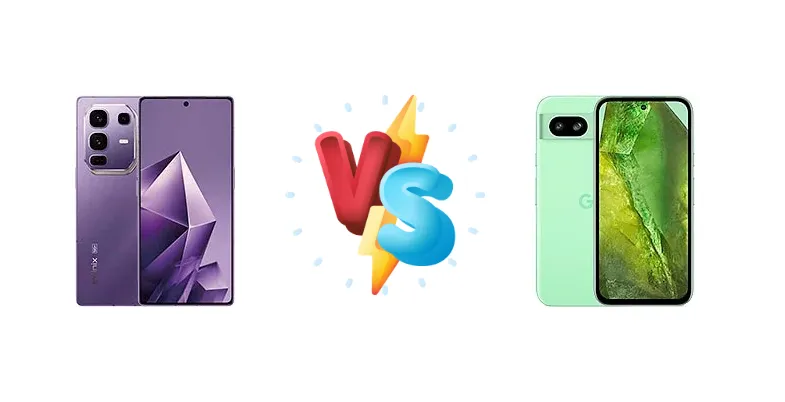
|
🏆 Quick Verdict
For users prioritizing raw performance and incredibly fast charging, the Infinix Note 50 Pro+ is the clear winner. However, the Google Pixel 8a’s superior display, longer-term battery endurance, and refined software experience make it the better choice for those valuing a polished, all-around experience and Google’s ecosystem.
| PHONES | ||
|---|---|---|
| Phone Names | Infinix Note 50 Pro+ | Google Pixel 8a |
| Network | ||
|---|---|---|
| 2G bands | GSM 850 / 900 / 1800 / 1900 | GSM 850 / 900 / 1800 / 1900 |
| 3G bands | HSDPA 850 / 900 / 1700(AWS) / 1900 / 2100 | HSDPA 800 / 850 / 900 / 1700(AWS) / 1900 / 2100 |
| 4G bands | 1, 2, 3, 4, 5, 7, 8, 12, 17, 20, 28, 38, 40, 41, 42, 66 | 1, 2, 3, 4, 5, 7, 8, 12, 17, 18, 19, 20, 26, 28, 32, 38, 40, 41, 42, 66 - G6GPR (International) |
| 5G bands | 1, 3, 5, 7, 8, 12, 20, 28, 38, 40, 41, 66, 71, 77, 78 SA/NSA/Sub6 | 1, 2, 3, 5, 7, 8, 12, 20, 26, 28, 38, 40, 41, 66, 75, 76, 77, 78 SA/NSA/Sub6 - G6GPR (International) |
| Speed | HSPA, LTE, 5G | HSPA, LTE, 5G |
| Technology | GSM / HSPA / LTE / 5G | GSM / HSPA / LTE / 5G |
| Launch | ||
|---|---|---|
| Announced | 2025, March 20 | 2024, May 07 |
| Status | Available. Released 2025, April | Available. Released 2024, May 14 |
| Body | ||
|---|---|---|
| Build | Glass front, aluminum frame, glass back | Glass front (Gorilla Glass 3), aluminum frame, plastic back |
| Dimensions | 163.4 x 74.5 x 8 mm (6.43 x 2.93 x 0.31 in) | 152.1 x 72.7 x 8.9 mm (5.99 x 2.86 x 0.35 in) |
| SIM | Nano-SIM + Nano-SIM | Nano-SIM + eSIM |
| Weight | 209 g (7.37 oz) | 188 g (6.63 oz) |
| Display | ||
|---|---|---|
| Protection | - | Corning Gorilla Glass 3, Mohs level 5 |
| Resolution | 1080 x 2436 pixels (~393 ppi density) | 1080 x 2400 pixels, 20:9 ratio (~430 ppi density) |
| Size | 6.78 inches, 109.9 cm2 (~90.3% screen-to-body ratio) | 6.1 inches, 90.3 cm2 (~81.6% screen-to-body ratio) |
| Type | AMOLED, 1B colors, 144Hz, 2304Hz PWM, 1300 nits (peak) | OLED, HDR, 120Hz, 2000 nits (peak) |
| Platform | ||
|---|---|---|
| CPU | Octa-core (1x3.35 GHz Cortex-A715 & 3x3.20 GHz Cortex-A715 & 4x2.20 GHz Cortex-A510) | Nona-core (1x3.0 GHz Cortex-X3 & 4x2.45 GHz Cortex-A715 & 4x2.15 GHz Cortex-A510) |
| Chipset | Mediatek Dimensity 8350 Ultimate (4 nm) | Google Tensor G3 (4 nm) |
| GPU | Mali G615-MC6 | Immortalis-G715s MC10 |
| OS | Android 15, up to 2 major Android upgrades, XOS 15 | Android 14, upgradable to Android 16, up to 7 major Android upgrades |
| Memory | ||
|---|---|---|
| Card slot | No | No |
| Internal | 256GB 12GB RAM | 128GB 8GB RAM, 256GB 8GB RAM |
| Main Camera | ||
|---|---|---|
| Dual | - | 64 MP (16 MP eff.), f/1.9, 26mm (wide), 1/1.73", 0.8µm, dual pixel PDAF, OIS 13 MP, f/2.2, 120˚ (ultrawide), 1.12µm |
| Features | Dual-LED flash, HDR, panorama | Dual-LED flash, Pixel Shift, Ultra HDR, panorama, Best Take |
| Triple | 50 MP, f/1.9, 24mm (wide), 1/1.56", 1.0µm, multi-directional PDAF, OIS 50 MP, f/2.4, 70mm (periscope telephoto), 1/2.76", 0.64µm, multi-directional PDAF, OIS, 3x optical zoom 8 MP, f/2.2, 15mm, 112˚ (ultrawide), 1/4.0", 1.12µm | - |
| Video | 4K@30/60fps, 1080p@30/60/120/240fps, gyro-EIS, OIS | 4K@30/60fps, 1080p@30/60/120/240fps, OIS |
| Selfie camera | ||
|---|---|---|
| Features | - | HDR, panorama |
| Single | 32 MP, f/2.2, (wide), 1/3.1", 0.7µm | 13 MP, f/2.2, 20mm (ultrawide), 1.12µm |
| Video | 4K@30fps, 1080p@30/60fps | 4K@30fps, 1080p@30/60fps |
| Sound | ||
|---|---|---|
| 35mm jack | No | No |
| Loudspeaker | Yes, with stereo speakers | Yes, with stereo speakers |
| Comms | ||
|---|---|---|
| Bluetooth | 5.4, A2DP, LE | 5.3, A2DP, LE |
| Infrared port | Yes | - |
| NFC | Yes | Yes |
| Positioning | GPS | GPS, GLONASS, GALILEO, BDS, QZSS, NavIC |
| Radio | FM radio | No |
| USB | USB Type-C 2.0, OTG | USB Type-C 3.2 |
| WLAN | Wi-Fi 802.11 a/b/g/n/ac/6, dual-band | Wi-Fi 802.11 a/b/g/n/ac/6e, dual/tri-band (market/region dependent) |
| Features | ||
|---|---|---|
| Sensors | Fingerprint (under display, optical), accelerometer, gyro, proximity, compass, heart rate, SpO2 | Fingerprint (under display, optical), accelerometer, gyro, proximity, compass, barometer |
| Battery | ||
|---|---|---|
| Charging | 100W wired, 100% in 32 min 50W wireless MagCharge 10W reverse wired 7.5w reverse wireless Bypass Charging | 18W wired, PD3.0 7.5W wireless Bypass charging |
| Type | Si/C Li-Ion 5200 mAh | Li-Po 4492 mAh |
| Misc | ||
|---|---|---|
| Colors | Titanium Grey, Enchanted Purple, Racing Edition | Obsidian, Porcelain, Bay, Aloe |
| Models | X6856 | GKV4X, G6GPR, G8HHN, G576D |
| Price | About 350 EUR | $ 229.98 / C$ 417.99 / £ 279.00 / € 299.99 / ₹ 33,300 |
| EU LABEL | ||
|---|---|---|
| Battery | - | 40:06h endurance, 1000 cycles |
| Energy | - | Class B |
| Free fall | - | Class A (270 falls) |
| Repairability | - | Class B |
Infinix Note 50 Pro+
- Incredibly fast 100W wired charging
- 50W MagCharge wireless charging
- Potentially higher CPU performance in sustained workloads
- Aggressive pricing for the hardware offered
- Significantly lower battery endurance compared to Pixel 8a
- Display brightness is lower than Pixel 8a
- Camera performance is an unknown quantity
Google Pixel 8a
- Superior display brightness and color accuracy
- Exceptional camera quality and computational photography
- Long-term battery health with 1000 charge cycles
- Clean Android experience with guaranteed updates
- Slow 18W charging speed
- Less raw CPU power compared to Infinix Note 50 Pro+
- Higher price point
Display Comparison
The Pixel 8a boasts a significantly brighter display, reaching 1508 nits compared to the Infinix Note 50 Pro+'s 1043 nits. This translates to superior visibility in direct sunlight. While both utilize 4nm chipsets, the Pixel 8a’s display technology likely contributes to better power efficiency in typical usage. The Infinix doesn’t specify panel type, but the Pixel 8a’s OLED panel will offer superior contrast and color accuracy. The difference in peak brightness is substantial, making the Pixel 8a the preferred choice for outdoor users and media consumers.
Camera Comparison
The context data lacks detailed camera specifications for both devices, making a direct comparison challenging. However, Google’s Pixel line is renowned for its computational photography prowess, leveraging the Tensor G3’s AI capabilities to deliver exceptional image quality, particularly in challenging lighting conditions. The Pixel 8a likely benefits from Google’s advanced HDR+ and Night Sight algorithms. Without knowing the Infinix’s sensor size and aperture, it’s difficult to assess its low-light performance. The Pixel 8a’s consistent image processing and software features give it a likely advantage in overall camera experience.
Performance
Both phones employ 4nm chipsets, but their architectures differ significantly. The Infinix Note 50 Pro+ features the Mediatek Dimensity 8350 Ultimate, an octa-core processor with a unique core configuration (1x3.35 GHz Cortex-A715, 3x3.20 GHz Cortex-A715, 4x2.20 GHz Cortex-A510). The Pixel 8a utilizes Google’s Tensor G3, a nona-core processor (1x3.0 GHz Cortex-X3, 4x2.45 GHz Cortex-A715, 4x2.15 GHz Cortex-A510). The Tensor G3’s Cortex-X3 prime core offers a performance advantage in AI-related tasks and Google’s specific software optimizations. However, the Dimensity 8350 Ultimate’s higher clock speeds on its A715 cores suggest a potential edge in sustained CPU-intensive workloads. Real-world performance will depend on software optimization, but the Infinix appears geared towards raw processing power.
Battery Life
The Pixel 8a’s endurance rating of 40:06h significantly surpasses the Infinix Note 50 Pro+'s active use score of 11:43h. This suggests a more efficient chipset and/or larger battery capacity, despite the Infinix’s faster charging. The Pixel 8a also boasts 1000 charge cycles, indicating superior long-term battery health. While the Infinix Note 50 Pro+ offers blazing-fast 100W wired charging (0-100% in 32 minutes) and 50W MagCharge wireless charging, the Pixel 8a’s 18W charging is considerably slower. However, the Pixel 8a’s bypass charging feature allows it to operate directly from the power adapter, reducing heat buildup during prolonged gaming sessions.
Buying Guide
Buy the Infinix Note 50 Pro+ if you need a phone for demanding tasks like gaming, video editing, or frequent multitasking, and value the convenience of 100W charging and MagCharge wireless capabilities. Buy the Google Pixel 8a if you prioritize a vibrant display, exceptional camera quality, long-term battery health, and a clean, consistently updated Android experience with exclusive Google features.