
Infinix Note 50 Pro 4G vs. Xiaomi Redmi Note 13 Pro 4G: A Deep Dive Comparison
| Phones Images | |||||
|---|---|---|---|---|---|
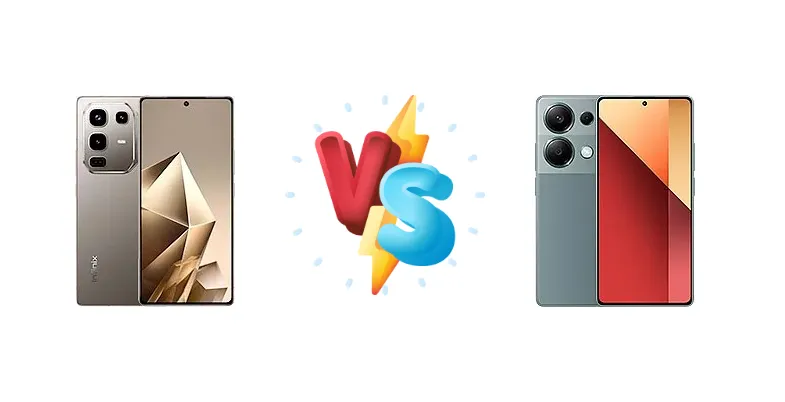
|
🏆 Quick Verdict
For the average user prioritizing rapid replenishment, the Infinix Note 50 Pro 4G emerges as the winner. Its 90W wired charging, coupled with 30W MagCharge wireless charging, significantly outperforms the Redmi Note 13 Pro’s 67W charging. While battery life is comparable, the Infinix’s charging speed offers a tangible convenience advantage.
| PHONES | ||
|---|---|---|
| Phone Names | Infinix Note 50 Pro 4G | Xiaomi Redmi Note 13 Pro 4G |
| Network | ||
|---|---|---|
| 2G bands | GSM 850 / 900 / 1800 / 1900 | GSM 850 / 900 / 1800 / 1900 |
| 3G bands | HSDPA 850 / 900 / 1700(AWS) / 1900 / 2100 | HSDPA 850 / 900 / 1700(AWS) / 1900 / 2100 |
| 4G bands | 1, 2, 3, 4, 5, 7, 8, 12, 17, 13, 26, 28, 38, 40, 41, 66 | 1, 2, 3, 4, 5, 7, 8, 12, 13, 17, 18, 19, 20, 26, 28, 38, 40, 41, 66 |
| Speed | HSPA, LTE | HSPA, LTE |
| Technology | GSM / HSPA / LTE | GSM / HSPA / LTE |
| Launch | ||
|---|---|---|
| Announced | 2025, March 04 | 2024, January 15 |
| Status | Available. Released 2025, March | Available. Released 2024, January 15 |
| Body | ||
|---|---|---|
| Build | Glass front, aluminum frame | Glass front (Gorilla Glass 5), plastic frame, plastic back |
| Dimensions | 163.3 x 74.4 x 7.3 mm (6.43 x 2.93 x 0.29 in) | 161.1 x 75 x 8 mm (6.34 x 2.95 x 0.31 in) |
| SIM | Nano-SIM + Nano-SIM | Nano-SIM + Nano-SIM |
| Weight | 198 g (6.98 oz) | 188 g (6.63 oz) |
| Display | ||
|---|---|---|
| Protection | - | Corning Gorilla Glass 5 |
| Resolution | 1080 x 2436 pixels (~393 ppi density) | 1080 x 2400 pixels, 20:9 ratio (~395 ppi density) |
| Size | 6.78 inches, 109.9 cm2 (~90.4% screen-to-body ratio) | 6.67 inches, 107.4 cm2 (~88.9% screen-to-body ratio) |
| Type | AMOLED, 1B colors, 144Hz, 2160Hz PWM, 1300 nits (peak) | AMOLED, 1B colors, 120Hz, 500 nits (typ), 1000 nits (HBM), 1300 nits (peak) |
| Platform | ||
|---|---|---|
| CPU | Octa-core (2x2.2 GHz Cortex-A76 & 6x2.0 GHz Cortex-A55) | Octa-core (2x2.2 GHz Cortex-A76 & 6x2.0 GHz Cortex-A55) |
| Chipset | Mediatek Helio G100 Ultimate (6 nm) | Mediatek Helio G99 Ultra |
| GPU | Mali-G57 MC2 | Mali-G57 MC2 |
| OS | Android 15, up to 2 major Android upgrades, XOS 15 | Android 13, up to 3 major Android upgrades, HyperOS |
| Memory | ||
|---|---|---|
| Card slot | No | microSDXC (uses shared SIM slot) |
| Internal | 256GB 8GB RAM, 256GB 12GB RAM | 128GB 8GB RAM, 256GB 8GB RAM, 256GB 12GB RAM, 512GB 8GB RAM, 512GB 12GB RAM |
| Main Camera | ||
|---|---|---|
| Dual | 50 MP, f/1.9, (wide), 1/1.57", 1.0µm, PDAF, OIS 8 MP, f/2.2, 15mm, 112˚ (ultrawide) | - |
| Features | Dual-LED flash, HDR, panorama | LED flash, HDR, panorama |
| Triple | - | 200 MP, f/1.7, 23mm (wide), 1/1.4", 0.56µm, multi-directional PDAF, OIS 8 MP, f/2.2, 15mm, 120˚ (ultrawide), 1/4.4", 1.0µm 2 MP (macro) |
| Video | 1440p@30fps, 1080p@30/60/240fps | 1080p@30/60fps |
| Selfie camera | ||
|---|---|---|
| Single | 32 MP, f/2.2, (wide), 1/3.1" | 16 MP, f/2.4, (wide), 1/3.0", 1.0µm |
| Video | 1080p@30fps | 1080p@30/60fps |
| Sound | ||
|---|---|---|
| 35mm jack | No | Yes |
| Loudspeaker | Yes, with stereo speakers | Yes, with dual speakers |
| Comms | ||
|---|---|---|
| Bluetooth | 5.4, A2DP, LE | 5.2, A2DP, LE |
| Infrared port | Yes | Yes |
| NFC | Yes (market/region dependent) | Yes (market/region dependent) |
| Positioning | GPS | GPS, GLONASS, GALILEO, BDS |
| Radio | FM radio | FM radio |
| USB | USB Type-C 2.0, OTG | USB Type-C 2.0, OTG |
| WLAN | Wi-Fi 802.11 a/b/g/n/ac, dual-band | Wi-Fi 802.11 a/b/g/n/ac, dual-band |
| Features | ||
|---|---|---|
| Sensors | Fingerprint (under display, optical), accelerometer, gyro, compass, heart rate, SpO2 | Fingerprint (under display, optical), accelerometer, gyro, compass |
| Battery | ||
|---|---|---|
| Charging | 90W wired, 100% in 38 min 30W wireless MagCharge 10W Reverse wired Reverse wireless Bypass Charging | 67W wired, 50% in 16 min, 100% in 46 min |
| Type | 5200 mAh | 5000 mAh |
| Misc | ||
|---|---|---|
| Colors | Titanium Grey, Enchanted Purple, Racing Edition, Shadow Black | Midnight Black, Lavender Purple, Forest Green |
| Models | X6855 | 23117RA68G, 2312FPCA6G |
| Price | About 180 EUR | € 92.00 / $ 269.99 / £ 299.99 |
| SAR | - | 1.09 W/kg (head) 1.09 W/kg (body) |
| SAR EU | - | 0.99 W/kg (head) 0.99 W/kg (body) |
Infinix Note 50 Pro 4G
- Significantly faster 90W wired charging
- 30W MagCharge wireless charging support
- Reverse wired and wireless charging capabilities
- Potentially better thermal efficiency due to 6nm process
- Camera specifications are unknown
- Less established brand reputation compared to Xiaomi
Xiaomi Redmi Note 13 Pro 4G
- Established brand with a strong software ecosystem
- Potentially better camera image processing
- Slightly longer battery life in active use testing
- Generally good build quality
- Slower 67W wired charging
- No wireless charging support
- No reverse charging support
Display Comparison
Both the Infinix Note 50 Pro and Redmi Note 13 Pro feature displays capable of reaching approximately 1050 nits of peak brightness – the Infinix hitting 1054 nits and the Redmi 1047 nits. This ensures excellent visibility even in direct sunlight. While neither boasts LTPO technology for variable refresh rates, the comparable brightness levels mean users won’t experience significant differences in outdoor readability. The absence of detailed panel specifications (like color gamut coverage) necessitates relying on brand reputation; Xiaomi generally offers more color-accurate displays, but this requires independent verification.
Camera Comparison
The context data for the Redmi Note 13 Pro mentions 'Photo / Video' capabilities, but lacks specific sensor details. Given Xiaomi’s recent focus on camera technology, it’s reasonable to expect a more sophisticated camera system with potentially better image processing algorithms. The Infinix Note 50 Pro’s camera specifications are absent, making a direct comparison impossible. Without knowing sensor sizes, apertures, or the presence of Optical Image Stabilization (OIS), it’s difficult to assess the photographic capabilities of either device. We can assume both will include standard features like portrait mode and night mode, but image quality will depend heavily on the underlying hardware and software.
Performance
Both phones utilize MediaTek’s Helio series, with the Infinix employing the Helio G100 Ultimate and the Redmi the Helio G99 Ultra. Both CPUs share the same core configuration – an octa-core setup with 2x2.2 GHz Cortex-A76 and 6x2.0 GHz Cortex-A55 cores – suggesting similar CPU performance. However, the G100 is fabricated on a 6nm process, potentially offering slightly improved efficiency compared to the G99. Real-world performance differences will likely be minimal for typical tasks, but the 6nm node *could* translate to marginally better thermal management during sustained workloads. Neither phone specifies RAM speed, but LPDDR4X is a likely candidate for both, impacting multitasking responsiveness.
Battery Life
Battery life is remarkably similar, with the Infinix Note 50 Pro achieving 11:26 hours of active use and the Redmi Note 13 Pro managing 11:36 hours. This suggests comparable battery efficiency despite the different chipsets. However, the charging speeds are where these phones truly diverge. The Infinix Note 50 Pro’s 90W wired charging can fully charge the battery in just 38 minutes, a significant advantage over the Redmi Note 13 Pro’s 67W charging, which takes 46 minutes. Furthermore, the Infinix supports 30W MagCharge wireless charging and both wired and wireless reverse charging, features absent on the Redmi. This makes the Infinix a far more versatile option for users who rely on wireless charging or need to top up other devices.
Buying Guide
Buy the Infinix Note 50 Pro 4G if you need the fastest possible charging speeds and appreciate the convenience of wireless MagCharge and reverse charging. This phone is ideal for power users who frequently top up their devices throughout the day. Buy the Xiaomi Redmi Note 13 Pro 4G if you prioritize a more established brand ecosystem and potentially better camera software processing, even if it means sacrificing charging speed. It’s a solid all-rounder for everyday use.