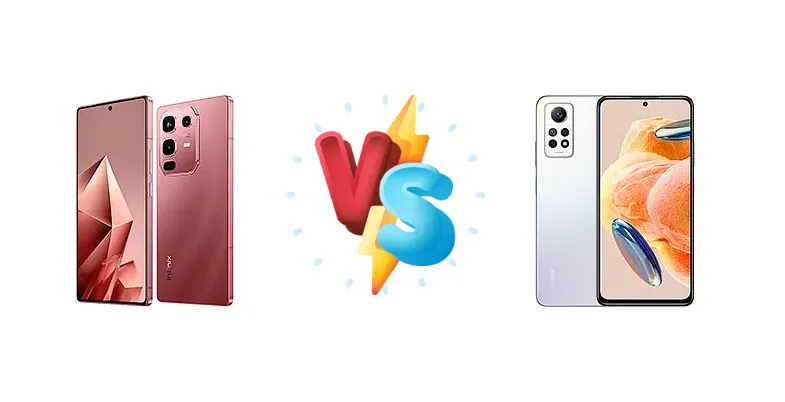
The sub-$200 4G smartphone market is fiercely competitive. The Infinix Note 50 4G attempts to stand out with its unique MagCharge wireless charging and MediaTek Helio G100 Ultimate chipset, while the Xiaomi Redmi Note 12 Pro 4G relies on the established Qualcomm Snapdragon 732G and a focus on rapid wired charging. This comparison dissects their strengths and weaknesses to determine which device offers the best value.
🏆 Quick Verdict
For users prioritizing wireless charging convenience and a potentially more versatile charging ecosystem, the Infinix Note 50 4G is the better choice. However, the Xiaomi Redmi Note 12 Pro 4G delivers a more refined and efficient chipset experience with its Snapdragon 732G, making it ideal for those focused on consistent performance.
| Network |
|---|
| 2G bands | GSM 850 / 900 / 1800 / 1900 | GSM 850 / 900 / 1800 / 1900 |
| 3G bands | HSDPA 850 / 900 / 1700(AWS) / 1900 / 2100 | HSDPA 850 / 900 / 1700(AWS) / 1900 / 2100 |
| 4G bands | 1, 2, 3, 4, 5, 7, 8, 12, 17, 13, 26, 28, 38, 40, 41, 66 | 1, 2, 3, 4, 5, 7, 8, 20, 28, 38, 40, 41, 66 |
| Speed | HSPA, LTE | HSPA, LTE |
| Technology | GSM / HSPA / LTE | GSM / HSPA / LTE |
| Launch |
|---|
| Announced | 2025, March 04 | 2023, March 03 |
| Status | Available. Released 2025, March | Available. Released 2023, April 11 |
| Body |
|---|
| Build | Glass front, aluminum frame | - |
| Dimensions | 163.3 x 74.4 x 7.6 mm (6.43 x 2.93 x 0.30 in) | 164.2 x 76.1 x 8.1 mm (6.46 x 3.00 x 0.32 in) |
| SIM | Nano-SIM + Nano-SIM | Nano-SIM + Nano-SIM |
| Weight | 199 g (7.02 oz) | 201.8 g (7.13 oz) |
| Display |
|---|
| Resolution | 1080 x 2436 pixels (~393 ppi density) | 1080 x 2400 pixels, 20:9 ratio (~395 ppi density) |
| Size | 6.78 inches, 109.9 cm2 (~90.4% screen-to-body ratio) | 6.67 inches, 107.4 cm2 (~86.0% screen-to-body ratio) |
| Type | AMOLED, 1B colors, 144Hz, 2160Hz PWM, 1300 nits (peak) | AMOLED, 120Hz, Dolby Vision, 700 nits (HBM), 1100 nits (peak) |
| Platform |
|---|
| CPU | Octa-core (2x2.2 GHz Cortex-A76 & 6x2.0 GHz Cortex-A55) | Octa-core (2x2.2 GHz Kryo 470 Gold & 6x1.8 GHz Kryo 470 Silver) |
| Chipset | Mediatek Helio G100 Ultimate (6 nm) | Qualcomm SM7150 Snapdragon 732G (8 nm) |
| GPU | Mali-G57 MC2 | Adreno 618 |
| OS | Android 15, up to 2 major Android upgrades, XOS 15 | Android 11, MIUI 13 |
| Memory |
|---|
| Card slot | Unspecified | microSDXC (uses shared SIM slot) |
| Internal | 256GB 8GB RAM | 128GB 6GB RAM, 128GB 8GB RAM, 256GB 8GB RAM |
| | - | UFS 2.2 |
| Main Camera |
|---|
| Dual | 50 MP, f/1.9, (wide), 1/1.57", 1.0µm, PDAF, OIS
2 MP (macro) | - |
| Features | Dual-LED flash, HDR, panorama | LED flash, HDR, panorama |
| Quad | - | 108 MP, f/1.9, (wide), 1/1.52", 0.7µm, PDAF
8 MP, 120˚, (ultrawide)
2 MP (macro)
Auxiliary lens |
| Video | 1440p@30fps, 1080p@30/60/240fps | 4K@30fps, 1080p@30/60fps |
| Selfie camera |
|---|
| Single | 13 MP, f/2.2, (wide) | 16 MP, f/2.4, (wide) |
| Video | 1080p@30fps | 1080p@30fps |
| Sound |
|---|
| 3.5mm jack | - | Yes |
| 35mm jack | No | Yes |
| Loudspeaker | Yes, with stereo speakers | Yes, with stereo speakers |
| Comms |
|---|
| Bluetooth | 5.4, A2DP, LE | 5.0, A2DP, LE |
| Infrared port | Yes | Yes |
| NFC | Yes (market/region dependent) | Yes (market/region dependent) |
| Positioning | GPS | GPS, GLONASS, GALILEO, BDS |
| Radio | FM radio | Unspecified |
| USB | USB Type-C 2.0, OTG | USB Type-C 2.0, OTG |
| WLAN | Wi-Fi 802.11 a/b/g/n/ac, dual-band | Wi-Fi 802.11 a/b/g/n/ac, dual-band |
| Features |
|---|
| Sensors | Fingerprint (under display, optical), accelerometer, gyro, proximity, compass | Fingerprint (side-mounted), accelerometer, gyro, compass |
| Battery |
|---|
| Charging | 45W wired, 100% in 60 min
30W wireless MagCharge
10W Reverse wired
Reverse wireless
Bypass Charging | 67W wired |
| Type | 5200 mAh | Li-Po 5000 mAh |
| Misc |
|---|
| Colors | Titanium Grey, Ruby Red, Mountain Shade, Shadow Black | Star Blue, Graphite Gray, Polar White, Ice blue |
| Models | X6858 | 2209116AG, 2209116AG |
| Price | About 160 EUR | About 150 EUR |
Infinix Note 50 4G
- Unique MagCharge wireless charging support
- Reverse wired and wireless charging capabilities
- Potentially more versatile charging ecosystem
- Helio G100 Ultimate may exhibit more thermal throttling
- Snapdragon 732G is generally more power efficient
Xiaomi Redmi Note 12 Pro 4G
- More efficient Snapdragon 732G chipset
- Faster 67W wired charging
- Generally smoother software experience
- Lacks wireless charging capabilities
- No reverse charging support
Display Comparison
Neither device boasts a flagship-level display, but key differences exist. While both likely feature LCD panels (data not provided), the focus shifts to processing efficiency. The Redmi Note 12 Pro 4G’s Snapdragon 732G, built on an 8nm process, inherently offers better power efficiency for the display compared to the Infinix Note 50 4G’s 6nm Helio G100 Ultimate, potentially translating to slightly longer screen-on time. Without specific brightness or color gamut data, it’s difficult to declare a clear winner, but the Snapdragon’s process node gives it a slight edge.
Camera Comparison
Without detailed camera specs beyond the chipsets, a direct comparison is limited. However, the chipset plays a crucial role in image signal processing (ISP). Qualcomm’s Snapdragon 732G is known for its capable ISP, offering good dynamic range and noise reduction. The Helio G100 Ultimate’s ISP capabilities are less documented, but MediaTek has been improving in this area. Assuming similar sensor sizes (data unavailable), the Redmi Note 12 Pro 4G is likely to deliver more consistent and refined image processing, particularly in challenging lighting conditions. The absence of information on OIS or primary sensor resolution makes a definitive judgment impossible.
Performance
The core of the difference lies in the chipsets. The Qualcomm Snapdragon 732G (8nm) in the Redmi Note 12 Pro 4G is known for its stable performance and efficient power management. Its Kryo 470 Gold cores, clocked at 2.2 GHz, are designed for sustained workloads. Conversely, the MediaTek Helio G100 Ultimate (6nm) in the Infinix Note 50 4G features Cortex-A76 cores also at 2.2 GHz, but the 6nm process doesn’t automatically guarantee superior performance; the architectural differences and Qualcomm’s software optimization often give the Snapdragon an advantage in real-world usage, especially in graphically demanding tasks. The Redmi Note 12 Pro 4G will likely exhibit less thermal throttling during extended gaming sessions.
Battery Life
The Infinix Note 50 4G distinguishes itself with a comprehensive charging solution. Its 45W wired charging reaches 100% in 60 minutes, while the Redmi Note 12 Pro 4G’s 67W charging is significantly faster. However, the Note 50 4G adds 30W MagCharge wireless charging, 10W reverse wired charging, and reverse wireless charging – features absent on the Redmi. While battery capacity isn’t specified, the Infinix’s charging versatility is a major advantage for users who value convenience and ecosystem flexibility. The faster wired charging of the Redmi Note 12 Pro 4G is beneficial for quick top-ups, but the Infinix offers more charging options overall.
Buying Guide
Buy the Infinix Note 50 4G if you need wireless charging, reverse charging capabilities, and a flexible charging solution with MagCharge. Buy the Xiaomi Redmi Note 12 Pro 4G if you prefer a more power-efficient chipset, faster wired charging, and a generally smoother software experience, even if it means sacrificing wireless charging.
Frequently Asked Questions
❓ Does the Infinix Note 50 4G's MagCharge work with all wireless chargers?
The Infinix Note 50 4G utilizes the MagCharge standard, which is based on the Qi wireless charging protocol but adds magnetic alignment. While it will charge on standard Qi chargers, you'll get the full magnetic alignment and potentially faster charging speeds with MagCharge-compatible accessories.
❓ Is the Snapdragon 732G in the Redmi Note 12 Pro 4G powerful enough for demanding games like PUBG Mobile?
Yes, the Snapdragon 732G is capable of running PUBG Mobile at medium to high settings with stable frame rates. While it won't deliver the absolute highest performance, it provides a smooth and enjoyable gaming experience without significant overheating.
❓ How does the 6nm process of the Helio G100 Ultimate compare to the 8nm process of the Snapdragon 732G in terms of battery life?
While a smaller process node (6nm vs 8nm) generally indicates better power efficiency, the overall chipset architecture and software optimization play a significant role. The Snapdragon 732G is known for its efficient power management, and in real-world usage, it's likely to offer comparable or even better battery life than the Helio G100 Ultimate despite the larger process node.
❓ Can I use the Infinix Note 50 4G to charge other devices wirelessly?
Yes, the Infinix Note 50 4G supports reverse wireless charging, allowing you to wirelessly charge compatible devices like earbuds or other smartphones. However, the charging speed will be relatively slow.