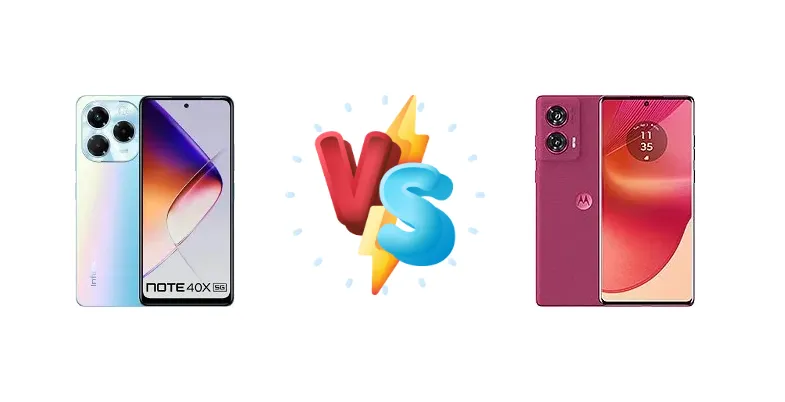
The mid-range 5G smartphone market is fiercely competitive, and the Infinix Note 40X 5G and Motorola Edge 50 Fusion represent compelling options. The Infinix prioritizes rapid charging and a value-focused approach, while the Motorola Edge 50 Fusion aims for a more refined experience with a brighter display and a potentially more powerful chipset, depending on the region.
🏆 Quick Verdict
For the average user prioritizing display quality and potentially faster performance (International version), the Motorola Edge 50 Fusion is the stronger choice. However, the Infinix Note 40X 5G delivers exceptional charging speed and represents a compelling value proposition for those on a tighter budget.
| Network |
|---|
| 2G bands | GSM 850 / 900 / 1800 / 1900 | GSM 850 / 900 / 1800 / 1900 |
| 3G bands | HSDPA 850 / 900 / 1700(AWS) / 1900 / 2100 | HSDPA 850 / 900 / 1900 / 2100 |
| 4G bands | 1, 3, 5, 8, 28, 38, 40, 41 | 1, 2, 3, 5, 7, 8, 18, 19, 20, 26, 28, 32, 38, 40, 41, 42, 71 - International |
| 5G bands | 1, 3, 5, 8, 28, 38, 40, 41, 77, 78 SA/NSA | 1, 3, 5, 7, 8, 20, 26, 28, 38, 40, 41, 77, 78 SA/NSA |
| Speed | HSPA, LTE, 5G | HSPA, LTE, 5G |
| Technology | GSM / HSPA / LTE / 5G | GSM / HSPA / LTE / 5G |
| Launch |
|---|
| Announced | 2024, August 05 | 2024, April 16 |
| Status | Available. Released 2024, August 09 | Available. Released 2024, May 15 |
| Body |
|---|
| Build | - | Glass front, silicone polymer back (eco leather), plastic frame |
| Dimensions | 168.9 x 76.5 x 8.3 mm (6.65 x 3.01 x 0.33 in) | 161.9 x 73.1 x 7.9 mm (6.37 x 2.88 x 0.31 in) |
| SIM | Nano-SIM + Nano-SIM | · Nano-SIM + eSIM· Nano-SIM + Nano-SIM |
| Weight | 201 g (7.09 oz) | 174.9 g (6.17 oz) |
| Display |
|---|
| Protection | - | Corning Gorilla Glass 5 |
| Resolution | 1080 x 2460 pixels (~396 ppi density) | 1080 x 2400 pixels, 20:9 ratio (~393 ppi density) |
| Size | 6.78 inches, 109.2 cm2 (~84.5% screen-to-body ratio) | 6.7 inches, 108.4 cm2 (~91.6% screen-to-body ratio) |
| Type | IPS LCD, 120Hz, 500 | P-OLED, 1B colors, 120Hz (LATAM), 144Hz (INT), 1600 nits (peak) |
| Platform |
|---|
| CPU | Octa-core (2x2.4 GHz Cortex-A76 & 6x2.0 GHz Cortex-A55) | Octa-core (4x2.40 GHz Cortex-A78 & 4x1.95 GHz Cortex-A55) - InternationalOcta-core (4x2.2 GHz Cortex-A78 & 4x1.8 GHz Cortex-A55) - LATAM |
| Chipset | Mediatek Dimensity 6300 (6 nm) | Qualcomm SM7435-AB Snapdragon 7s Gen 2 (4 nm) - InternationalQualcomm SM6450 Snapdragon 6 Gen 1 (4 nm) - LATAM |
| GPU | Mali-G57 MC2 | Adreno 710 |
| OS | Android 14, XOS 14 | Android 14, upgradable to Android 15, up to 3 major Android upgrades |
| Memory |
|---|
| Card slot | microSDXC (dedicated slot) | No |
| Internal | 256GB 8GB RAM, 256GB 12GB RAM | 128GB 8GB RAM, 256GB 8GB RAM, 256GB 12GB RAM, 512GB 8GB RAM, 512GB 12GB RAM |
| Main Camera |
|---|
| Dual | - | 50 MP, f/1.9, (wide), 1/1.56", 1.0µm, multi-directional PDAF, OIS
13 MP, f/2.2, 120˚ (ultrawide), 1/3.0", 1.12µm, AF |
| Features | Quad-LED flash, HDR, panorama | LED flash, HDR, panorama |
| Triple | 108 MP, f/1.8, (wide), PDAF
2 MP (macro)
Auxiliary lens | - |
| Video | 1440p@30fps, 1080p@30/60fps | 4K@30fps, 1080p@30/60/120fps, gyro-EIS |
| Selfie camera |
|---|
| Features | Dual-LED flash | HDR |
| Single | 8 MP, (wide) | 32 MP, f/2.5, (wide), 1/3.14", 0.7µm |
| Video | 1080p@30fps | 4K@30fps, 1080p@30fps |
| Sound |
|---|
| 35mm jack | Yes | No |
| Loudspeaker | Yes, with dual speakers | Yes, with stereo speakers |
| Comms |
|---|
| Bluetooth | 5.3, A2DP, LE | 5.2, A2DP, LE |
| NFC | Yes | Yes |
| Positioning | GPS | GPS, GLONASS, GALILEO |
| Radio | FM radio | No |
| USB | USB Type-C 2.0, OTG | USB Type-C 2.0, OTG |
| WLAN | Wi-Fi 802.11 a/b/g/n/ac | Wi-Fi 802.11 a/b/g/n/ac, dual-band |
| Features |
|---|
| Sensors | Fingerprint (side-mounted), accelerometer, proximity, compass | Fingerprint (under display, optical), accelerometer, gyro, proximity, compass |
| Battery |
|---|
| Charging | 18W wired, 50% in 31 min
Reverse wired | 68W wired, 50% in 15 min |
| Type | 5000 mAh | 5000 mAh |
| Misc |
|---|
| Colors | Palm Blue, Lime Green, Starlit Black | Forest Blue, Marshmallow Blue, Hot Pink |
| Models | X6838 | XT2429-1 |
| Price | About 150 EUR | € 208.99 / $ 245.00 / ₹ 18,667 |
Infinix Note 40X 5G
- Extremely fast charging (potentially)
- Competitive price point
- Decent performance for everyday tasks
- Less powerful chipset compared to Snapdragon 7s Gen 2
- Likely lower display brightness
- Limited information on camera capabilities
Motorola Edge 50 Fusion
- Brighter, higher-quality display
- More powerful chipset (International version)
- Faster charging speeds
- Higher price point
- Performance varies by region (LATAM Snapdragon 6 Gen 1)
- May not offer the same value for money as the Infinix
Display Comparison
The Motorola Edge 50 Fusion boasts a significantly brighter display, peaking at 1322 nits measured, offering superior visibility in direct sunlight. While the Infinix Note 40X 5G’s display specs are not provided, it’s unlikely to match this peak brightness. The Edge 50 Fusion’s brightness advantage is crucial for outdoor users. We lack information on panel technology (LTPO, AMOLED) for the Infinix, but the Motorola’s display is likely to offer better color accuracy and viewing angles, contributing to a more immersive experience.
Camera Comparison
Detailed camera specs are missing for both devices, making a direct comparison difficult. However, focusing on the chipsets, the Snapdragon 7s Gen 2’s ISP (Image Signal Processor) is likely more advanced than the Dimensity 6300’s, potentially resulting in better image processing, especially in low-light conditions. Without sensor size information, it’s hard to definitively say which phone will capture better images, but the Motorola’s chipset gives it an edge. We can assume both phones will feature a standard array of lenses, but the image processing capabilities will be a key differentiator.
Performance
The chipset is where the biggest divergence lies. The Motorola Edge 50 Fusion ships with either the Qualcomm SM7435-AB Snapdragon 7s Gen 2 (4nm) in international markets or the Snapdragon 6 Gen 1 (4nm) in LATAM. The Snapdragon 7s Gen 2, built on a 4nm process, offers a substantial performance and efficiency advantage over the Infinix Note 40X 5G’s Mediatek Dimensity 6300 (6nm). The Dimensity 6300 utilizes older Cortex-A76 cores, while the Snapdragon 7s Gen 2 features newer Cortex-A78 cores, resulting in better single-core and multi-core performance. The 4nm process node of the Snapdragon further enhances thermal efficiency, potentially leading to less throttling during sustained workloads. However, the LATAM variant of the Edge 50 Fusion with the Snapdragon 6 Gen 1 will see a performance decrease.
Battery Life
The Motorola Edge 50 Fusion demonstrates strong battery life, achieving 12:40h in active use testing. The Infinix Note 40X 5G’s battery capacity is not specified, but its 18W charging is significantly slower than the Motorola’s 68W charging, which can reach 50% in just 15 minutes. While a larger battery capacity on the Infinix could offset the slower charging, the Motorola’s rapid charging is a significant convenience factor. The Edge 50 Fusion’s efficiency, thanks to the 4nm Snapdragon chipset, also contributes to its impressive battery endurance.
Buying Guide
Buy the Infinix Note 40X 5G if you need blazing-fast charging and prioritize getting the most performance for your money, even if it means sacrificing some display refinement. Buy the Motorola Edge 50 Fusion if you prefer a brighter, more vibrant display, potentially smoother performance (International version), and a more polished overall user experience, and are willing to pay a slight premium.
Frequently Asked Questions
❓ Will the Dimensity 6300 in the Infinix Note 40X 5G struggle with demanding games?
The Dimensity 6300 is a capable chipset for everyday tasks and moderate gaming. However, it will likely struggle with graphically intensive games at higher settings compared to the Snapdragon 7s Gen 2 found in the international version of the Motorola Edge 50 Fusion. Expect to lower graphics settings for a smoother experience.
❓ How much faster is the 68W charging on the Motorola Edge 50 Fusion compared to the 18W charging on the Infinix Note 40X 5G?
The 68W charging on the Motorola Edge 50 Fusion is significantly faster. It can reach 50% charge in approximately 15 minutes, while the Infinix Note 40X 5G takes around 31 minutes to reach the same level. This difference is substantial and offers a much more convenient charging experience.
❓ Does the regional chipset difference (Snapdragon 7s Gen 2 vs 6 Gen 1) on the Motorola Edge 50 Fusion significantly impact performance?
Yes, the difference is substantial. The Snapdragon 7s Gen 2 offers a noticeable performance uplift over the Snapdragon 6 Gen 1 in both CPU and GPU performance. If you are in a region where the Snapdragon 6 Gen 1 version is sold, the performance gap between the two phones narrows considerably.
❓ Is the lack of detailed camera specs a concern for both phones?
Yes, it is. Without knowing sensor sizes, apertures, and OIS availability, it's difficult to assess the camera capabilities accurately. However, the Motorola Edge 50 Fusion's more advanced ISP suggests it will likely perform better in challenging lighting conditions.