
Infinix Note 40S vs Xiaomi Redmi Note 13 Pro+: A Deep Dive into Mid-Range Power
| Phones Images | |||||
|---|---|---|---|---|---|
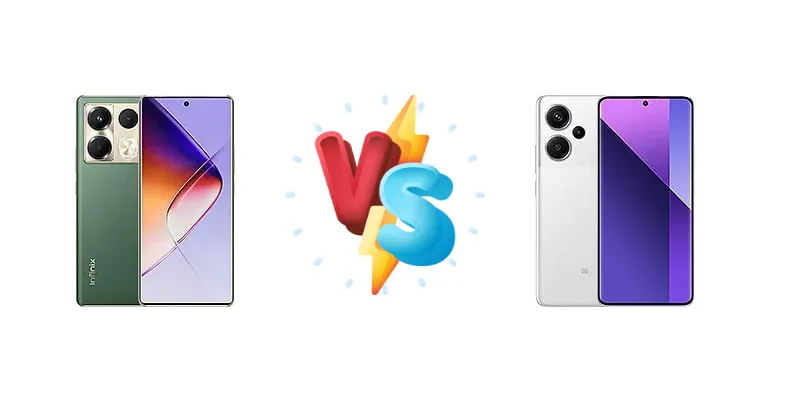
|
🏆 Quick Verdict
For the average user prioritizing speed and a premium display, the Xiaomi Redmi Note 13 Pro+ is the clear winner. Its Dimensity 7200 Ultra chipset and 120W charging significantly outperform the Infinix Note 40S, despite the latter's MagCharge convenience. However, the Note 40S offers a unique wireless charging experience at a potentially lower price point.
| PHONES | ||
|---|---|---|
| Phone Names | Infinix Note 40S | Xiaomi Redmi Note 13 Pro+ |
| Network | ||
|---|---|---|
| 2G bands | GSM 850 / 900 / 1800 / 1900 | GSM 850 / 900 / 1800 / 1900 |
| 3G bands | HSDPA 850 / 900 / 1700(AWS) / 1900 / 2100 | HSDPA 800 / 850 / 900 / 1700(AWS) / 1900 / 2100 - International |
| 4G bands | 1, 2, 3, 4, 5, 7, 8, 20, 28, 38, 40, 41 | 1, 2, 3, 4, 5, 7, 8, 12, 13, 17, 18, 19, 20, 26, 28, 32, 38, 40, 41, 66 - International |
| 5G bands | - | 1, 3, 5, 7, 8, 20, 28, 38, 40, 41, 66, 77, 78 SA/NSA- International |
| Speed | HSPA, LTE | HSPA, LTE, 5G |
| Technology | GSM / HSPA / LTE | GSM / CDMA / HSPA / EVDO / LTE / 5G |
| Launch | ||
|---|---|---|
| Announced | 2024, September | 2023, September 21 |
| Status | Available. Released 2024, October | Available. Released 2023, September 21 |
| Body | ||
|---|---|---|
| Build | - | Glass front (Gorilla Glass Victus), glass back or silicone polymer back (eco leather) |
| Dimensions | 164.1 x 74.6 x 7.8 mm (6.46 x 2.94 x 0.31 in) | 161.4 x 74.2 x 8.9 mm (6.35 x 2.92 x 0.35 in) |
| SIM | Nano-SIM + Nano-SIM | · Nano-SIM + eSIM· Nano-SIM + Nano-SIM |
| Weight | 176 g (6.21 oz) | 199 g or 204.5 g (7.02 oz) |
| Display | ||
|---|---|---|
| Protection | Corning Gorilla Glass | Corning Gorilla Glass Victus |
| Resolution | 1080 x 2436 pixels (~393 ppi density) | 1220 x 2712 pixels, 20:9 ratio (~446 ppi density) |
| Size | 6.78 inches, 109.9 cm2 (~89.8% screen-to-body ratio) | 6.67 inches, 107.4 cm2 (~89.7% screen-to-body ratio) |
| Type | AMOLED, 1B colors, 120Hz, 550 nits (typ), 1300 nits (peak) | AMOLED, 68B colors, 120Hz, 1920Hz PWM, Dolby Vision, HDR10+, 1800 nits (peak) |
| Platform | ||
|---|---|---|
| CPU | Octa-core (2x2.2 GHz Cortex-A76 & 6x2.0 GHz Cortex-A55) | Octa-core (2x2.8 GHz Cortex-A715 & 6x2.0 GHz Cortex-A510) |
| Chipset | Mediatek Helio G99 Ultimate | Mediatek Dimensity 7200 Ultra (4 nm) |
| GPU | Mali-G57 MC2 | Mali-G610 MC4 |
| OS | Android 14, up to 2 major Android upgrades, XOS 14 | Android 13, up to 3 major Android upgrades, HyperOS |
| Memory | ||
|---|---|---|
| Card slot | Unspecified | No |
| Internal | 256GB 8GB RAM | 256GB 8GB RAM, 256GB 12GB RAM, 512GB 8GB RAM, 512GB 12GB RAM, 512GB 16GB RAM |
| Main Camera | ||
|---|---|---|
| Features | Quad-LED flash, HDR, panorama | Dual-LED dual-tone flash, HDR, panorama |
| Triple | 108 MP, f/1.9, 24mm (wide), 1/1.52", PDAF 2 MP (macro) 3rd unspecified camera | 200 MP, f/1.7, 23mm (wide), 1/1.4", 0.56µm, multi-directional PDAF, OIS 8 MP, f/2.2, 16mm, 120˚ (ultrawide), 1/4.0", 1.12µm 2 MP (macro) |
| Video | 1440p@30fps, 1080p@30/60fps | 4K@24/30fps, 1080p@30/60/120fps, gyro-EIS |
| Selfie camera | ||
|---|---|---|
| Features | Dual-LED flash | HDR, panorama |
| Single | 32 MP, f/2.2, (wide), 1/3.1" | 16 MP, f/2.4, (wide) |
| Video | 1080p@30fps | 1080p@30/60fps |
| Sound | ||
|---|---|---|
| 35mm jack | No | No |
| Loudspeaker | Yes, with stereo speakers | Yes, with stereo speakers |
| Comms | ||
|---|---|---|
| Bluetooth | Yes | 5.3, A2DP, LE |
| Infrared port | - | Yes |
| NFC | Yes (market/region dependent) | Yes (market/region dependent) |
| Positioning | GPS | GPS, GLONASS, BDS, GALILEO, QZSS |
| Radio | FM radio | No |
| USB | USB Type-C 2.0, OTG | USB Type-C 2.0, OTG |
| WLAN | Wi-Fi 802.11 a/b/g/n/ac, dual-band | Wi-Fi 802.11 a/b/g/n/ac/6, dual-band, Wi-Fi Direct |
| Features | ||
|---|---|---|
| Sensors | Fingerprint (under display, optical), accelerometer, gyro, proximity, compass | Fingerprint (under display, optical), accelerometer, gyro, proximity, compass |
| Battery | ||
|---|---|---|
| Charging | 33W wired, 50% in 31 min 20W wireless MagCharge Reverse wired Reverse wireless Bypass charging | 120W wired, PD3.0, 100% in 19 min |
| Type | 5000 mAh | Li-Po 5000 mAh |
| Misc | ||
|---|---|---|
| Colors | Obsidian Black, Vintage Green | Midnight Black (Fushion Black), Moonlight White (Fushion White), Aurora Purple, Fushion Purple, Camo Green |
| Models | X6850B | 23090RA98C, 23090RA98G, 23090RA98I |
| Price | - | $ 299.98 / £ 299.00 / € 208.98 / ₹ 24,999 |
| SAR | - | 1.09 W/kg (head) 0.85 W/kg (body) |
| SAR EU | - | 0.98 W/kg (head) 1.00 W/kg (body) |
Infinix Note 40S
- Unique MagCharge wireless charging ecosystem
- Reverse wired and wireless charging for accessories
- Bypass charging for direct power delivery
- Significantly slower charging speeds (33W wired)
- Less powerful processor compared to the Redmi Note 13 Pro+
Xiaomi Redmi Note 13 Pro+
- Ultra-fast 120W wired charging
- Powerful Mediatek Dimensity 7200 Ultra chipset
- Bright and vibrant display (1283 nits)
- Lacks MagCharge wireless charging convenience
- Potentially higher price point
Display Comparison
The Redmi Note 13 Pro+ boasts a significantly brighter display, reaching a measured peak of 1283 nits, making it far more usable in direct sunlight compared to the Infinix Note 40S (brightness data unavailable). While both likely utilize AMOLED panels, the Redmi’s higher peak brightness and potentially better color calibration (based on Xiaomi’s display track record) provide a superior viewing experience. The absence of LTPO technology in either device suggests both will rely on adaptive refresh rate switching to conserve battery, but the Redmi’s superior brightness is a key differentiator.
Camera Comparison
Without detailed camera specs for the Infinix Note 40S, a direct comparison is limited. However, the Redmi Note 13 Pro+ likely features a more sophisticated camera system, benefiting from the processing power of the Dimensity 7200 Ultra. The Redmi’s image processing algorithms are generally well-regarded, and the larger sensor size (assuming a typical configuration for this price point) will capture more light, resulting in better low-light performance. The presence of OIS (Optical Image Stabilization) on the Redmi is also a significant advantage for capturing sharp photos and stable videos.
Performance
The Xiaomi Redmi Note 13 Pro+’s Mediatek Dimensity 7200 Ultra (4nm) represents a substantial leap in processing power over the Infinix Note 40S’s Helio G99 Ultimate. The Dimensity 7200 Ultra’s Cortex-A715 cores, clocked at 2.8 GHz, offer a significant performance advantage over the G99 Ultimate’s Cortex-A76 cores at 2.2 GHz. The 4nm fabrication process of the Dimensity chip also translates to improved thermal efficiency, reducing the likelihood of throttling during sustained workloads. This makes the Redmi Note 13 Pro+ the better choice for gamers and users running demanding applications.
Battery Life
The Redmi Note 13 Pro+’s 120W wired charging is a game-changer, achieving a full charge in just 19 minutes. This drastically outperforms the Infinix Note 40S’s 33W charging, which takes over 30 minutes to reach 50%. While the Infinix Note 40S compensates with 20W wireless MagCharge and reverse charging capabilities, the sheer speed of the Redmi’s wired charging is a major convenience factor. The Redmi Note 13 Pro+ also demonstrates excellent battery life, achieving 10:38h of active use, suggesting efficient power management despite its powerful chipset.
Buying Guide
Buy the Infinix Note 40S if you value wireless charging convenience, particularly the MagCharge ecosystem, and are comfortable with a more modest performance profile. It’s ideal for users who prioritize battery flexibility and aren’t heavy gamers. Buy the Xiaomi Redmi Note 13 Pro+ if you demand faster performance for gaming and demanding apps, a brighter and more vibrant display, and the quickest possible wired charging speeds. This phone is geared towards power users and multimedia enthusiasts.