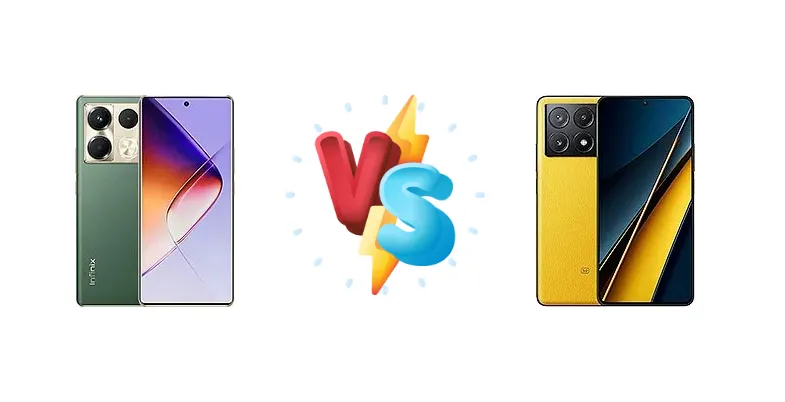
The mid-range smartphone market is fiercely competitive, and the Infinix Note 40S and Xiaomi Poco X6 Pro represent compelling options. The Poco X6 Pro aims for performance dominance with the Dimensity 8300 Ultra, while the Infinix Note 40S prioritizes convenience with its MagCharge wireless charging and a focus on everyday usability. This comparison dissects their strengths and weaknesses to determine which device best suits your needs.
🏆 Quick Verdict
For users prioritizing raw performance and gaming, the Xiaomi Poco X6 Pro is the clear winner. Its Dimensity 8300 Ultra chipset delivers significantly faster processing speeds. However, the Infinix Note 40S offers a unique combination of wireless MagCharge, reverse charging, and bypass charging, making it ideal for users who value convenience and versatility.
| Network |
|---|
| 2G bands | GSM 850 / 900 / 1800 / 1900 | GSM 850 / 900 / 1800 / 1900 |
| 3G bands | HSDPA 850 / 900 / 1700(AWS) / 1900 / 2100 | HSDPA 850 / 900 / 1700(AWS) / 1900 / 2100 |
| 4G bands | 1, 2, 3, 4, 5, 7, 8, 20, 28, 38, 40, 41 | 1, 2, 3, 4, 5, 7, 8, 18, 19, 20, 28, 38, 40, 41, 48, 66 |
| 5G bands | - | 1, 2, 3, 5, 7, 8, 20, 28, 38, 40, 41, 48, 77, 78 SA/NSA/Sub6 |
| Speed | HSPA, LTE | HSPA, LTE, 5G |
| Technology | GSM / HSPA / LTE | GSM / HSPA / LTE / 5G |
| Launch |
|---|
| Announced | 2024, September | 2024, January 11 |
| Status | Available. Released 2024, October | Available. Released 2024, January 12 |
| Body |
|---|
| Build | - | Glass front (Gorilla Glass 5), plastic frame, plastic back or silicone polymer back (eco leather) |
| Dimensions | 164.1 x 74.6 x 7.8 mm (6.46 x 2.94 x 0.31 in) | 160.5 x 74.3 x 8.3 mm (6.32 x 2.93 x 0.33 in) |
| SIM | Nano-SIM + Nano-SIM | Nano-SIM + Nano-SIM |
| Weight | 176 g (6.21 oz) | 186 g or 190 g (6.56 oz) |
| Display |
|---|
| Protection | Corning Gorilla Glass | Corning Gorilla Glass 5 |
| Resolution | 1080 x 2436 pixels (~393 ppi density) | 1220 x 2712 pixels, 20:9 ratio (~446 ppi density) |
| Size | 6.78 inches, 109.9 cm2 (~89.8% screen-to-body ratio) | 6.67 inches, 107.4 cm2 (~90.1% screen-to-body ratio) |
| Type | AMOLED, 1B colors, 120Hz, 550 nits (typ), 1300 nits (peak) | AMOLED, 68B colors, 120Hz, 1920Hz PWM, HDR10+, Dolby Vision, 500 nits (typ), 1200 nits (HBM), 1800 nits (peak) |
| Platform |
|---|
| CPU | Octa-core (2x2.2 GHz Cortex-A76 & 6x2.0 GHz Cortex-A55) | Octa-core (1x3.35 GHz Cortex-A715 & 3x3.20 GHz Cortex-A715 & 4x2.20 GHz Cortex-A510) |
| Chipset | Mediatek Helio G99 Ultimate | Mediatek Dimensity 8300 Ultra (4 nm) |
| GPU | Mali-G57 MC2 | Mali G615-MC6 |
| OS | Android 14, up to 2 major Android upgrades, XOS 14 | Android 14, up to 3 major Android upgrades, HyperOS |
| Memory |
|---|
| Card slot | Unspecified | No |
| Internal | 256GB 8GB RAM | 256GB 8GB RAM, 256GB 12GB RAM, 512GB 12GB RAM |
| Main Camera |
|---|
| Features | Quad-LED flash, HDR, panorama | LED flash, HDR, panorama |
| Triple | 108 MP, f/1.9, 24mm (wide), 1/1.52", PDAF
2 MP (macro)
3rd unspecified camera | 64 MP, f/1.7, 25mm (wide), 1/2.0", 0.7µm, PDAF, OIS
8 MP, f/2.2, 120˚ (ultrawide), 1/4.0", 1.12µm
2 MP (macro) |
| Video | 1440p@30fps, 1080p@30/60fps | 4K@24/30fps, 1080p@30/60fps, gyro-EIS |
| Selfie camera |
|---|
| Features | Dual-LED flash | HDR, panorama |
| Single | 32 MP, f/2.2, (wide), 1/3.1" | 16 MP, f/2.4, (wide), 1/3.06", 1.0µm |
| Video | 1080p@30fps | 1080p@30/60fps |
| Sound |
|---|
| 35mm jack | No | No |
| Loudspeaker | Yes, with stereo speakers | Yes, with dual speakers |
| Comms |
|---|
| Bluetooth | Yes | 5.4, A2DP, LE, aptX HD |
| Infrared port | - | Yes |
| NFC | Yes (market/region dependent) | Yes (market/region dependent) |
| Positioning | GPS | GPS, GALILEO, GLONASS, QZSS, BDS (B1I+B1c) |
| Radio | FM radio | No |
| USB | USB Type-C 2.0, OTG | USB Type-C 2.0, OTG |
| WLAN | Wi-Fi 802.11 a/b/g/n/ac, dual-band | Wi-Fi 802.11 a/b/g/n/ac/6, dual-band, Wi-Fi Direct |
| Features |
|---|
| Sensors | Fingerprint (under display, optical), accelerometer, gyro, proximity, compass | Fingerprint (under display, optical), accelerometer, gyro, compass |
| Battery |
|---|
| Charging | 33W wired, 50% in 31 min
20W wireless MagCharge
Reverse wired
Reverse wireless
Bypass charging | 67W wired, QC2.0, PD3.0, 100% in 45 min |
| Type | 5000 mAh | 5000 mAh |
| Misc |
|---|
| Colors | Obsidian Black, Vintage Green | Black, Yellow, Gray |
| Models | X6850B | 2311DRK48G, 2311DRK48I |
| Price | - | € 195.30 / $ 209.79 / £ 274.99 / ₹ 21,999 |
| SAR EU | - | 0.99 W/kg (head) 1.00 W/kg (body) |
Infinix Note 40S
- Convenient 20W MagCharge wireless charging
- Reverse wired and wireless charging for accessory power
- Bypass charging minimizes heat during gaming
- Significantly less powerful Helio G99 Ultimate chipset
- Likely inferior camera performance compared to the Poco X6 Pro
Xiaomi Poco X6 Pro
- Powerful Mediatek Dimensity 8300 Ultra chipset for gaming and multitasking
- Brighter display for better outdoor visibility
- Faster 67W wired charging
- Lacks wireless charging capabilities
- No reverse charging functionality
Display Comparison
The Poco X6 Pro boasts a significantly brighter display, reaching a measured 1148 nits, which translates to excellent visibility outdoors. While the Infinix Note 40S’s display specs aren’t provided, the X6 Pro’s brightness advantage is substantial. The X6 Pro’s panel likely benefits from its higher price point, potentially offering better color accuracy and viewing angles. The absence of LTPO technology in either phone suggests neither will dynamically adjust refresh rates for optimal power efficiency, but the X6 Pro’s brightness is a key differentiator.
Camera Comparison
The context data provides limited camera details. However, given the Poco X6 Pro’s positioning, it likely features a more sophisticated camera system with a larger main sensor and potentially optical image stabilization (OIS). The Infinix Note 40S likely relies on software processing to enhance image quality. Without specific sensor sizes or aperture information, it’s difficult to make a definitive judgment, but the X6 Pro’s higher overall performance suggests a more capable image signal processor (ISP) for faster and more accurate image processing. We can assume the 2MP macro camera on the Note 40S will offer limited utility.
Performance
The performance gap between these two devices is considerable. The Poco X6 Pro’s Mediatek Dimensity 8300 Ultra (4nm) is a flagship-level chipset, featuring an octa-core configuration with a prime Cortex-A715 core clocked at 3.35 GHz. This is a substantial leap over the Infinix Note 40S’s Mediatek Helio G99 Ultimate, which utilizes a more modest octa-core setup with Cortex-A76 cores peaking at 2.2 GHz. The 4nm process node of the Dimensity 8300 Ultra also provides superior thermal efficiency, minimizing throttling during sustained workloads. The X6 Pro will handle demanding games and multitasking with ease, while the Note 40S is better suited for everyday tasks.
Battery Life
The Poco X6 Pro demonstrates superior battery endurance with an active use score of 11:46h, indicating efficient power management despite its powerful chipset. The Infinix Note 40S lacks this specific endurance test data, but its 33W wired charging (50% in 31 minutes) is slower than the Poco X6 Pro’s 67W wired charging (100% in 45 minutes). The Note 40S compensates with 20W wireless MagCharge, reverse wired charging, and bypass charging – features absent on the X6 Pro. Bypass charging allows the phone to power directly from the charger, reducing heat buildup during gaming. This makes the Note 40S a more versatile option for power users, despite potentially having a smaller overall battery capacity.
Buying Guide
Buy the Infinix Note 40S if you need a phone with convenient wireless charging, reverse wireless charging, and a focus on all-day usability. It’s perfect for users who frequently share power with friends or rely on wireless charging at home or in the office. Buy the Xiaomi Poco X6 Pro if you prefer a phone that excels in gaming, demanding applications, and overall speed. It’s the better choice for power users and mobile gamers who demand the best possible performance.
Frequently Asked Questions
❓ Does the Poco X6 Pro's Dimensity 8300 Ultra chipset get hot during prolonged gaming sessions?
The Dimensity 8300 Ultra is built on a 4nm process, which is more efficient than the 6nm or larger nodes used in many competing chips. This translates to better thermal management, reducing the likelihood of significant throttling during extended gaming. However, sustained high performance will inevitably generate heat, so a gaming-focused case or cooling accessory might be beneficial for the most demanding users.
❓ How practical is the Infinix Note 40S's MagCharge wireless charging compared to standard Qi wireless charging?
MagCharge offers a more secure and efficient wireless charging experience than standard Qi. The magnetic alignment ensures optimal coil positioning, maximizing charging speed and minimizing energy loss. While 20W isn't the fastest wireless charging available, the magnetic attachment and added convenience make it a compelling feature for users who frequently use wireless charging.
❓ Can the Infinix Note 40S charge other devices wirelessly, and how quickly?
Yes, the Infinix Note 40S supports reverse wireless charging. While the exact wattage isn't specified, it's sufficient to top up accessories like earbuds or smartwatches. Charging speeds will be slower than wired charging, but it provides a convenient way to share power on the go.
❓ What gaming performance can I expect from the Infinix Note 40S with the Helio G99 Ultimate?
The Helio G99 Ultimate is capable of running most popular mobile games at medium settings. However, demanding titles may require lower graphics settings to maintain a smooth frame rate. It's not a dedicated gaming chipset like the Dimensity 8300 Ultra, so don't expect flagship-level performance.