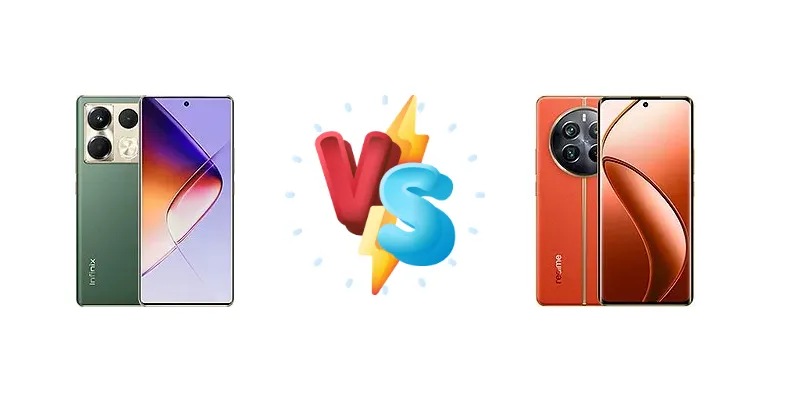
The sub-$300 smartphone market is fiercely competitive, and the Infinix Note 40S and Realme 12 Pro+ represent compelling options. The Infinix focuses on innovative charging solutions like MagCharge and bypass charging, while the Realme 12 Pro+ prioritizes a faster chipset and rapid wired charging. This comparison dissects their strengths and weaknesses to help you choose the right device.
🏆 Quick Verdict
For the average user prioritizing all-around performance and faster charging, the Realme 12 Pro+ emerges as the winner. Its Snapdragon 7s Gen 2 chipset and 67W charging significantly outperform the Infinix Note 40S’s Helio G99 Ultimate and 33W charging, despite the Infinix’s MagCharge convenience.
| Network |
|---|
| 2G bands | GSM 850 / 900 / 1800 / 1900 | GSM 850 / 900 / 1800 / 1900 |
| 3G bands | HSDPA 850 / 900 / 1700(AWS) / 1900 / 2100 | HSDPA 850 / 900 / 2100 |
| 4G bands | 1, 2, 3, 4, 5, 7, 8, 20, 28, 38, 40, 41 | 1, 3, 5, 8, 28, 40, 41 |
| 5G bands | - | 1, 3, 5, 8, 28, 40, 41, 77, 78 SA/NSA |
| Speed | HSPA, LTE | HSPA, LTE, 5G |
| Technology | GSM / HSPA / LTE | GSM / HSPA / LTE / 5G |
| Launch |
|---|
| Announced | 2024, September | 2024, January 29 |
| Status | Available. Released 2024, October | Available. Released 2024, January 29 |
| Body |
|---|
| Dimensions | 164.1 x 74.6 x 7.8 mm (6.46 x 2.94 x 0.31 in) | 161.5 x 74 x 8.8 mm (6.36 x 2.91 x 0.35 in) |
| SIM | Nano-SIM + Nano-SIM | Nano-SIM + Nano-SIM |
| Weight | 176 g (6.21 oz) | 196 g (6.91 oz) |
| Display |
|---|
| Protection | Corning Gorilla Glass | - |
| Resolution | 1080 x 2436 pixels (~393 ppi density) | 1080 x 2412 pixels, 20:9 ratio (~394 ppi density) |
| Size | 6.78 inches, 109.9 cm2 (~89.8% screen-to-body ratio) | 6.7 inches, 108.0 cm2 (~90.4% screen-to-body ratio) |
| Type | AMOLED, 1B colors, 120Hz, 550 nits (typ), 1300 nits (peak) | AMOLED, 1B colors, 120Hz, 800 nits (HBM), 950 nits (peak) |
| Platform |
|---|
| CPU | Octa-core (2x2.2 GHz Cortex-A76 & 6x2.0 GHz Cortex-A55) | Octa-core (4x2.40 GHz Cortex-A78 & 4x1.95 GHz Cortex-A55) |
| Chipset | Mediatek Helio G99 Ultimate | Qualcomm SM7435-AB Snapdragon 7s Gen 2 (4 nm) |
| GPU | Mali-G57 MC2 | Adreno 710 |
| OS | Android 14, up to 2 major Android upgrades, XOS 14 | Android 14, Realme UI 5.0 |
| Memory |
|---|
| Card slot | Unspecified | No |
| Internal | 256GB 8GB RAM | 128GB 8GB RAM, 256GB 8GB RAM, 256GB 12GB RAM, 512GB 12GB RAM |
| Main Camera |
|---|
| Features | Quad-LED flash, HDR, panorama | LED flash, HDR, panorama |
| Triple | 108 MP, f/1.9, 24mm (wide), 1/1.52", PDAF
2 MP (macro)
3rd unspecified camera | 50 MP, f/1.8, 24mm (wide), 1/1.56", 1.0µm, multi-directional PDAF, OIS
64 MP, f/2.8, 71mm, (periscope telephoto), 1/2.0", 0.7µm, PDAF, OIS, 3x optical zoom
8 MP, f/2.2, 16mm, 112˚ (ultrawide), 1/4.0", 1.12µm |
| Video | 1440p@30fps, 1080p@30/60fps | 4K@30fps, 1080p@30/60/120fps, gyro-EIS |
| Selfie camera |
|---|
| Features | Dual-LED flash | - |
| Single | 32 MP, f/2.2, (wide), 1/3.1" | 32 MP, f/2.4, 22mm (wide) |
| Video | 1080p@30fps | 1080p@30fps |
| Sound |
|---|
| 35mm jack | No | No |
| Loudspeaker | Yes, with stereo speakers | Yes, with stereo speakers |
| Comms |
|---|
| Bluetooth | Yes | 5.2, A2DP, LE |
| NFC | Yes (market/region dependent) | Yes (market/region dependent) |
| Positioning | GPS | GPS, GLONASS, GALILEO, BDS, QZSS |
| Radio | FM radio | No |
| USB | USB Type-C 2.0, OTG | USB Type-C 2.0 |
| WLAN | Wi-Fi 802.11 a/b/g/n/ac, dual-band | Wi-Fi 802.11 a/b/g/n/ac/6, dual-band |
| Features |
|---|
| Sensors | Fingerprint (under display, optical), accelerometer, gyro, proximity, compass | Fingerprint (under display, optical), accelerometer, gyro, proximity, compass |
| Battery |
|---|
| Charging | 33W wired, 50% in 31 min
20W wireless MagCharge
Reverse wired
Reverse wireless
Bypass charging | 67W wired, 50% in 19 min |
| Type | 5000 mAh | 5000 mAh |
| Misc |
|---|
| Colors | Obsidian Black, Vintage Green | Submarine Blue, Navigator Beige, Explorer Red |
| Models | X6850B | RMX3840, RMX3841 |
| Price | - | $ 465.00 / £ 299.00 / € 344.26 / ₹ 28,400 |
Infinix Note 40S
- MagCharge wireless charging offers convenient accessory support.
- Reverse wired and wireless charging for sharing power.
- Bypass charging allows direct power from the adapter, reducing heat during gaming.
- Helio G99 Ultimate chipset is less powerful than the Snapdragon 7s Gen 2.
- Slower 33W wired charging compared to the Realme 12 Pro+.
Realme 12 Pro+
- Snapdragon 7s Gen 2 provides significantly better performance.
- 67W wired charging is much faster than the Infinix.
- Excellent battery life with 13:24h of active use.
- Lacks wireless charging capabilities.
- No reverse charging functionality.
Display Comparison
The Realme 12 Pro+ boasts a brighter display, reaching a measured peak of 802 nits, which translates to better visibility outdoors compared to the Infinix Note 40S (brightness data unavailable). While both likely utilize AMOLED panels given the market segment, the Realme’s higher peak brightness is a tangible advantage. We expect the Realme to have better color accuracy out of the box, though both will likely offer sufficient color gamut coverage for most users. Bezels are expected to be comparable, with both aiming for a modern, immersive viewing experience.
Camera Comparison
Without detailed camera specs, a direct comparison is limited. However, the Realme 12 Pro+ is likely to feature a more sophisticated camera system, potentially with a larger main sensor and optical image stabilization (OIS). The Snapdragon 7s Gen 2’s image signal processor (ISP) also offers advanced image processing capabilities. While the Infinix Note 40S will likely deliver acceptable image quality in good lighting conditions, the Realme is expected to excel in low-light scenarios and offer more detailed, dynamic range-rich photos. We anticipate the Realme will also offer more advanced video recording features.
Performance
The Realme 12 Pro+’s Qualcomm Snapdragon 7s Gen 2 (4nm) represents a significant leap in processing power and efficiency over the Infinix Note 40S’s MediaTek Helio G99 Ultimate. The Snapdragon’s Cortex-A78 cores, clocked at 2.40 GHz, offer superior single-core performance, crucial for responsive app launches and smoother multitasking. The 4nm fabrication process also contributes to better thermal management, reducing the likelihood of throttling during extended gaming sessions. While the Helio G99 Ultimate is a capable chip, it’s geared towards efficiency rather than raw power. The Realme’s chipset will provide a noticeably snappier experience.
Battery Life
The Realme 12 Pro+ demonstrates a clear advantage in charging speed, achieving 50% charge in just 19 minutes with its 67W wired charging. The Infinix Note 40S, with its 33W charging, takes 31 minutes to reach the same level. While the Infinix offers 20W MagCharge wireless charging and reverse charging capabilities – features absent on the Realme – the significantly faster wired charging of the Realme is a major convenience factor. The Realme 12 Pro+ also boasts an impressive active use battery score of 13:24h, suggesting excellent battery life despite its faster charging profile. The Infinix Note 40S’s battery capacity is unknown, but the Realme’s endurance sets a high bar.
Buying Guide
Buy the Infinix Note 40S if you value wireless charging convenience, particularly the MagCharge ecosystem, and appreciate the flexibility of reverse charging. It’s ideal for users who frequently share power with friends or accessories. Buy the Realme 12 Pro+ if you prioritize a smoother, more responsive user experience, faster app loading times, and significantly quicker wired charging – making it the better choice for power users and gamers.
Frequently Asked Questions
❓ Does the Helio G99 Ultimate in the Infinix Note 40S struggle with demanding games like Genshin Impact?
While the Helio G99 Ultimate can run Genshin Impact, you'll likely need to lower graphics settings to achieve a consistently smooth frame rate. The Snapdragon 7s Gen 2 in the Realme 12 Pro+ offers a significantly better gaming experience, allowing for higher settings and more stable performance.
❓ How practical is the MagCharge feature on the Infinix Note 40S in everyday use?
MagCharge is most useful if you plan to purchase compatible accessories like wireless power banks or car mounts. It offers a convenient magnetic attachment, but the 20W charging speed is slower than the Realme 12 Pro+'s 67W wired charging. It's a niche feature that appeals to specific users.
❓ Will the Realme 12 Pro+ get noticeably warm during prolonged gaming sessions?
The Snapdragon 7s Gen 2's 4nm process is more efficient than the Helio G99 Ultimate's, meaning the Realme 12 Pro+ is less likely to overheat during extended gaming. However, some warmth is expected with any smartphone under heavy load. The Realme's thermal management should be superior, preventing significant performance throttling.
❓ Is the 67W charging on the Realme 12 Pro+ compatible with all USB-PD chargers?
While the Realme 12 Pro+ supports USB-PD, to achieve the full 67W charging speed, you'll need to use the charger included in the box or a compatible charger specifically rated for SuperVOOC/SuperDart charging. Standard USB-PD chargers may charge at a slower rate.