
Infinix Note 40S vs Motorola Edge 40 Neo: A Detailed Comparison
| Phones Images | |||||
|---|---|---|---|---|---|
|
🏆 Quick Verdict
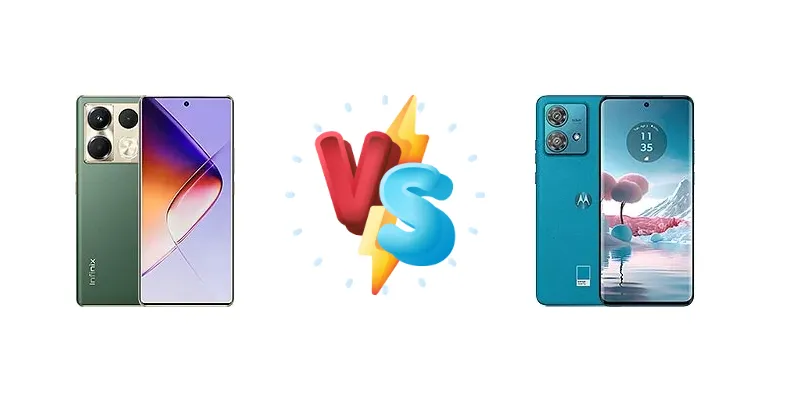
For the average user prioritizing rapid charging and unique features, the Infinix Note 40S is the better choice. Its MagCharge and bypass charging capabilities offer convenience, while the Motorola Edge 40 Neo excels in display brightness and sustained battery performance, making it ideal for media consumption.
| PHONES | ||
|---|---|---|
| Phone Names | Infinix Note 40S | Motorola Edge 40 Neo |
| Network | ||
|---|---|---|
| 2G bands | GSM 850 / 900 / 1800 / 1900 | GSM 850 / 900 / 1800 / 1900 |
| 3G bands | HSDPA 850 / 900 / 1700(AWS) / 1900 / 2100 | HSDPA 800 / 850 / 900 / 1700(AWS) / 1900 / 2100 |
| 4G bands | 1, 2, 3, 4, 5, 7, 8, 20, 28, 38, 40, 41 | 1, 2, 3, 4, 5, 7, 8, 12, 13, 17, 18, 19, 20, 25, 26, 28, 32, 38, 38, 39, 40, 41, 42, 43, 48, 66 |
| 5G bands | - | 1, 2, 3, 5, 7, 8, 20, 28, 38, 40, 41, 66, 77, 78 SA/NSA |
| Speed | HSPA, LTE | HSPA, LTE, 5G |
| Technology | GSM / HSPA / LTE | GSM / HSPA / LTE / 5G |
| Launch | ||
|---|---|---|
| Announced | 2024, September | 2023, September 14 |
| Status | Available. Released 2024, October | Available. Released 2023, September 14 |
| Body | ||
|---|---|---|
| Build | - | Glass front (Gorilla Glass 3), plastic frame, plastic back |
| Dimensions | 164.1 x 74.6 x 7.8 mm (6.46 x 2.94 x 0.31 in) | 159.6 x 72 x 7.9 mm (6.28 x 2.83 x 0.31 in) |
| SIM | Nano-SIM + Nano-SIM | · Nano-SIM + eSIM· Nano-SIM + Nano-SIM |
| Weight | 176 g (6.21 oz) | 170 g or 172 g (6.00 oz) |
| Display | ||
|---|---|---|
| Protection | Corning Gorilla Glass | Corning Gorilla Glass 3 |
| Resolution | 1080 x 2436 pixels (~393 ppi density) | 1080 x 2400 pixels, 20:9 ratio (~402 ppi density) |
| Size | 6.78 inches, 109.9 cm2 (~89.8% screen-to-body ratio) | 6.55 inches, 103.6 cm2 (~90.1% screen-to-body ratio) |
| Type | AMOLED, 1B colors, 120Hz, 550 nits (typ), 1300 nits (peak) | P-OLED, 1B colors, 144Hz, HDR10+, 1300 nits (peak) |
| Platform | ||
|---|---|---|
| CPU | Octa-core (2x2.2 GHz Cortex-A76 & 6x2.0 GHz Cortex-A55) | Octa-core (2x2.5 GHz Cortex-A78 & 6x2.0 GHz Cortex-A55) |
| Chipset | Mediatek Helio G99 Ultimate | MediaTek Dimensity 7030 (6 nm) |
| GPU | Mali-G57 MC2 | Mali-G610 MC3 |
| OS | Android 14, up to 2 major Android upgrades, XOS 14 | Android 13, up to 2 major Android upgrades |
| Memory | ||
|---|---|---|
| Card slot | Unspecified | No |
| Internal | 256GB 8GB RAM | 128GB 8GB RAM, 256GB 8GB RAM, 256GB 12GB RAM |
| Main Camera | ||
|---|---|---|
| Dual | - | 50 MP, f/1.8, (wide), 1/1.55", 1.0µm, multi-directional PDAF, OIS 13 MP, f/2.2, 120˚ (ultrawide), 1/3.0", 1.12µm, PDAF |
| Features | Quad-LED flash, HDR, panorama | LED flash, HDR, panorama |
| Triple | 108 MP, f/1.9, 24mm (wide), 1/1.52", PDAF 2 MP (macro) 3rd unspecified camera | - |
| Video | 1440p@30fps, 1080p@30/60fps | 4K@30fps, 1080p@30/60/120/240fps, gyro-EIS |
| Selfie camera | ||
|---|---|---|
| Features | Dual-LED flash | HDR |
| Single | 32 MP, f/2.2, (wide), 1/3.1" | 32 MP, f/2.4, (wide), 1/3.0", 0.7µm |
| Video | 1080p@30fps | 4K@30fps, 1080p@30fps |
| Sound | ||
|---|---|---|
| 35mm jack | No | No |
| Loudspeaker | Yes, with stereo speakers | Yes, with stereo speakers |
| Comms | ||
|---|---|---|
| Bluetooth | Yes | 5.4, A2DP, LE |
| NFC | Yes (market/region dependent) | Yes |
| Positioning | GPS | GPS, GLONASS, GALILEO |
| Radio | FM radio | No |
| USB | USB Type-C 2.0, OTG | USB Type-C 2.0, OTG |
| WLAN | Wi-Fi 802.11 a/b/g/n/ac, dual-band | Wi-Fi 802.11 a/b/g/n/ac/6e, tri-band, Wi-Fi Direct |
| Features | ||
|---|---|---|
| Sensors | Fingerprint (under display, optical), accelerometer, gyro, proximity, compass | Fingerprint (under display, optical), accelerometer, gyro, proximity, compass |
| Battery | ||
|---|---|---|
| Charging | 33W wired, 50% in 31 min 20W wireless MagCharge Reverse wired Reverse wireless Bypass charging | 68W wired, 50% in 15 min |
| Type | 5000 mAh | Li-Po 5000 mAh |
| Misc | ||
|---|---|---|
| Colors | Obsidian Black, Vintage Green | Black, Soothing Sea, Caneel Bay, Peach Fuzz |
| Models | X6850B | XT2307-1 |
| Price | - | $ 299.00 / € 168.73 / ₹ 19,900 |
Infinix Note 40S
- MagCharge wireless charging offers convenient power-ups.
- Bypass charging allows using the phone while charging without significant battery degradation.
- Reverse charging capabilities can top up accessories.
- Slower 33W wired charging compared to the competition.
- Performance likely lags behind the Dimensity 7030.
Motorola Edge 40 Neo
- 68W wired charging provides exceptionally fast top-ups.
- Brighter display (1073 nits) excels in outdoor visibility.
- Dimensity 7030 chipset delivers superior performance.
- Lacks wireless charging capabilities.
- No bypass charging feature.
Display Comparison
The Motorola Edge 40 Neo boasts a significantly brighter display, reaching a measured peak of 1073 nits. This is a crucial advantage for users frequently exposed to direct sunlight. While the Infinix Note 40S’s display specs are not provided, the Edge 40 Neo’s brightness level suggests a superior outdoor viewing experience. The Edge 40 Neo’s panel likely benefits from its more modern manufacturing process, contributing to its higher peak output. Color accuracy and panel technology (e.g., AMOLED vs. LCD) are unknown for the Note 40S, further solidifying the Edge 40 Neo’s display advantage.
Camera Comparison
Detailed camera analysis is limited by the provided data. Both phones feature a 'Photo / Video' capability, but specifics regarding sensor size, aperture, and optical image stabilization (OIS) are missing for the Infinix Note 40S. The Edge 40 Neo’s camera system likely benefits from Motorola’s image processing algorithms, potentially delivering more refined images. Without further details, it’s difficult to definitively assess camera performance, but the Edge 40 Neo’s brand reputation suggests a more polished camera experience.
Performance
The Motorola Edge 40 Neo’s MediaTek Dimensity 7030 (6nm) offers a performance edge over the Infinix Note 40S’s MediaTek Helio G99 Ultimate. The Dimensity 7030 utilizes Cortex-A78 cores clocked at 2.5 GHz, compared to the Note 40S’s Cortex-A76 cores at 2.2 GHz. This architectural difference, combined with the 6nm process node, translates to better sustained performance and efficiency. While both chips feature a 6x2.0 GHz Cortex-A55 cluster, the Dimensity 7030’s superior core architecture will be noticeable in demanding tasks like gaming and video editing. The Edge 40 Neo is likely to exhibit less thermal throttling under prolonged load.
Battery Life
The Motorola Edge 40 Neo demonstrates a clear advantage in battery endurance, achieving 10:28h of active use and an endurance rating of 80 hours. While the Infinix Note 40S’s battery capacity is unknown, the Edge 40 Neo’s performance is substantial. Furthermore, the Edge 40 Neo’s 68W wired charging significantly outperforms the Note 40S’s 33W charging, achieving 50% charge in just 15 minutes versus 31 minutes. The Note 40S attempts to compensate with 20W wireless MagCharge, reverse wired charging, reverse wireless charging, and bypass charging – features absent on the Edge 40 Neo – offering greater charging versatility, but not necessarily faster overall charging speeds.
Buying Guide
Buy the Infinix Note 40S if you need versatile charging options – including wireless MagCharge and the ability to use the phone while charging – and appreciate a feature-rich experience. Buy the Motorola Edge 40 Neo if you prioritize a vibrant, bright display for outdoor use and value longer battery life during active use, even if it means sacrificing some charging flexibility.