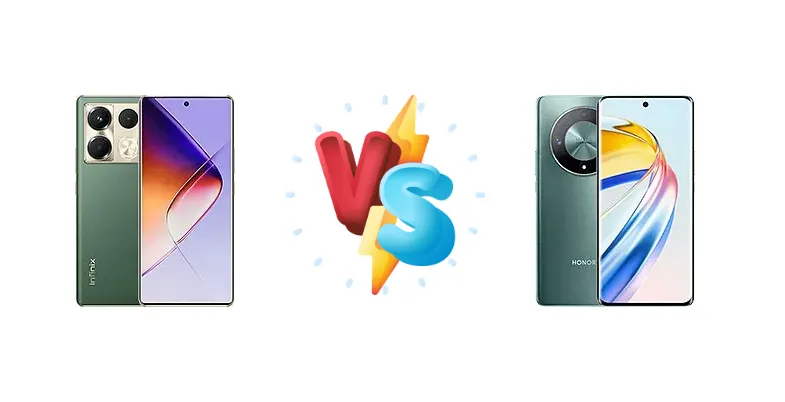
The Infinix Note 40S and Honor X9b represent compelling options in the increasingly competitive sub-$300 smartphone market. The Infinix prioritizes fast charging and wireless convenience, while the Honor focuses on a more efficient chipset and a streamlined user experience. This comparison dives deep into their specifications to determine which device delivers the most bang for your buck.
🏆 Quick Verdict
For the average user prioritizing all-around value and fast charging, the Infinix Note 40S emerges as the winner. Its MagCharge wireless charging and reverse charging capabilities, combined with a competitive processor, offer a feature set the Honor X9b can't match. However, the Honor X9b's more efficient chipset provides a slight edge in sustained performance.
| Network |
|---|
| 2G bands | GSM 850 / 900 / 1800 / 1900 | GSM 850 / 900 / 1800 / 1900 |
| 3G bands | HSDPA 850 / 900 / 1700(AWS) / 1900 / 2100 | HSDPA 850 / 900 / 1900 / 2100 |
| 4G bands | 1, 2, 3, 4, 5, 7, 8, 20, 28, 38, 40, 41 | 1, 2, 3, 4, 5, 7, 8, 20, 28, 32, 38, 40, 41 |
| 5G bands | - | 1, 3, 7, 8, 20, 28, 38, 40, 41, 77, 78 SA/NSA |
| Speed | HSPA, LTE | HSPA, LTE, 5G |
| Technology | GSM / HSPA / LTE | GSM / HSPA / LTE / 5G |
| Launch |
|---|
| Announced | 2024, September | 2023, October 18 |
| Status | Available. Released 2024, October | Available. Released 2023, October |
| Body |
|---|
| Dimensions | 164.1 x 74.6 x 7.8 mm (6.46 x 2.94 x 0.31 in) | 163.6 x 75.5 x 8 mm (6.44 x 2.97 x 0.31 in) |
| SIM | Nano-SIM + Nano-SIM | Nano-SIM + Nano-SIM |
| Weight | 176 g (6.21 oz) | 185 g (6.53 oz) |
| Display |
|---|
| Protection | Corning Gorilla Glass | - |
| Resolution | 1080 x 2436 pixels (~393 ppi density) | 1220 x 2652 pixels, 19.5:9 ratio (~431 ppi density) |
| Size | 6.78 inches, 109.9 cm2 (~89.8% screen-to-body ratio) | 6.78 inches, 112.6 cm2 (~91.2% screen-to-body ratio) |
| Type | AMOLED, 1B colors, 120Hz, 550 nits (typ), 1300 nits (peak) | AMOLED, 1B colors, 120Hz, 1200 nits (peak) |
| Platform |
|---|
| CPU | Octa-core (2x2.2 GHz Cortex-A76 & 6x2.0 GHz Cortex-A55) | Octa-core (4x2.2 GHz Cortex-A78 & 4x1.8 GHz Cortex-A55) |
| Chipset | Mediatek Helio G99 Ultimate | Qualcomm SM6450 Snapdragon 6 Gen 1 (4 nm) |
| GPU | Mali-G57 MC2 | Adreno 710 |
| OS | Android 14, up to 2 major Android upgrades, XOS 14 | Android 13, Magic OS 7.2 |
| Memory |
|---|
| Card slot | Unspecified | No |
| Internal | 256GB 8GB RAM | 256GB 8GB RAM, 256GB 12GB RAM, 512GB 8GB RAM, 512GB 12GB RAM |
| Main Camera |
|---|
| Features | Quad-LED flash, HDR, panorama | LED flash, panorama, HDR |
| Triple | 108 MP, f/1.9, 24mm (wide), 1/1.52", PDAF
2 MP (macro)
3rd unspecified camera | 108 MP, f/1.8, (wide), 1/1.67", PDAF
5 MP, f/2.2, (ultrawide)
2 MP (macro) |
| Video | 1440p@30fps, 1080p@30/60fps | 4K@30fps, 1080p@30fps |
| Selfie camera |
|---|
| Features | Dual-LED flash | - |
| Single | 32 MP, f/2.2, (wide), 1/3.1" | 16 MP, f/2.5, (wide) |
| Video | 1080p@30fps | 1080p@30fps |
| Sound |
|---|
| 35mm jack | No | No |
| Loudspeaker | Yes, with stereo speakers | Yes |
| Comms |
|---|
| Bluetooth | Yes | 5.1, A2DP, LE |
| Infrared port | - | Yes |
| NFC | Yes (market/region dependent) | Yes (market/region dependent) |
| Positioning | GPS | GPS, GLONASS, GALILEO, BDS |
| Radio | FM radio | No |
| USB | USB Type-C 2.0, OTG | USB Type-C 2.0, OTG |
| WLAN | Wi-Fi 802.11 a/b/g/n/ac, dual-band | Wi-Fi 802.11 a/b/g/n/ac, dual-band, Wi-Fi Direct |
| Features |
|---|
| Sensors | Fingerprint (under display, optical), accelerometer, gyro, proximity, compass | Fingerprint (under display, optical), accelerometer, gyro, proximity, compass |
| Battery |
|---|
| Charging | 33W wired, 50% in 31 min
20W wireless MagCharge
Reverse wired
Reverse wireless
Bypass charging | 35W wired
Reverse wired |
| Type | 5000 mAh | Li-Po 5800 mAh |
| Misc |
|---|
| Colors | Obsidian Black, Vintage Green | Sunrise Orange, Midnight Black, Emerald Green |
| Models | X6850B | ALI-NX1 |
| Price | - | About 970 EUR |
Infinix Note 40S
- Fast 33W wired charging
- 20W MagCharge wireless charging
- Reverse wired and wireless charging
- Competitive processor for the price
- Helio G99 Ultimate less efficient than Snapdragon 6 Gen 1
- Potential for more throttling under sustained load
Honor X9b
- More efficient Snapdragon 6 Gen 1 chipset
- 4nm fabrication process for better thermal management
- Potentially smoother performance in demanding tasks
- 35W fast wired charging
- Lacks wireless charging capabilities
- No reverse charging functionality
Display Comparison
Neither device boasts a standout display, focusing instead on value. While specific display specs (resolution, panel type) are missing, the core difference lies elsewhere. The focus is on functionality rather than premium features like high refresh rates or LTPO technology, typical of this price bracket. Bezels are likely comparable, and color accuracy will depend on software calibration, a factor not specified in the provided data.
Camera Comparison
Without detailed camera specifications, a direct comparison is limited. Both phones likely feature multi-camera setups, but the quality will hinge on sensor size, lens aperture, and image processing algorithms. The absence of information regarding sensor size makes it difficult to assess image quality. We can assume both will offer acceptable performance in good lighting conditions, but low-light photography will likely be a weak point for both. The inclusion of a 2MP macro camera on either device is largely a marketing tactic, offering minimal practical benefit.
Performance
The chipset is where the core difference lies. The Honor X9b’s Qualcomm Snapdragon 6 Gen 1 (4nm) benefits from a more modern fabrication process, offering improved power efficiency compared to the Infinix Note 40S’s MediaTek Helio G99 Ultimate. While both CPUs feature octa-core architectures with a 2.2 GHz peak clock speed, the Snapdragon 6 Gen 1 utilizes Cortex-A78 cores (4x) versus the Cortex-A76 cores (2x) in the Helio G99 Ultimate. A78 cores generally offer better single-core performance, translating to snappier app launches and smoother multitasking. The 4nm process also means the Snapdragon 6 Gen 1 is likely to throttle less under sustained load, benefiting gamers. However, the Helio G99 Ultimate is still a capable performer for everyday tasks and moderate gaming.
Battery Life
Both devices offer respectable charging speeds, with the Honor X9b’s 35W wired charging slightly edging out the Infinix Note 40S’s 33W. The Infinix Note 40S, however, significantly differentiates itself with 20W MagCharge wireless charging and both reverse wired and wireless charging. This provides unparalleled convenience for users invested in the wireless charging ecosystem. While the Infinix Note 40S charges to 50% in 31 minutes, the Honor X9b’s 0-100% time is not specified. The ability to reverse charge, both wired and wirelessly, on the Infinix Note 40S is a significant advantage for users who frequently need to top up accessories or share power with friends.
Buying Guide
Buy the Infinix Note 40S if you need versatile charging options – including wireless and reverse wireless – and appreciate the convenience of MagCharge. It’s ideal for users who frequently share power or rely on wireless charging. Buy the Honor X9b if you prioritize sustained performance during gaming or demanding tasks and prefer a more power-efficient chipset, even if it means sacrificing wireless charging features.
Frequently Asked Questions
❓ Does the Infinix Note 40S's MagCharge work with all wireless chargers, or is it proprietary?
The Infinix Note 40S utilizes the Qi wireless charging standard with MagCharge, meaning it's compatible with most Qi-enabled wireless chargers. However, the 'Mag' aspect refers to magnetic alignment, offering a more secure and efficient connection with chargers specifically designed for MagCharge, similar to MagSafe on iPhones.
❓ Will the Snapdragon 6 Gen 1 in the Honor X9b handle demanding games like PUBG Mobile at high settings?
The Snapdragon 6 Gen 1 is capable of running PUBG Mobile at medium to high settings, but expect some frame drops during intense firefights. The 4nm process helps with thermal management, but sustained gaming will still generate heat. Optimizing in-game settings is crucial for a smooth experience.
❓ How useful is the reverse charging feature on the Infinix Note 40S in real-world scenarios?
Reverse charging is incredibly useful for topping up accessories like wireless earbuds or smartwatches when you're away from a power outlet. While it won't fully charge another phone quickly, it can provide enough juice for emergency calls or navigation.
❓ Is the difference in CPU architecture (Cortex-A76 vs A78) noticeable in everyday use?
For basic tasks like browsing, social media, and messaging, the difference between the Cortex-A76 and A78 cores will be minimal. However, the A78 cores in the Honor X9b will provide a more noticeable improvement in app launch speeds and responsiveness when multitasking or running more demanding applications.