
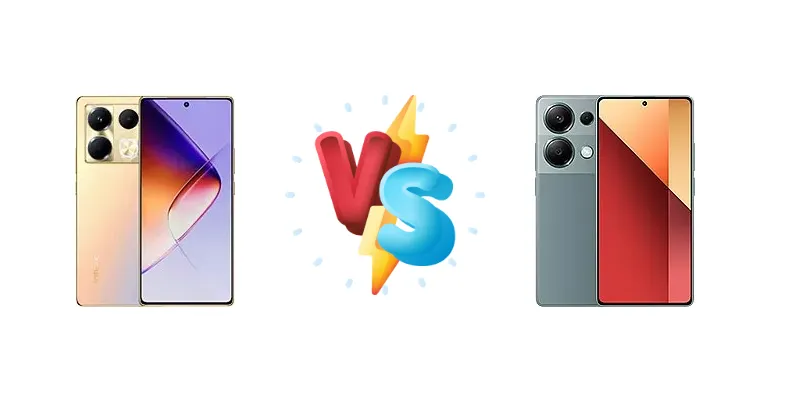
Infinix Note 40 vs Xiaomi Redmi Note 13 Pro 4G: A Detailed Comparison
| Phones Images | |||||
|---|---|---|---|---|---|
|
🏆 Quick Verdict
For the average user, the Xiaomi Redmi Note 13 Pro 4G emerges as the slightly stronger choice. Its significantly faster 67W wired charging and brighter 1047 nit display offer tangible benefits in daily use, outweighing the Infinix Note 40’s MagCharge wireless capabilities for most consumers.
| PHONES | ||
|---|---|---|
| Phone Names | Infinix Note 40 | Xiaomi Redmi Note 13 Pro 4G |
| Network | ||
|---|---|---|
| 2G bands | GSM 850 / 900 / 1800 / 1900 | GSM 850 / 900 / 1800 / 1900 |
| 3G bands | HSDPA 850 / 900 / 1700(AWS) / 1900 / 2100 | HSDPA 850 / 900 / 1700(AWS) / 1900 / 2100 |
| 4G bands | 1, 2, 3, 4, 5, 7, 8, 12, 17, 13, 26, 28, 38, 40, 41, 66 | 1, 2, 3, 4, 5, 7, 8, 12, 13, 17, 18, 19, 20, 26, 28, 38, 40, 41, 66 |
| Speed | HSPA, LTE | HSPA, LTE |
| Technology | GSM / HSPA / LTE | GSM / HSPA / LTE |
| Launch | ||
|---|---|---|
| Announced | 2024, March 18 | 2024, January 15 |
| Status | Available. Released 2024, March 19 | Available. Released 2024, January 15 |
| Body | ||
|---|---|---|
| Build | - | Glass front (Gorilla Glass 5), plastic frame, plastic back |
| Dimensions | 164.1 x 74.5 x 7.8 mm (6.46 x 2.93 x 0.31 in) | 161.1 x 75 x 8 mm (6.34 x 2.95 x 0.31 in) |
| SIM | Nano-SIM + Nano-SIM | Nano-SIM + Nano-SIM |
| Weight | 190 g (6.70 oz) | 188 g (6.63 oz) |
| Display | ||
|---|---|---|
| Protection | Corning Gorilla Glass | Corning Gorilla Glass 5 |
| Resolution | 1080 x 2436 pixels (~393 ppi density) | 1080 x 2400 pixels, 20:9 ratio (~395 ppi density) |
| Size | 6.78 inches, 109.9 cm2 (~89.9% screen-to-body ratio) | 6.67 inches, 107.4 cm2 (~88.9% screen-to-body ratio) |
| Type | AMOLED, 120Hz, 1300 nits (peak) | AMOLED, 1B colors, 120Hz, 500 nits (typ), 1000 nits (HBM), 1300 nits (peak) |
| Platform | ||
|---|---|---|
| CPU | Octa-core (2x2.2 GHz Cortex-A76 & 6x2.0 GHz Cortex-A55) | Octa-core (2x2.2 GHz Cortex-A76 & 6x2.0 GHz Cortex-A55) |
| Chipset | Mediatek Helio G99 Ultimate | Mediatek Helio G99 Ultra |
| GPU | Mali-G57 MC2 | Mali-G57 MC2 |
| OS | Android 14, XOS 14 | Android 13, up to 3 major Android upgrades, HyperOS |
| Memory | ||
|---|---|---|
| Card slot | Unspecified | microSDXC (uses shared SIM slot) |
| Internal | 256GB 8GB RAM | 128GB 8GB RAM, 256GB 8GB RAM, 256GB 12GB RAM, 512GB 8GB RAM, 512GB 12GB RAM |
| Main Camera | ||
|---|---|---|
| Features | Quad-LED flash, HDR, panorama | LED flash, HDR, panorama |
| Triple | 108 MP, f/1.9, (wide), 1/1.52", PDAF 2 MP, f/2.4 3rd unspecified camera | 200 MP, f/1.7, 23mm (wide), 1/1.4", 0.56µm, multi-directional PDAF, OIS 8 MP, f/2.2, 15mm, 120˚ (ultrawide), 1/4.4", 1.0µm 2 MP (macro) |
| Video | 1440p@30fps, 1080p@30/60fps | 1080p@30/60fps |
| Selfie camera | ||
|---|---|---|
| Single | 32 MP, f/2.2, (wide), 1/3.1" | 16 MP, f/2.4, (wide), 1/3.0", 1.0µm |
| Video | 1080p@30fps | 1080p@30/60fps |
| Sound | ||
|---|---|---|
| 35mm jack | No | Yes |
| Loudspeaker | Yes, with stereo speakers | Yes, with dual speakers |
| Comms | ||
|---|---|---|
| Bluetooth | Yes | 5.2, A2DP, LE |
| Infrared port | - | Yes |
| NFC | Yes (market/region dependent) | Yes (market/region dependent) |
| Positioning | GPS | GPS, GLONASS, GALILEO, BDS |
| Radio | FM radio | FM radio |
| USB | USB Type-C 2.0, OTG | USB Type-C 2.0, OTG |
| WLAN | Wi-Fi 802.11 a/b/g/n/ac, dual-band | Wi-Fi 802.11 a/b/g/n/ac, dual-band |
| Features | ||
|---|---|---|
| Sensors | Fingerprint (under display, optical), accelerometer, gyro, proximity, compass | Fingerprint (under display, optical), accelerometer, gyro, compass |
| Battery | ||
|---|---|---|
| Charging | 45W wired, 50% in 26 min 20W wireless MagCharge Reverse wired Reverse wireless | 67W wired, 50% in 16 min, 100% in 46 min |
| Type | 5000 mAh | 5000 mAh |
| Misc | ||
|---|---|---|
| Colors | Titan Gold, Obsidian Black, Racing Edition | Midnight Black, Lavender Purple, Forest Green |
| Models | X6853 | 23117RA68G, 2312FPCA6G |
| Price | About 180 EUR | € 92.00 / $ 269.99 / £ 299.99 |
| SAR | - | 1.09 W/kg (head) 1.09 W/kg (body) |
| SAR EU | - | 0.99 W/kg (head) 0.99 W/kg (body) |
Infinix Note 40
- Convenient 20W MagCharge wireless charging
- Reverse wired and wireless charging for accessories
- Competitive pricing within the mid-range segment
- Slower 45W wired charging compared to the Redmi
- Display brightness likely lower than the Redmi Note 13 Pro 4G
Xiaomi Redmi Note 13 Pro 4G
- Significantly faster 67W wired charging
- Brighter 1047 nit display for better outdoor visibility
- Longer active use battery life (11:36h)
- Lacks MagCharge wireless charging
- Image processing quality dependent on Xiaomi’s software
Display Comparison
The Xiaomi Redmi Note 13 Pro 4G boasts a notably brighter display, reaching a measured peak brightness of 1047 nits. This is a significant advantage for outdoor visibility compared to the Infinix Note 40, which lacks published brightness data. While both likely utilize similar LCD or AMOLED panels (market segment suggests AMOLED for the Redmi), the Redmi’s higher peak brightness translates to a superior viewing experience in direct sunlight. Bezels are expected to be comparable, given the similar price points, but color accuracy data is unavailable for either device, making a definitive judgment impossible.
Camera Comparison
Detailed camera specifications are limited, but both phones are expected to feature multi-camera systems. The Redmi Note 13 Pro 4G likely benefits from Xiaomi’s established image processing algorithms, potentially delivering more refined photos. Without sensor size or aperture information, it’s difficult to assess low-light performance. The presence of a 2MP macro camera on both devices is largely a marketing tactic, offering limited practical value due to the small sensor size and low resolution. Focus should be on the main camera performance, which remains largely unknown.
Performance
Both the Infinix Note 40 and Xiaomi Redmi Note 13 Pro 4G are powered by the MediaTek Helio G99 Ultra chipset, featuring an identical CPU configuration: an octa-core setup with 2x2.2 GHz Cortex-A76 cores and 6x2.0 GHz Cortex-A55 cores. This means CPU performance will be virtually indistinguishable between the two. The real-world performance difference will likely hinge on RAM configuration (not specified) and thermal management, which is unknown for both devices. The G99 Ultra’s efficiency is good for its class, but sustained gaming will likely result in some throttling.
Battery Life
The Redmi Note 13 Pro 4G demonstrates a clear advantage in charging speed, achieving a 50% charge in just 16 minutes and a full charge in 46 minutes with its 67W wired charging. The Infinix Note 40, with its 45W wired charging, takes 26 minutes to reach 50%. The Redmi Note 13 Pro 4G also boasts a strong active use battery score of 11:36h, suggesting excellent battery life. The Infinix Note 40 counters with 20W MagCharge wireless charging and reverse charging capabilities, offering flexibility for users invested in the wireless charging ecosystem.
Buying Guide
Buy the Infinix Note 40 if you heavily value wireless charging convenience and the MagCharge ecosystem, potentially owning other compatible accessories. Buy the Xiaomi Redmi Note 13 Pro 4G if you prioritize faster wired charging speeds, a brighter and more visible display in outdoor conditions, and longer sustained battery life during active use.