
Infinix Note 40 vs. vivo V30e: A Deep Dive into Performance and Charging
| Phones Images | |||||
|---|---|---|---|---|---|
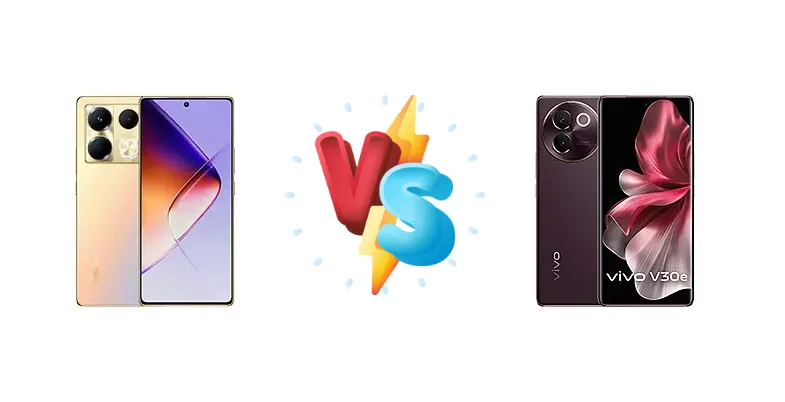
|
🏆 Quick Verdict
For users prioritizing sustained gaming performance and the convenience of wireless charging, the Infinix Note 40 emerges as the stronger contender. Its Mediatek Helio G99 Ultimate, coupled with MagCharge, offers a more versatile experience. However, the vivo V30e’s Snapdragon 6 Gen 1 provides a more efficient architecture for everyday tasks.
| PHONES | ||
|---|---|---|
| Phone Names | Infinix Note 40 | vivo V30e |
| Network | ||
|---|---|---|
| 2G bands | GSM 850 / 900 / 1800 / 1900 | GSM 850 / 900 / 1800 / 1900 |
| 3G bands | HSDPA 850 / 900 / 1700(AWS) / 1900 / 2100 | HSDPA 850 / 900 / 1700(AWS) / 1900 / 2100 - Malaysia |
| 4G bands | 1, 2, 3, 4, 5, 7, 8, 12, 17, 13, 26, 28, 38, 40, 41, 66 | 1, 2, 3, 4, 5, 7, 8, 18, 19, 20, 26, 28, 38, 39, 40, 41 - Malaysia |
| 5G bands | - | 1, 3, 5, 7, 8, 20, 28, 38, 40, 41, 77, 78 SA/NSA - Malaysia |
| Speed | HSPA, LTE | HSPA, LTE, 5G |
| Technology | GSM / HSPA / LTE | GSM / HSPA / LTE / 5G |
| Launch | ||
|---|---|---|
| Announced | 2024, March 18 | 2024, May 02 |
| Status | Available. Released 2024, March 19 | Available. Released 2024, May 09 |
| Body | ||
|---|---|---|
| Build | - | Glass front, plastic frame, glass back or plastic back |
| Dimensions | 164.1 x 74.5 x 7.8 mm (6.46 x 2.93 x 0.31 in) | 164.4 x 74.8 x 7.7 mm (6.47 x 2.94 x 0.30 in) |
| SIM | Nano-SIM + Nano-SIM | Nano-SIM + Nano-SIM |
| Weight | 190 g (6.70 oz) | 179 g or 188 g (6.31 oz) |
| Display | ||
|---|---|---|
| Protection | Corning Gorilla Glass | Schott Xensation |
| Resolution | 1080 x 2436 pixels (~393 ppi density) | 1080 x 2400 pixels, 20:9 ratio (~388 ppi density) |
| Size | 6.78 inches, 109.9 cm2 (~89.9% screen-to-body ratio) | 6.78 inches, 111.0 cm2 (~90.3% screen-to-body ratio) |
| Type | AMOLED, 120Hz, 1300 nits (peak) | AMOLED, 1B colors, 120Hz, 1300 nits (peak) |
| Platform | ||
|---|---|---|
| CPU | Octa-core (2x2.2 GHz Cortex-A76 & 6x2.0 GHz Cortex-A55) | Octa-core (4x2.2 GHz Cortex-A78 & 4x1.8 GHz Cortex-A55) |
| Chipset | Mediatek Helio G99 Ultimate | Qualcomm SM6450 Snapdragon 6 Gen 1 (4 nm) |
| GPU | Mali-G57 MC2 | Adreno 710 |
| OS | Android 14, XOS 14 | Android 14, Funtouch 14 |
| Memory | ||
|---|---|---|
| Card slot | Unspecified | microSDXC (uses shared SIM slot) |
| Internal | 256GB 8GB RAM | 128GB 8GB RAM, 256GB 8GB RAM, 256GB 12GB RAM |
| Main Camera | ||
|---|---|---|
| Dual | - | 50 MP, f/1.8, 26mm (wide), 1/1.95", 0.8µm, PDAF, OIS (India only) 8 MP, f/2.2, 120˚ (ultrawide), 1/4.0", 1.12µm |
| Features | Quad-LED flash, HDR, panorama | Ring-LED flash, panorama, HDR |
| Triple | 108 MP, f/1.9, (wide), 1/1.52", PDAF 2 MP, f/2.4 3rd unspecified camera | - |
| Video | 1440p@30fps, 1080p@30/60fps | 4K@30fps, 1080p@30fps |
| Selfie camera | ||
|---|---|---|
| Single | 32 MP, f/2.2, (wide), 1/3.1" | 50 MP, f/2.5, 25mm (wide), AF - India 32 MP, f/2.0, 24mm (wide) - Malaysia |
| Video | 1080p@30fps | 4K@30fps (India only), 1080p@30fps |
| Sound | ||
|---|---|---|
| 35mm jack | No | No |
| Loudspeaker | Yes, with stereo speakers | Yes |
| Comms | ||
|---|---|---|
| Bluetooth | Yes | 5.1, A2DP, LE |
| NFC | Yes (market/region dependent) | Yes (market/region dependent) |
| Positioning | GPS | GPS, GLONASS, GALILEO, BDS, QZSS, NavIC |
| Radio | FM radio | No |
| USB | USB Type-C 2.0, OTG | USB Type-C 2.0, OTG |
| WLAN | Wi-Fi 802.11 a/b/g/n/ac, dual-band | Wi-Fi 802.11 a/b/g/n/ac, dual-band |
| Features | ||
|---|---|---|
| Sensors | Fingerprint (under display, optical), accelerometer, gyro, proximity, compass | Fingerprint (under display, optical), accelerometer, gyro, proximity, compass |
| Battery | ||
|---|---|---|
| Charging | 45W wired, 50% in 26 min 20W wireless MagCharge Reverse wired Reverse wireless | 44W wired, PD Reverse wired |
| Type | 5000 mAh | Li-Ion 5500 mAh |
| Misc | ||
|---|---|---|
| Colors | Titan Gold, Obsidian Black, Racing Edition | Velvet Red (Coco Brown), Silk Blue, Sky Mirror |
| Models | X6853 | V2339 |
| Price | About 180 EUR | ₹ 23,999 |
Infinix Note 40
- Faster wired charging (45W)
- Wireless MagCharge and Reverse Charging
- Potentially better gaming performance due to GPU
- More versatile charging options
- Less efficient chipset architecture (6nm vs 4nm)
- Potential for more thermal throttling under sustained load
vivo V30e
- More efficient Snapdragon 6 Gen 1 chipset (4nm)
- Potentially better sustained performance due to thermal efficiency
- PD support for wider charger compatibility
- Streamlined user experience
- Lacks wireless charging
- No reverse charging functionality
Display Comparison
Neither device’s display specifications are provided, so a direct comparison is limited. However, given the price points, we can expect both to feature AMOLED panels. The absence of LTPO technology suggests neither will offer adaptive refresh rates for optimal battery life. Bezels are likely comparable, and color accuracy will depend on software calibration. The user experience will likely be similar, with both aiming for vibrant visuals.
Camera Comparison
Without detailed camera specifications, a comprehensive comparison is difficult. However, the market segment suggests both will feature multi-camera systems. The absence of information regarding sensor sizes and OIS is a significant omission. Image processing will likely differ, with vivo traditionally favoring more saturated and ‘beauty-focused’ images, while Infinix may lean towards a more natural look. The presence of a 2MP macro lens on either device is likely a marketing gimmick, offering limited practical benefit due to its small sensor size and fixed focus.
Performance
The core difference lies in the chipsets. The Infinix Note 40 utilizes the Mediatek Helio G99 Ultimate, featuring a dual-core Cortex-A76 setup alongside six Cortex-A55 cores. The vivo V30e employs the Qualcomm Snapdragon 6 Gen 1, built on a more efficient 4nm process with a quad-core Cortex-A78 configuration and four Cortex-A55 cores. While clock speeds are similar (2.2 GHz peak), the Snapdragon 6 Gen 1’s newer architecture and smaller node should translate to better sustained performance and thermal management, especially in demanding applications. The Snapdragon’s CPU architecture is a step up, offering improved single-core performance, which benefits app launch times and general responsiveness. However, the G99 Ultimate’s Mali-G57 MC2 GPU is a capable performer for mid-range gaming.
Battery Life
Both phones offer fast charging, with the Infinix Note 40 boasting 45W wired charging, reaching 50% in 26 minutes, and 20W wireless MagCharge. The vivo V30e supports 44W wired charging with PD. The Infinix Note 40’s inclusion of wireless charging, and especially MagCharge, is a significant advantage for users who value convenience. The 20W wireless charging, while slower than wired, provides a cable-free top-up option. The Infinix also offers reverse wired and wireless charging, turning the phone into a portable power bank for other devices – a feature absent on the vivo V30e. While battery capacity isn’t specified, the faster wired charging of the Infinix Note 40 could offset a slightly smaller battery.
Buying Guide
Buy the Infinix Note 40 if you need a phone geared towards gaming and value the flexibility of wireless and reverse charging. It’s ideal for users who frequently play demanding mobile games or rely on their phone as a portable power bank. Buy the vivo V30e if you prioritize a more power-efficient processor for daily tasks and a streamlined user experience, and don't require wireless charging capabilities.