
Infinix Note 40 vs Samsung Galaxy A55: A Detailed Comparison
| Phones Images | |||||
|---|---|---|---|---|---|
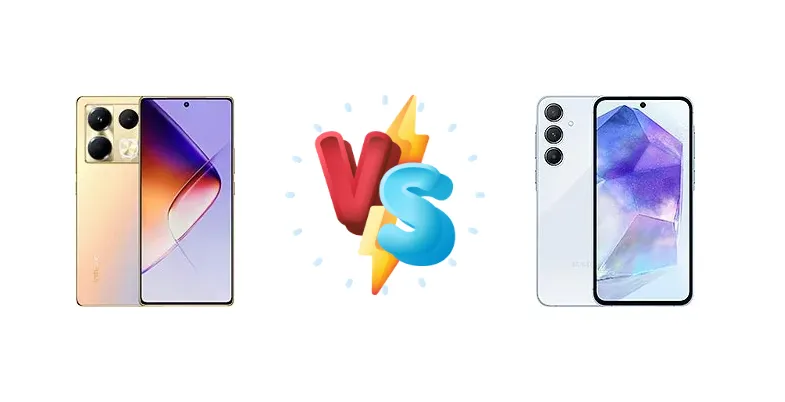
|
🏆 Quick Verdict
For the average user prioritizing a balanced experience and long-term software support, the Samsung Galaxy A55 is the better choice. Its superior display brightness and more efficient Exynos 1480 chipset provide a smoother, more enjoyable daily experience. However, the Infinix Note 40’s blazing-fast charging and aggressive pricing make it a strong contender for budget-conscious gamers.
| PHONES | ||
|---|---|---|
| Phone Names | Infinix Note 40 | Samsung Galaxy A55 |
| Network | ||
|---|---|---|
| 2G bands | GSM 850 / 900 / 1800 / 1900 | GSM 850 / 900 / 1800 / 1900 |
| 3G bands | HSDPA 850 / 900 / 1700(AWS) / 1900 / 2100 | HSDPA 850 / 900 / 1700(AWS) / 1900 / 2100 |
| 4G bands | 1, 2, 3, 4, 5, 7, 8, 12, 17, 13, 26, 28, 38, 40, 41, 66 | 1, 2, 3, 4, 5, 7, 8, 12, 17, 20, 25, 26, 28, 32, 38, 40, 41, 66 |
| 5G bands | - | 1, 3, 5, 7, 8, 20, 28, 38, 40, 41, 66, 77, 78 SA/NSA/Sub6 |
| Speed | HSPA, LTE | HSPA, LTE, 5G |
| Technology | GSM / HSPA / LTE | GSM / HSPA / LTE / 5G |
| Launch | ||
|---|---|---|
| Announced | 2024, March 18 | 2024, March 11 |
| Status | Available. Released 2024, March 19 | Available. Released 2024, March 15 |
| Body | ||
|---|---|---|
| Build | - | Glass front (Gorilla Glass Victus+), glass back (Gorilla Glass), aluminum frame |
| Dimensions | 164.1 x 74.5 x 7.8 mm (6.46 x 2.93 x 0.31 in) | 161.1 x 77.4 x 8.2 mm (6.34 x 3.05 x 0.32 in) |
| SIM | Nano-SIM + Nano-SIM | · Nano-SIM· Nano-SIM + eSIM· Nano-SIM + Nano-SIM· Nano-SIM + Nano-SIM + eSIM (max 2 at a time) |
| Weight | 190 g (6.70 oz) | 213 g (7.51 oz) |
| Display | ||
|---|---|---|
| Protection | Corning Gorilla Glass | Corning Gorilla Glass Victus+ |
| Resolution | 1080 x 2436 pixels (~393 ppi density) | 1080 x 2340 pixels, 19.5:9 ratio (~390 ppi density) |
| Size | 6.78 inches, 109.9 cm2 (~89.9% screen-to-body ratio) | 6.6 inches, 106.9 cm2 (~85.8% screen-to-body ratio) |
| Type | AMOLED, 120Hz, 1300 nits (peak) | Super AMOLED, 120Hz, HDR10+, 1000 nits (HBM) |
| Platform | ||
|---|---|---|
| CPU | Octa-core (2x2.2 GHz Cortex-A76 & 6x2.0 GHz Cortex-A55) | Octa-core (4x2.75 GHz Cortex-A78 & 4x2.0 GHz Cortex-A55) |
| Chipset | Mediatek Helio G99 Ultimate | Exynos 1480 (4 nm) |
| GPU | Mali-G57 MC2 | Xclipse 530 |
| OS | Android 14, XOS 14 | Android 14, up to 4 major Android upgrades, One UI 6.1 |
| Memory | ||
|---|---|---|
| Card slot | Unspecified | microSDXC (uses shared SIM slot) |
| Internal | 256GB 8GB RAM | 128GB 6GB RAM, 128GB 8GB RAM, 256GB 6GB RAM, 256GB 8GB RAM, 256GB 12GB RAM |
| Main Camera | ||
|---|---|---|
| Features | Quad-LED flash, HDR, panorama | LED flash, panorama, HDR |
| Triple | 108 MP, f/1.9, (wide), 1/1.52", PDAF 2 MP, f/2.4 3rd unspecified camera | 50 MP, f/1.8, (wide), 1/1.56", 1.0µm, PDAF, OIS 12 MP, f/2.2, 123˚ (ultrawide), 1/3.06", 1.12µm 5 MP (macro) |
| Video | 1440p@30fps, 1080p@30/60fps | 4K@30fps, 1080p@30/60fps, gyro-EIS |
| Selfie camera | ||
|---|---|---|
| Single | 32 MP, f/2.2, (wide), 1/3.1" | 32 MP, f/2.2, 26mm (wide), 1/2.74", 0.8µm |
| Video | 1080p@30fps | 4K@30fps, 1080p@30/60fps |
| Sound | ||
|---|---|---|
| 35mm jack | No | No |
| Loudspeaker | Yes, with stereo speakers | Yes, with stereo speakers |
| Comms | ||
|---|---|---|
| Bluetooth | Yes | 5.3, A2DP, LE |
| NFC | Yes (market/region dependent) | Yes (market/region dependent) |
| Positioning | GPS | GPS, GALILEO, GLONASS, BDS, QZSS |
| Radio | FM radio | No |
| USB | USB Type-C 2.0, OTG | USB Type-C 2.0, OTG |
| WLAN | Wi-Fi 802.11 a/b/g/n/ac, dual-band | Wi-Fi 802.11 a/b/g/n/ac/6, dual-band, Wi-Fi Direct |
| Features | ||
|---|---|---|
| Sensors | Fingerprint (under display, optical), accelerometer, gyro, proximity, compass | Fingerprint (under display, optical), accelerometer, gyro, compass |
| Battery | ||
|---|---|---|
| Charging | 45W wired, 50% in 26 min 20W wireless MagCharge Reverse wired Reverse wireless | 25W wired |
| Type | 5000 mAh | Li-Ion 5000 mAh |
| Misc | ||
|---|---|---|
| Colors | Titan Gold, Obsidian Black, Racing Edition | Iceblue, Lilac, Navy, Lemon |
| Models | X6853 | SM-A556V, SM-A556B, SM-A556B/DS, SM-A556E, SM-A556E/DS, SM-A5560 |
| Price | About 180 EUR | $ 324.99 / £ 251.50 / € 319.99 / ₹ 23,998 |
| SAR EU | - | 0.68 W/kg (head) 1.04 W/kg (body) |
Infinix Note 40
- Blazing-fast 45W wired and 20W MagCharge wireless charging
- Competitive gaming performance with Helio G99 Ultimate
- Aggressive pricing for the features offered
- Reverse wired and wireless charging capabilities
- Likely inferior display quality compared to the A55
- Potentially less refined software experience
Samsung Galaxy A55
- Brighter and more color-accurate Super AMOLED display
- More efficient Exynos 1480 chipset for smoother performance
- Longer battery life in real-world usage
- Samsung’s established software support and ecosystem
- Slower 25W wired charging
- Higher price point compared to the Infinix Note 40
Display Comparison
The Samsung Galaxy A55 boasts a significantly brighter display, reaching a measured 1010 nits, compared to an unstated peak brightness for the Infinix Note 40. This translates to superior visibility outdoors under direct sunlight. While the Note 40’s panel technology isn’t specified, the A55’s likely utilizes Super AMOLED, offering vibrant colors and deep blacks. The A55’s display is a clear advantage for media consumption and outdoor use. Bezels appear comparable based on available imagery, but color accuracy is likely superior on the A55 due to Samsung’s display calibration expertise.
Camera Comparison
Without detailed camera specs for the Infinix Note 40, a direct comparison is limited. However, Samsung typically excels in image processing, and the A55 likely benefits from this. The A55’s image processing will likely prioritize natural colors and dynamic range. The Note 40’s camera performance will likely be adequate for social media sharing, but may struggle in low-light conditions compared to the A55. The presence of OIS (Optical Image Stabilization) on the A55 is a significant advantage for capturing stable videos and sharper photos in low light.
Performance
The Samsung Galaxy A55’s Exynos 1480 (4nm) chipset represents a significant architectural leap over the Infinix Note 40’s MediaTek Helio G99 Ultimate. The A55 utilizes Cortex-A78 cores clocked at 2.75 GHz, offering substantially higher single-core performance than the Note 40’s Cortex-A76 cores at 2.2 GHz. The 4nm process node of the Exynos 1480 also contributes to improved thermal efficiency, reducing the likelihood of throttling during sustained workloads. While both phones feature 8GB of RAM (assumed based on market segment), the A55’s faster chipset and more efficient architecture will deliver a smoother experience in demanding applications and games.
Battery Life
The Samsung Galaxy A55 demonstrates superior battery endurance with a reported 13:27 hours of active use. While the Infinix Note 40’s battery capacity is unstated, its 45W wired charging and 20W MagCharge wireless charging are its standout features. The A55 is limited to 25W wired charging. The Note 40 can reach 50% charge in just 26 minutes, a significant advantage for users who need a quick top-up. The A55’s longer battery life is ideal for all-day use, but the Note 40’s faster charging mitigates the impact of a potentially smaller battery capacity.
Buying Guide
Buy the Infinix Note 40 if you need exceptionally fast charging – both wired and wireless – and prioritize gaming on a budget. Its MagCharge feature and Helio G99 Ultimate chipset offer a unique combination for power users. Buy the Samsung Galaxy A55 if you prefer a more polished software experience, a brighter and more color-accurate display, and longer-term software updates, even if it means sacrificing some charging speed and raw gaming power.