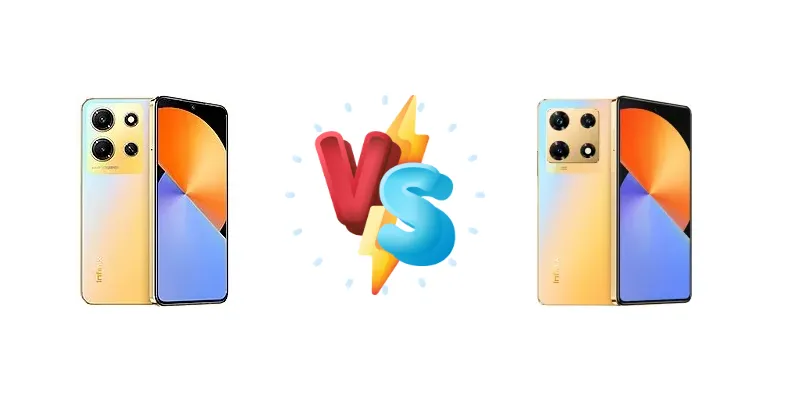
The Infinix Note series consistently delivers impressive features at competitive prices. The Note 30i and Note 30 Pro are the latest contenders, offering a blend of style and functionality. But which one is the better choice for you? Let's dive into a comprehensive comparison.
🏆 Quick Verdict
The Infinix Note 30 Pro emerges as the clear winner thanks to its significantly faster charging, more powerful chipset, and wireless charging capabilities. While the Note 30i offers good value, the Pro's upgrades justify its slightly higher price for most users.
| Network |
|---|
| 2G bands | GSM 850 / 900 / 1800 / 1900 | GSM 850 / 900 / 1800 / 1900 |
| 3G bands | HSDPA 850 / 900 / 1700(AWS) / 1900 / 2100 | HSDPA 850 / 900 / 1700(AWS) / 1900 / 2100 |
| 4G bands | LTE | 1, 2, 3, 4, 5, 7, 8, 12, 17, 20, 28, 38, 40, 41, 66 |
| Speed | HSPA, LTE | HSPA, LTE |
| Technology | GSM / HSPA / LTE | GSM / HSPA / LTE |
| Launch |
|---|
| Announced | 2023, May 16 | 2023, May 22 |
| Status | Available. Released 2023, June | Available. Released 2023, May 22 |
| Body |
|---|
| Build | Glass front, plastic frame, glass back or eco leather back | Glass front, plastic frame, glass back |
| Dimensions | 164.5 x 76.7 x 8.2 mm (6.48 x 3.02 x 0.32 in) | 162.7 x 76 x 8.2 mm (6.41 x 2.99 x 0.32 in) |
| SIM | Nano-SIM + Nano-SIM | Nano-SIM + Nano-SIM |
| Weight | 198 g (6.98 oz) | 203 g (7.16 oz) |
| | IP53 | IP53 |
| Display |
|---|
| Resolution | 1080 x 2400 pixels, 20:9 ratio (~395 ppi density) | 1080 x 2400 pixels, 20:9 ratio (~395 ppi density) |
| Size | 6.66 inches, 107.1 cm2 (~84.9% screen-to-body ratio) | 6.67 inches, 107.4 cm2 (~86.9% screen-to-body ratio) |
| Type | AMOLED | AMOLED, 1B colors, 120Hz, 900 nits (peak) |
| | * the display resolution is unconfirmed | * the display diagonal size and resolution is unconfirmed |
| Platform |
|---|
| CPU | Octa-core (2x2.0 GHz Cortex-A75 & 6x1.8 GHz Cortex-A55) | Octa-core (2x2.2 GHz Cortex-A76 & 6x2.0 GHz Cortex-A55) |
| Chipset | Mediatek MT6769 Helio G85 (12 nm) | Mediatek Helio G99 (6 nm) |
| GPU | Mali-G52 MC2 | Mali-G57 MC2 |
| OS | Android 13, XOS 13 | Android 13, XOS 13 |
| Memory |
|---|
| Card slot | Unspecified | microSDXC (dedicated slot) |
| Internal | 256GB 8GB RAM | 256GB 8GB RAM |
| Main Camera |
|---|
| Dual | 64 MP, f/1.7, (wide), 1/2.0", PDAF
Auxiliary lens | - |
| Features | Quad-LED flash, HDR, panorama | Quad-LED flash, HDR, panorama |
| Triple | - | 108 MP, (wide), 1/1.67", PDAF
2 MP (macro)
Auxiliary lens |
| Video | 1440p@30fps, 1080p@30fps | 1440p@30fps, 1080p@30fps |
| Selfie camera |
|---|
| Features | Dual-LED flash | LED flash, HDR |
| Single | 16 MP, f/2.0 | 32 MP, f/2.0, (wide), 1/2.8" |
| Video | 1080p@30fps | 1080p@30fps |
| Sound |
|---|
| 3.5mm jack | Yes | Yes |
| 35mm jack | Yes | Yes |
| Loudspeaker | Yes, with dual speakers | Yes, with dual speakers |
| | Sound by JBL | Sound by JBL
24-bit/192kHz audio |
| Comms |
|---|
| Bluetooth | Yes | Yes |
| NFC | Yes (market/region dependent) | Yes (market/region dependent) |
| Positioning | GPS | GPS |
| Radio | FM radio | FM radio |
| USB | USB Type-C 2.0, OTG | USB Type-C 2.0, OTG |
| WLAN | Wi-Fi 802.11 a/b/g/n/ac, dual-band | Wi-Fi 802.11 a/b/g/n/ac, dual-band, Wi-Fi Direct |
| Features |
|---|
| Sensors | Fingerprint (side-mounted), accelerometer, proximity, compass | Fingerprint (side-mounted), accelerometer, gyro, proximity, compass |
| Battery |
|---|
| Charging | 33W wired, PD3.0, 95% in 60 min
Reverse wired | 68W wired, PD3.0, 80% in 30 min
15W wireless
Reverse wireless |
| Type | 5000 mAh | 5000 mAh |
| Misc |
|---|
| Colors | Variable Gold, Obsidian Black, Impression Green | Magic Black, Variable Gold |
| Models | X6716 | X678B |
Infinix Note 30i
- More affordable
- Decent display
- Reliable performance for everyday tasks
- Reverse wired charging
- Slower charging
- Less powerful chipset
- No wireless charging
- Older manufacturing process (12nm)
Infinix Note 30 Pro
- Faster charging (68W wired, 15W wireless)
- More powerful chipset (Helio G99)
- More efficient (6nm process)
- Wireless charging
- Potentially better camera processing
- Slightly more expensive
- No significant display upgrade
Display Comparison
Both phones feature a 6.79-inch FHD+ AMOLED display with a 120Hz refresh rate, offering vibrant colors and smooth scrolling. The Note 30 Pro might have slightly better color accuracy due to potential calibration differences, but the difference is minimal for most users. Both have excellent viewing angles and brightness.
Camera Comparison
Both phones typically feature a 108MP main camera, but image processing and secondary lenses differ. The Note 30 Pro likely has improved image processing algorithms, resulting in slightly better dynamic range and low-light performance. Both offer decent selfie cameras, but the Pro might have a wider aperture for better bokeh.
Performance
The Note 30 Pro's Mediatek Helio G99 chipset (6nm) provides a noticeable performance boost over the Note 30i's Helio G85 (12nm). Expect smoother multitasking, faster app loading times, and better gaming performance on the Pro. The G99's efficiency also contributes to better thermal management.
Battery Life
Both phones pack a 5000mAh battery, providing all-day battery life. However, the Note 30 Pro's 68W wired charging is a game-changer, charging the phone to 80% in just 30 minutes, compared to the Note 30i's 33W charging. The Pro also has 15W wireless charging, a significant advantage.
Buying Guide
The Infinix Note 30i is ideal for budget-conscious users who prioritize a decent display and reliable performance for everyday tasks. The Infinix Note 30 Pro is perfect for those who want faster charging, smoother performance for gaming and demanding apps, and the added convenience of wireless charging.
Frequently Asked Questions
❓ Is the Infinix Note 30 Pro worth the extra money?
Yes, if you value faster charging, smoother performance, and wireless charging. The upgrades are significant enough to justify the price difference for most users.
❓ What is the difference between the Helio G85 and Helio G99?
The Helio G99 is a newer and more powerful chipset built on a more efficient 6nm process, offering better performance and improved power efficiency compared to the 12nm Helio G85.