
Infinix Note 12i vs Xiaomi Redmi Note 12 Pro: A Detailed Showdown
| Phones Images | |||||
|---|---|---|---|---|---|
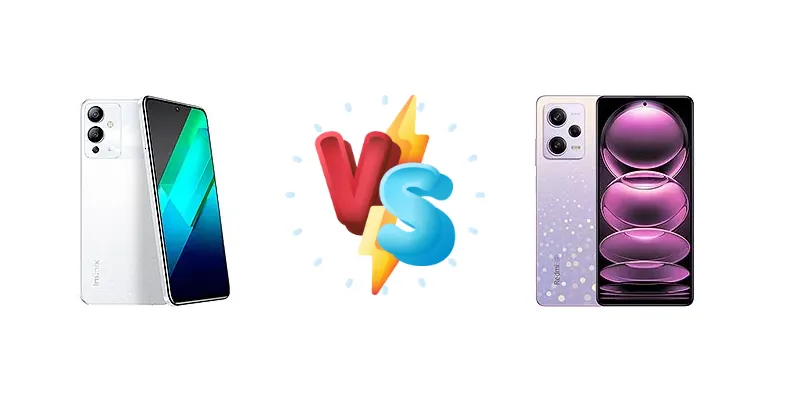
|
🏆 Quick Verdict
The Xiaomi Redmi Note 12 Pro emerges as the clear winner thanks to its superior chipset, faster charging, brighter display, and generally better camera capabilities. While the Infinix Note 12i offers decent value, the Redmi Note 12 Pro provides a more premium and well-rounded experience.
| PHONES | ||
|---|---|---|
| Phone Names | Infinix Note 12i | Xiaomi Redmi Note 12 Pro |
| Network | ||
|---|---|---|
| 2G bands | GSM 850 / 900 / 1800 / 1900 | GSM 850 / 900 / 1800 / 1900 |
| 3G bands | HSDPA 850 / 900 / 1700(AWS) / 1900 / 2100 | HSDPA 800 / 850 / 900 / 1900 / 2100 |
| 4G bands | 1, 2, 3, 4, 5, 7, 8, 20, 28, 38, 41, 40 | 1, 2, 3, 4, 5, 7, 8, 12, 13, 17, 18, 19, 20, 26, 28, 32, 38, 40, 41, 66 - International |
| 5G bands | - | 1, 3, 5, 7, 8, 20, 28, 38, 40, 41, 66, 77, 78 SA/NSA - International |
| Speed | HSPA, LTE | HSPA, LTE, 5G |
| Technology | GSM / HSPA / LTE | GSM / CDMA / HSPA / EVDO / LTE / 5G |
| 1, 3, 7, 8, 20, 28, 38, 40, 41 | 1, 3, 5, 8, 28, 38, 41, 77, 78 SA/NSA - China | |
| Launch | ||
|---|---|---|
| Announced | 2022, May 11 | 2022, October 27 |
| Status | Available. Released 2022, May 11 | Available. Released 2022, November 01 |
| Body | ||
|---|---|---|
| Build | Glass front, plastic frame, plastic back | Glass front (Gorilla Glass 5), glass back, plastic frame |
| Dimensions | 170.7 x 77.4 x 8.3 mm (6.72 x 3.05 x 0.33 in) | 163 x 76 x 8 mm (6.42 x 2.99 x 0.31 in) |
| SIM | Nano-SIM + Nano-SIM | Nano-SIM + Nano-SIM |
| Weight | 198 g (6.98 oz) | 187 g (6.60 oz) |
| - | IP53, dust and splash resistant | |
| Display | ||
|---|---|---|
| Protection | - | Corning Gorilla Glass 5 |
| Resolution | 720 x 1640 pixels (~263 ppi density) | 1080 x 2400 pixels, 20:9 ratio (~395 ppi density) |
| Size | 6.82 inches, 110.5 cm2 (~83.6% screen-to-body ratio) | 6.67 inches, 107.4 cm2 (~86.7% screen-to-body ratio) |
| Type | IPS LCD, 90Hz | AMOLED, 1B colors, 120Hz, Dolby Vision, HDR10+, 500 nits (typ), 900 nits (HBM) |
| Platform | ||
|---|---|---|
| CPU | Octa-core (2x2.0 GHz Cortex-A75 & 6x1.8 GHz Cortex-A55) | Octa-core (2x2.6 GHz Cortex-A78 & 6x2.0 GHz Cortex-A55) |
| Chipset | Mediatek MT6769Z Helio G85 (12 nm) | Mediatek Dimensity 1080 (6 nm) |
| GPU | Mali-G52 MC2 | Mali-G68 MC4 |
| OS | Android 12, XOS 10.6 | Android 12, MIUI 13 |
| Memory | ||
|---|---|---|
| Card slot | microSDXC (dedicated slot) | No |
| Internal | 128GB 4GB RAM | 128GB 6GB RAM, 128GB 8GB RAM, 256GB 8GB RAM, 256GB 12GB RAM |
| - | UFS 2.2 | |
| Main Camera | ||
|---|---|---|
| Features | Quad-LED flash, HDR, panorama | Dual-LED dual-tone flash, HDR, panorama |
| Single | 8 MP | - |
| Triple | 50 MP, f/1.6, (wide), 1/2.8", 0.64µm, PDAF Auxiliary lenses | 50 MP, f/1.9, 24mm (wide), 1/1.56", 1.0µm, PDAF, OIS 8 MP, f/2.2, 120˚ (ultrawide), 1/4.0", 1.12µm 2 MP (macro) |
| Video | 1440p@30fps | 4K@30fps, 1080p@30/60/120fps, 720p@960fps |
| Selfie camera | ||
|---|---|---|
| Features | Dual-LED flash | HDR |
| Single | 8 MP | 16 MP, f/2.5, (wide), 1/3.06", 1.0µm |
| Video | 1080p@30fps | 1080p@30/60fps |
| Sound | ||
|---|---|---|
| 3.5mm jack | Yes | Yes |
| 35mm jack | Yes | Yes |
| Loudspeaker | Yes, with dual speakers | Yes, with stereo speakers |
| - | 24-bit/192kHz audio | |
| Comms | ||
|---|---|---|
| Bluetooth | Yes | 5.2, A2DP, LE |
| Infrared port | - | Yes |
| NFC | No | Yes (market/region dependent) |
| Positioning | GPS | GPS (L1), GLONASS (G1), BDS (B1I+B1c), GALILEO (E1), QZSS (L1) |
| Radio | FM radio | No |
| USB | USB Type-C 2.0, OTG | USB Type-C 2.0, OTG |
| WLAN | Wi-Fi 802.11 a/b/g/n/ac, dual-band, Wi-Fi Direct | Wi-Fi 802.11 a/b/g/n/ac/6, dual-band, Wi-Fi Direct |
| Features | ||
|---|---|---|
| Sensors | Fingerprint (side-mounted), accelerometer, gyro, proximity, compass | Fingerprint (side-mounted), accelerometer, gyro, proximity, compass |
| Battery | ||
|---|---|---|
| Charging | 33W wired | 67W wired, PD3.0, 50% in 15 min, 100% in 46 min |
| Type | 5000 mAh | Li-Po 5000 mAh |
| Misc | ||
|---|---|---|
| Colors | Force Black, Snowfall | Frosted Blue (Sky Blue), Onyx Black (Midnight Black), Polar White, Stardust Purple |
| Models | X6819 | 22101316C, 22101316I, 23013RK75C, 22101316G |
| Price | About 170 EUR | € 148.54 / $ 142.17 / £ 149.99 / ₹ 19,999 |
| SAR | - | 1.09 W/kg (head) 1.06 W/kg (body) |
| SAR EU | - | 0.99 W/kg (head) 0.99 W/kg (body) |
| Tests | ||
|---|---|---|
| Battery life | - | Endurance rating 97h |
| Camera | - | Photo / Video |
| Display | - | Contrast ratio: Infinite (nominal) |
| Loudspeaker | - | -26.6 LUFS (Good) |
| Performance | - | AnTuTu: 490526 (v9) GeekBench: 2209 (v5.1), 2372 (v6) GFXBench: 22fps (ES 3.1 onscreen) |
Infinix Note 12i
- Large Display
- Decent Battery Life
- Affordable Price
- Stylish Design
- Weaker Processor
- Slower Charging
- Less Bright Display
- Mediocre Camera
Xiaomi Redmi Note 12 Pro
- Powerful Processor
- Fast Charging (67W)
- Bright and Vibrant Display
- Excellent Camera
- Good Value
- Slightly Higher Price
- Software Bloat (Potential)
Display Comparison
The Redmi Note 12 Pro boasts a significant advantage with its 890 nits max brightness, offering excellent visibility even in direct sunlight. Its contrast ratio is also superior. The Note 12i's display is adequate but lacks the vibrancy and brightness of its competitor. Both likely use AMOLED panels, but the Redmi's implementation is noticeably better.
Camera Comparison
While both phones offer capable camera systems, the Redmi Note 12 Pro generally delivers superior image quality. Expect better detail, dynamic range, and low-light performance. The Redmi likely has a higher resolution main sensor and potentially improved image processing algorithms. Both offer video recording, but the Redmi's likely has better stabilization.
Performance
The Redmi Note 12 Pro's Dimensity 1080 chipset is considerably more powerful than the Helio G85 in the Note 12i. This translates to smoother multitasking, faster app loading times, and better gaming performance. The Dimensity 1080's 6nm process also contributes to improved power efficiency.
Battery Life
Both phones offer excellent battery life, with the Redmi Note 12 Pro demonstrating an impressive endurance rating of 97 hours. The Infinix Note 12i also provides solid battery performance. However, the Redmi Note 12 Pro's 67W charging is a game-changer, allowing for significantly faster top-ups compared to the Note 12i's 33W charging.
Buying Guide
The Infinix Note 12i is a good choice for budget-conscious users who prioritize a large display and decent battery life for everyday tasks. The Xiaomi Redmi Note 12 Pro is ideal for those seeking better performance, faster charging, a brighter display, and a more capable camera system, even if it means spending a bit more.